


doi: 10.1128/AAC.46.4.1147-1152.2002.
Novel type of staphylococcal cassette chromosome mec identified in community-acquired methicillin-resistant Staphylococcus aureus strains
Affiliations
- PMID: 11897611
- PMCID: PMC127097
- DOI: 10.1128/AAC.46.4.1147-1152.2002
Item in Clipboard
Novel type of staphylococcal cassette chromosome mec identified in community-acquired methicillin-resistant Staphylococcus aureus strains
Antimicrob Agents Chemother.
2002 Apr.
Abstract
We identified a new type of staphylococcal cassette chromosome mec (SCCmec) from two community-acquired methicillin-resistant Staphylococcus aureus (MRSA) strains. The novel element, designated type IV SCCmec, had a unique combination of the class B mec gene complex and the type 2 ccr gene complex and was much smaller in size (21 to 24 kb) than previously identified SCCmec elements of hospital-acquired MRSA. Consistent with the strains' susceptibilities to various non-beta-lactam antibiotics, the type IV SCCmec was devoid of any antibiotic resistance genes other than the mecA gene.
Figures
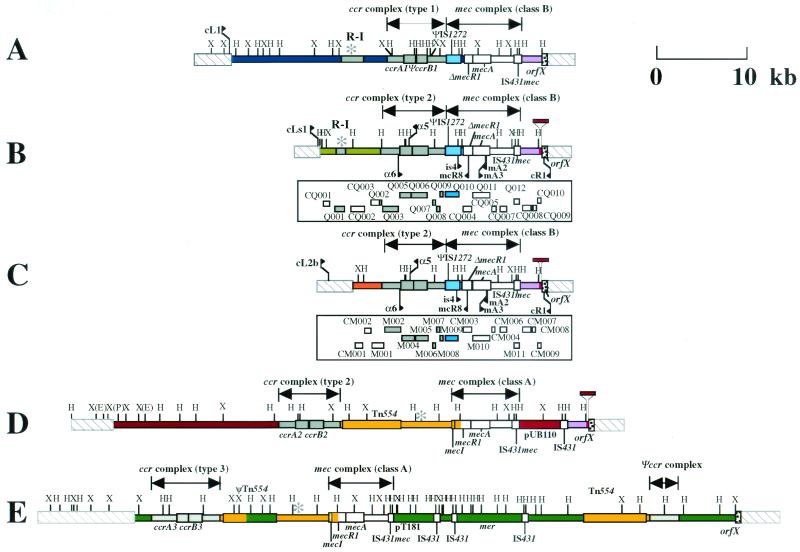
Structure of the SCCmec elements identified from C-MRSA strains in comparison with the three types of SCCmec elements. (A) Type I SCCmec carried by NCTC 10442. (B) Type IV SCCmec carried by strain CA05 (subtype a). (C) Type IV SCCmec carried by strain 8/6-3P (subtype b). (D) Type II SCCmec carried by N315. (E) Type III SCCmec carried by 85/2082. The ORFs of greater than 200 nucleotides in six possible reading frames of type IV SCCmec elements are illustrated in the squares under the bars that represent essential genes and restriction sites for HindIII and XbaI. Differences in coloration correspond to differences in the nucleotide sequences. Color codes are as follows: white, ORFs or the parts of ORFs that are conserved in all four types of SCCmec elements with greater than 99% amino acid identities; gray, ORFs or the parts of ORFs that are conserved in four types of SCCmec with amino acid identities of 46 to 98%; magenta, ORFs or the parts of ORFs that are common to type I and type II SCCmec elements; yellow, ORFs or the parts of ORFs that are common to type II and type III SCCmec elements; blue, ORFs or the parts of ORFs that are unique to type I SCCmec; red, ORFs or the parts of ORFs that are unique to type II SCCmec; green, ORFs or the parts of ORFs that are unique to type III SCCmec, light green, ORFs or the parts of ORFs that are unique to type IVa SCCmec; and orange, ORFs or the parts of ORFs that are unique to type IVb SCCmec. The locations of primers used for amplification of the type IV SCCmec are indicated by arrows: they are primers α5 (5′-TGTTAAGTATATTGCACTTTATGATTCAATGCCT-3′), cLs1 (5′-TGCCAATCACAGTTCAATCAATT-3′), α6 (5′-ATTAGCCGATTTGGTAATTGAA-3′), mCR8 (5′-ATATTCCCGTATGAAAAACAGGACTTGAACTTGCA-3′), and CL2b (ATATTCCCGATAGAAAAACAGGACTTGAACTTGCA) and previously described primers is4, mA2, mA3, and cR1 (11, 12, 14). The entire nucleotide sequences of the type IV SCCmec elements are available in the DDBJ/EMBL/GenBank databases under accession no. AB063172 (subtype a) and AB063173 (subtype b). H, HindIII, X, XbaI; E, EcoRI; P, Pst1.

Chromosome-SCCmec junction sequences of type IV SCCmec. The nucleotide sequences around the left and right boundaries of the SCCmec elements of CA05 and 8/6-3P are aligned with those of type II SCCmec. Thin arrows indicate inverted repeats IR-L and IR-R at both extremities of SCCmec elements. Thick arrows indicate direct repeats DRscc-L and DRscc-R.
References
-
- Altschul, S. F., W. Gish, W. Miller, E. W. Myers, and D. J. Lipman. 1990. Basic local alignment search tool. J. Mol. Biol. 215:403-410. - PubMed
-
- Brown, D. F., and P. E. Reynolds. 1980. Intrinsic resistance to beta-lactam antibiotics in Staphylococcus aureus. FEBS Lett. 122:275-278. - PubMed
-
- Centers for Disease Control and Prevention. 1999. Four pediatric deaths from community-acquired methicillin-resistant Staphylococcus aureus—Minnesota and North Dakota, 1997-1999. Morb. Mortal. Wkly. Rep. 48:707-710. - PubMed
-
- Embil, J., K. Ramotar, L. Tomance, M. Alfa, J. Conly, S. Cronk, G. Taylor, B. Sutherland, T. Louie, E. Henderson, et al. 1994. Methicillin-resistant Staphylococcus aureus in tertiary care institutions on the Canadian prairies 1990-1992. Infect. Control. Hosp. Epidemiol. 15:646-651. - PubMed
Publication types
MeSH terms
Substances
Associated data
- Actions
- Actions
LinkOut - more resources
Full Text Sources
Other Literature Sources
Medical
Molecular Biology Databases
