


Comment
doi: 10.1113/jphysiol.2001.014829.
The TREK two P domain K+ channels
Affiliations
- PMID: 11897836
- PMCID: PMC2290184
- DOI: 10.1113/jphysiol.2001.014829
Item in Clipboard
Comment
The TREK two P domain K+ channels
J Physiol.
.
No abstract available
Figures
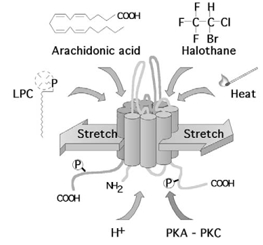
4TMS/2P subunits are believed to dimerize to form functional K+ channels. TREK channels and their functional homologue, the Aplysia S-type K+ channel, have been implicated in learning and memory. At the pathophysiological level, cell swelling, intracellular acidosis, along with the release of cellular lipids, will contribute to the opening of TREK and TRAAK channels during brain ischaemia and could represent an important neuroprotective switch.
Comment on
-
Expression pattern and functional characteristics of two novel splice variants of the two-pore-domain potassium channel TREK-2.J Physiol. 2002 Mar 15;539(Pt 3):657-68. doi: 10.1113/jphysiol.2001.013432. J Physiol. 2002. PMID: 11897838 Free PMC article.
References
-
- Belardetti F, Siegelbaum SA. Trends in Neurosciences. 1988;11:232–238. - PubMed
-
- Patel AJ, Honoronoré E. Trends in Neurosciences. 2001a;24:339–346. - PubMed
-
- Patel AJ, Honoronoré E. Anesthesiology. 2001b;95:1013–1021. - PubMed
-
- Patel AJ, Lazdunski M, Honoronoré E. Current Opinion in Cell Biology. 2001;13:422–428. - PubMed
Publication types
MeSH terms
Substances
LinkOut - more resources
Full Text Sources
