


Expression pattern and functional characteristics of two novel splice variants of the two-pore-domain potassium channel TREK-2
- PMID: 11897838
- PMCID: PMC2290188
- DOI: 10.1113/jphysiol.2001.013432
Expression pattern and functional characteristics of two novel splice variants of the two-pore-domain potassium channel TREK-2
Abstract
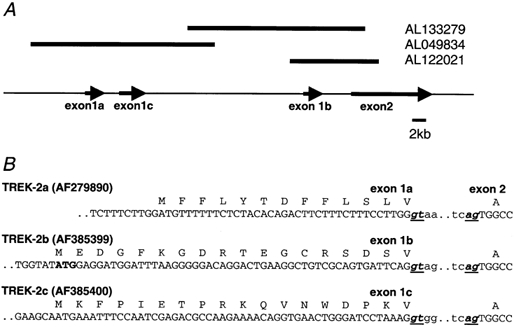
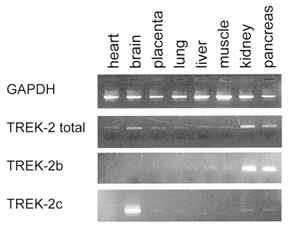
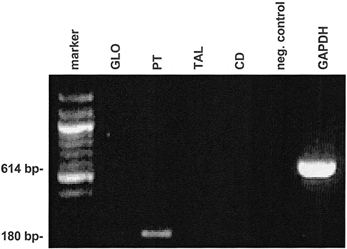
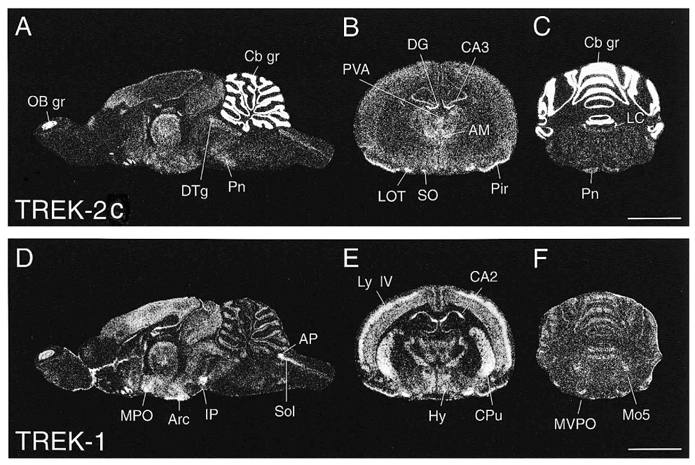
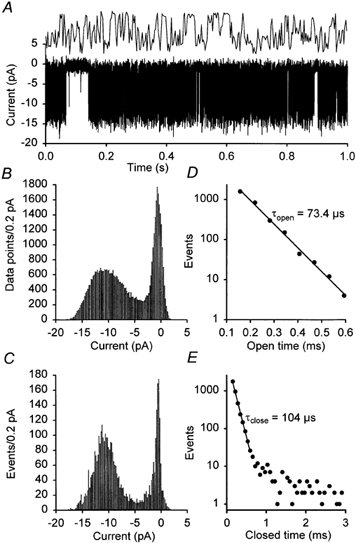
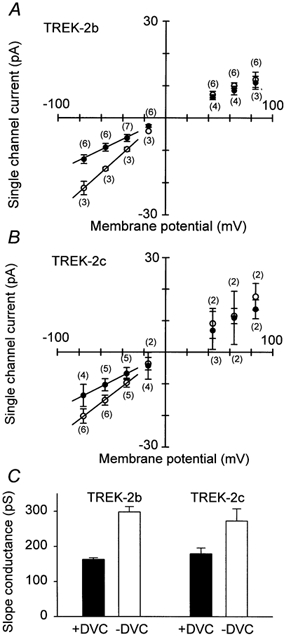
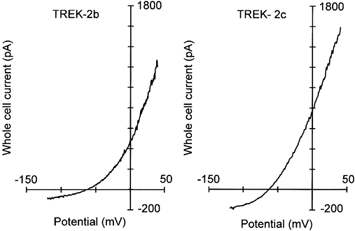
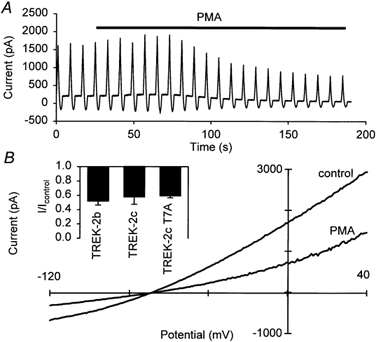
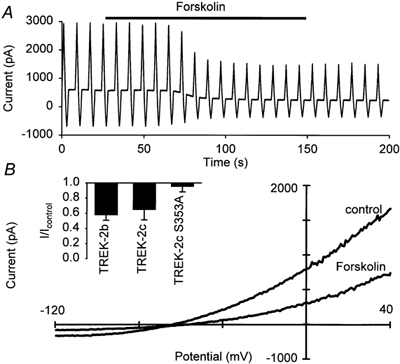
Two novel alternatively spliced isoforms of the human two-pore-domain potassium channel TREK-2 were isolated from cDNA libraries of human kidney and fetal brain. The cDNAs of 2438 base pairs (bp) (TREK-2b) and 2559 bp (TREK-2c) encode proteins of 508 amino acids each. RT-PCR showed that TREK-2b is strongly expressed in kidney (primarily in the proximal tubule) and pancreas, whereas TREK-2c is abundantly expressed in brain. In situ hybridization revealed a very distinct expression pattern of TREK-2c in rat brain which partially overlapped with that of TREK-1. Expression of TREK-2b and TREK-2c in human embryonic kidney (HEK) 293 cells showed that their single-channel characteristics were similar. The slope conductance at negative potentials was 163 +/- 5 pS for TREK-2b and 179 +/- 17 pS for TREK-2c. The mean open and closed times of TREK-2b at -84 mV were 133 +/- 16 and 109 +/- 11 micros, respectively. Application of forskolin decreased the whole-cell current carried by TREK-2b and TREK-2c. The sensitivity to forskolin was abolished by mutating a protein kinase A phosphorylation site at position 364 of TREK-2c (construct S364A). Activation of protein kinase C (PKC) by application of phorbol-12-myristate-13-acetate (PMA) also reduced whole-cell current. However, removal of the putative TREK-2b-specific PKC phosphorylation site (construct T7A) did not affect inhibition by PMA. Our results suggest that alternative splicing of TREK-2 contributes to the diversity of two-pore-domain K+ channels.
Figures
Comment in
-
The TREK two P domain K+ channels.J Physiol. 2002 Mar 15;539(Pt 3):647. doi: 10.1113/jphysiol.2001.014829. J Physiol. 2002. PMID: 11897836 Free PMC article. No abstract available.
References
-
- Attali B, Lesage F, Ziliani P, Guillemare E, Honore E, Waldmann R, Hugnot JP, Mattei MG, Lazdunski M, Barhanin J. Multiple mRNA isoforms encoding the mouse cardiac Kv1. 5 delayed rectifier K+ channel. Journal of Biological Chemistry. 1993;268:24283–24289. - PubMed
-
- Bang H, Kim Y, Kim D. TREK-2, a new member of the mechanosensitive tandem-pore K+ channel family. Journal of Biological Chemistry. 2000;275:17412–17419. - PubMed
-
- Bockenhauer D, Zilberberg N, Goldstein SAN. KCNK2: reversible conversion of a hippocampal potassium leak into a voltage-dependent channel. Nature Neuroscience. 2001;4:486–491. - PubMed
-
- Butler A, Tsunoda S, McCobb DP, Wei A, Salkoff L. mSlo, a complex mouse gene encoding “maxi” calcium-activated potassium channels. Science. 1993;261:221–224. - PubMed
-
- Chavez RA, Gray AT, Zhao BB, Kindler CH, Mazurek MJ, Mehta Y, Forsayeth JR, Yost CS. TWIK-2, a new weak inward rectifying member of the tandem pore domain potassium channel family. Journal of Biological Chemistry. 1999;274:7887–7892. - PubMed
Publication types
MeSH terms
Substances
LinkOut - more resources
Full Text Sources
Other Literature Sources
Molecular Biology Databases
Miscellaneous
