


Effects of prior contractions on muscle microvascular oxygen pressure at onset of subsequent contractions
- PMID: 11897861
- PMCID: PMC2290194
- DOI: 10.1113/jphysiol.2001.013165
Effects of prior contractions on muscle microvascular oxygen pressure at onset of subsequent contractions
Abstract
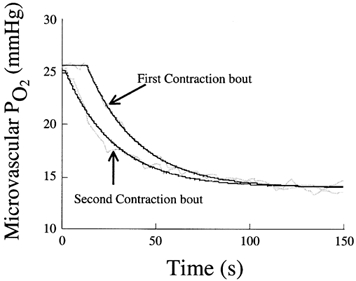
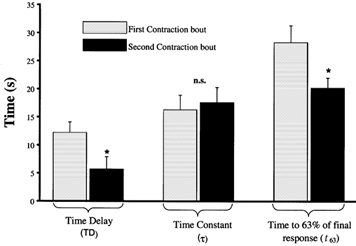
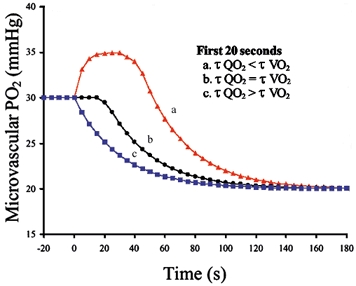
In humans, pulmonary oxygen uptake (.V(O2)) kinetics may be speeded by prior exercise in the heavy domain. This "speeding" arises potentially as the result of an increased muscle O(2) delivery (.Q(O2)) and/or a more rapid elevation of oxidative phosphorylation. We adapted phosphorescence quenching techniques to determine the.Q(O2)-to-O(2) utilization (.Q(O2)/.V(O2)) characteristics via microvascular O(2) pressure (P(O2,m)) measurements across sequential bouts of contractions in rat spinotrapezius muscle. Spinotrapezius muscles from female Sprague-Dawley rats (n = 6) were electrically stimulated (1 Hz twitch, 3-5 V) for two 3 min bouts (ST(1) and ST(2)) separated by 10 min rest. P(O2,m) responses were analysed using an exponential + time delay (TD) model. There was no significant difference in baseline and DeltaP(O2,m) between ST(1) and ST(2) (28.5 +/- 2.6 vs. 27.9 +/- 2.4 mmHg, and 13.9 +/- 1.8 vs. 14.1 +/- 1.3 mmHg, respectively). The TD was reduced significantly in the second contraction bout (ST(1), 12.2 +/- 1.9; ST(2), 5.7 +/- 2.2 s, P < 0.05), whereas the time constant of the exponential P(O2,m) decrease was unchanged (ST(1), 16.3 +/- 2.6; ST(2), 17.6 +/- 2.7 s, P > 0.1). The shortened TD found in ST(2) led to a reduced time to reach 63 % of the final response of ST(2) compared to ST(1) (ST(1), 28.3 +/- 3.0; ST(2), 20.2 +/- 1.8 s, P < 0.05). The speeding of the overall response in the absence of an elevated P(O2,m) baseline (which had it occurred would indicate an elevated.Q(O2)/.V(O2) or muscle blood flow suggests that some intracellular process(es) (e.g. more rapid increase in oxidative phosphorylation) may be responsible for the increased speed of P(O2,m) kinetics after prior contractions under these conditions.
Figures

References
-
- Barstow TJ, Lamarra N, Whipp BJ. Modulation of muscle and pulmonary O2 uptakes by circulatory dynamics during exercise. Journal of Applied Physiology. 1990;68:979–989. - PubMed
-
- Behnke BJ, Kindig CA, Musch TI, Koga S, Poole DC. Dynamics of muscle microvascular oxygen pressure across the rest-exercise transition. Respiration Physiology. 2001;126:53–63. - PubMed
-
- Bevington PR. Data Reduction and Error Analysis for Physical Sciences. New York: McGraw-Hill; 1969. chap. 1–4.
-
- Bohnert B, Ward SA, Whipp BJ. Effects of prior arm exercise on pulmonary gas exchange kinetics during high-intensity leg exercise in humans. Experimental Physiology. 1998;83:557–570. - PubMed
-
- Burnley M, Jones AM, Carter H, Doust JH. Effects of prior exercise on phase II pulmonary oxygen uptake kinetics during heavy exercise. Journal of Applied Physiology. 2000;89:1387–1396. - PubMed
Publication types
MeSH terms
Substances
Grants and funding
LinkOut - more resources
Full Text Sources
