


Attitudes toward colorectal cancer screening tests
- PMID: 11903761
- PMCID: PMC1495302
- DOI: 10.1111/j.1525-1497.2001.10337.x
Attitudes toward colorectal cancer screening tests
Abstract
Objective: To examine patient and physician preferences in regard to 5 colorectal cancer screening alternatives endorsed by a 1997 expert panel, determine the impact of patient and physician values regarding certain test features on screening preference, and assess physicians' perceptions of patients' values.
Design: Cross-sectional survey.
Setting: A general internal medicine practice at an academic medical center in 1998.
Participants: Patients (N=217; 76% response rate) and physicians (N=39; 87% response rate) at the study setting.
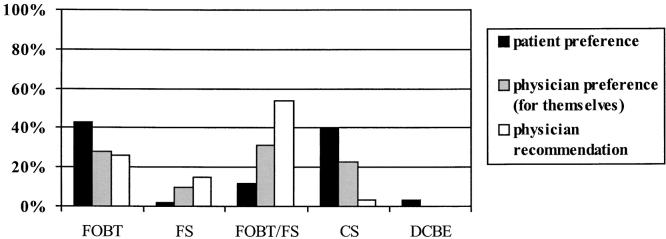
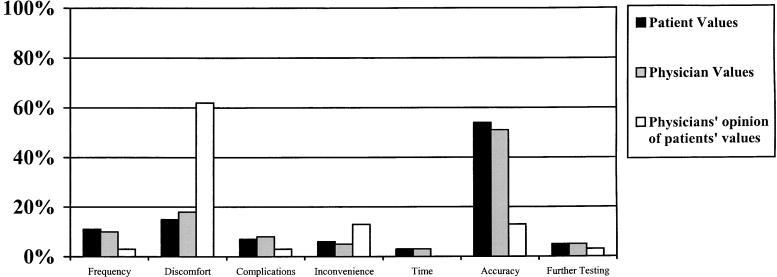
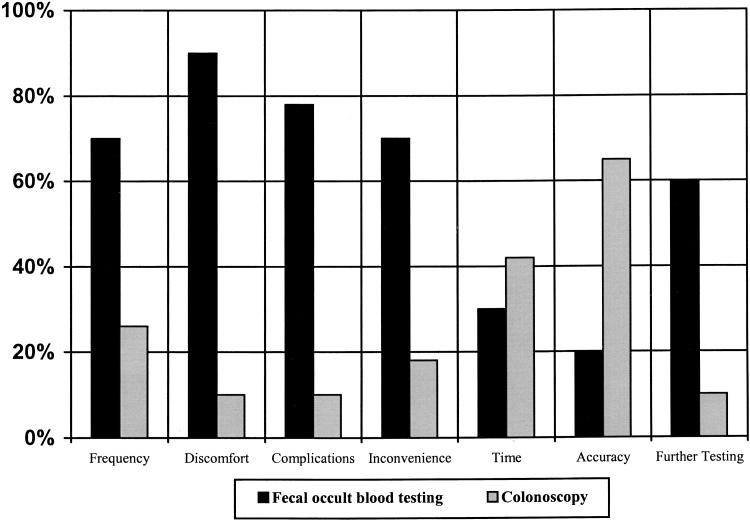
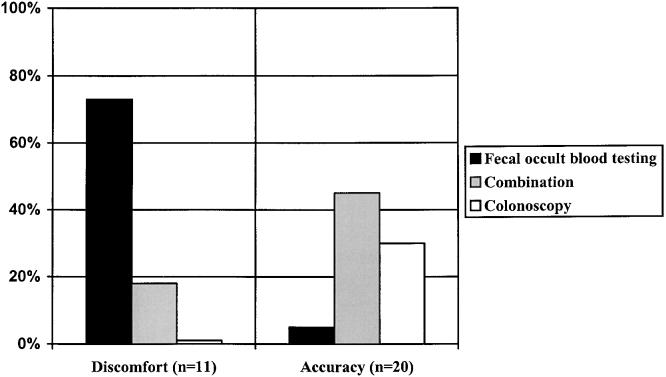
Measurements and main results: Patients preferred fecal occult blood testing (43%) or colonoscopy (40%). In patients for whom accuracy was the most important test feature, colonoscopy (62%) was the preferred screening method. Patients for whom invasive test features were more important preferred fecal occult blood testing (76%; P <.001). Patients and physicians were similar in their values regarding the various test features. However, there was a significant difference between physicians' perceptions of which test features were important to patients compared with the patients' actual responses (P <.001). The largest discrepancy was for accuracy (patient actual 54% vs physician opinion 15%) and discomfort (patient actual 15% vs physician opinion 64%).
Conclusions: Patients have distinct preferences for colorectal cancer screening tests that are associated with the importance placed on certain test features. Physicians incorrectly perceive those factors that are important to patients. Physicians should incorporate patient values in regard to certain test features when discussing colorectal cancer screening with their patients and when eliciting their screening preferences.
Figures
Comment in
-
Cancer screening in primary care. Are we communicating?J Gen Intern Med. 2001 Dec;16(12):867. doi: 10.1111/j.1525-1497.2001.11014.x. J Gen Intern Med. 2001. PMID: 11903768 Free PMC article. No abstract available.
References
-
- Greenlee RT, Murray T, Bolden S, Wingo PA. Cancer statistics, 2000. Ca Cancer J Clin. 2000;50:7–33. - PubMed
-
- Mandel JS, Bond JH, Church TR, et al. Reducing mortality from colorectal cancer by screening for fecal occult blood. Minnesota Colon Cancer Control Study. (published erratum appears in N Engl J Med 1993;329:672) N Engl J Med. 1993;328:1365–71. - PubMed
-
- Mandel JS, Church TR, Ederer F, Bond JH. Colorectal cancer mortality: effectiveness of biennial screening for fecal occult blood. J Natl Cancer Inst. 1999;91:434–7. - PubMed
-
- Kronborg O, Fenger C, Olsen J, Jorgensen OD, Sondegaard O. Randomised study of screening for colorectal cancer with faecal-occult-blood test. Lancet. 1996;348:1467–71. - PubMed
-
- Hardcastle JD, Chamberlain JO, Robinson MH, et al. Randomised controlled trial of faecal-ocult-blood screening for colorectal cancer. Lancet. 1996;348:1472–7. - PubMed
Publication types
MeSH terms
LinkOut - more resources
Full Text Sources
Medical