


Low accuracy and low consistency of fourth-graders' school breakfast and school lunch recalls
- PMID: 11905461
- PMCID: PMC1482457
- DOI: 10.1016/s0002-8223(02)90089-1
Low accuracy and low consistency of fourth-graders' school breakfast and school lunch recalls
Abstract
Objective: To determine the accuracy and consistency of fourth-graders' school breakfast and school lunch recalls obtained during 24-hour recalls and compared with observed intake.
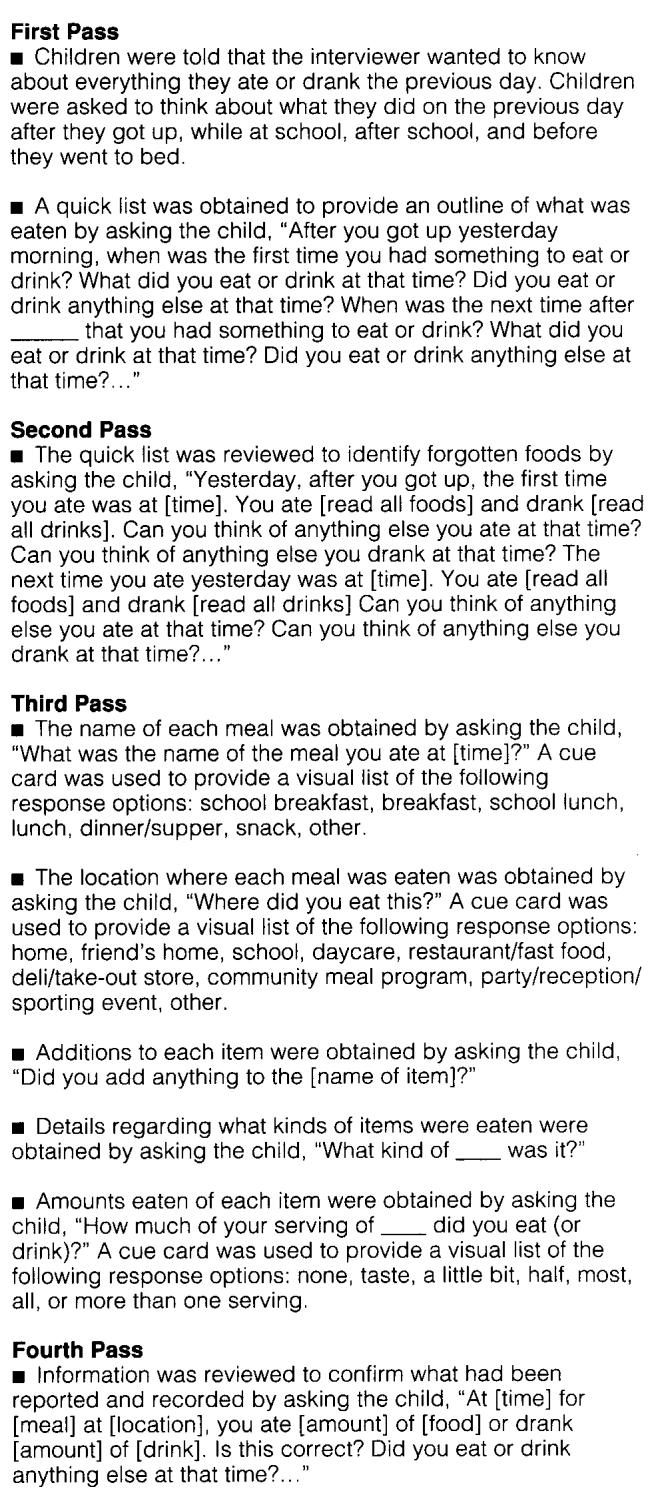
Design: Children were interviewed using a multiple-pass protocol at school the morning after being observed eating school breakfast and school lunch.
Subjects: 104 children stratified by ethnicity (African-American, white) and gender were randomly selected and interviewed up to 3 times each with 4 to 14 weeks between each interview.
Statistical analysis: Match, omission, and intrusion rates to determine accuracy of reporting items; arithmetic and/or absolute differences to determine accuracy for reporting amounts; total inaccuracy to determine inaccuracy for reporting items and amounts combined; intraclass correlation coefficients (ICC) to determine consistency.
Results: Means were 51% for omission rate, 39% for intrusion rate, and 7.1 servings for total inaccuracy. Total inaccuracy decreased significantly from the first to the third recall (P=0.006). The ICC was 0.29 for total inaccuracy and 0.15 for omission rate. For all meal components except bread/grain and beverage, there were more omissions than intrusions. Mean arithmetic and absolute differences per serving in amount reported for matches were -0.08 and 0.24, respectively. Mean amounts per serving of omissions and intrusions were 0.86 and 0.80, respectively.
Applications/conclusions: The low accuracy and low consistency of children's recalls from this study raise concerns regarding the current uses of dietary recalls obtained from children. To improve the accuracy and consistency of children's dietary recalls, validation studies are needed to determine the best way(s) to interview children.
Figures


Comment in
-
Insight into the origins of intrusions (reports of uneaten food items) in children's dietary recalls, based on data from a validation study of reporting accuracy over multiple recalls and school foodservice production records.J Am Diet Assoc. 2008 Aug;108(8):1305-14. doi: 10.1016/j.jada.2008.05.012. J Am Diet Assoc. 2008. PMID: 18656570 Free PMC article.
References
-
- Buzzard M. 24-hour dietary recall and food record methods. In: Willett W, editor. Nutritional Epidemiology. 2nd edition Oxford University Press; New York, NY: 1998. p. 52.
-
- Presser S, Blair J, Mack K, Ryan C, Van Dyne MA. Final report on the University of Maryland-USDA Cooperative agreement to improve reporting for children in the Continuing Survey of Food Intakes by Individuals. Survey Research Center, University of Maryland; Aug, 1993. Unpublished report.
-
- Nicklas TA, Webber LS, Srinivasan SR, Berenson GS. Secular trends in dietary intakes and cardiovascular risk factors of 10-y-old children: the Bogalusa Heart Study. Am J Cin Nutr. 1993;57(6):930–937. - PubMed
-
- Luepker RV, Perry CL, McKinlay SM, Nader PR, Parcel GS, Stone EF, Webber LS, Elder JP, Feldman HA, Johnson CC, Kelder SH, Wu M. Outcomes of a field trial to improve children's dietary patterns and physical activity: The Child and Adolescent Trial for Cardiovascular Health (CATCH) JAMA. 1996;275:768–776. - PubMed
Publication types
MeSH terms
Grants and funding
LinkOut - more resources
Full Text Sources
