


Outcome of simian-human immunodeficiency virus strain 89.6p challenge following vaccination of rhesus macaques with human immunodeficiency virus Tat protein
- PMID: 11907220
- PMCID: PMC136117
- DOI: 10.1128/jvi.76.8.3800-3809.2002
Outcome of simian-human immunodeficiency virus strain 89.6p challenge following vaccination of rhesus macaques with human immunodeficiency virus Tat protein
Abstract
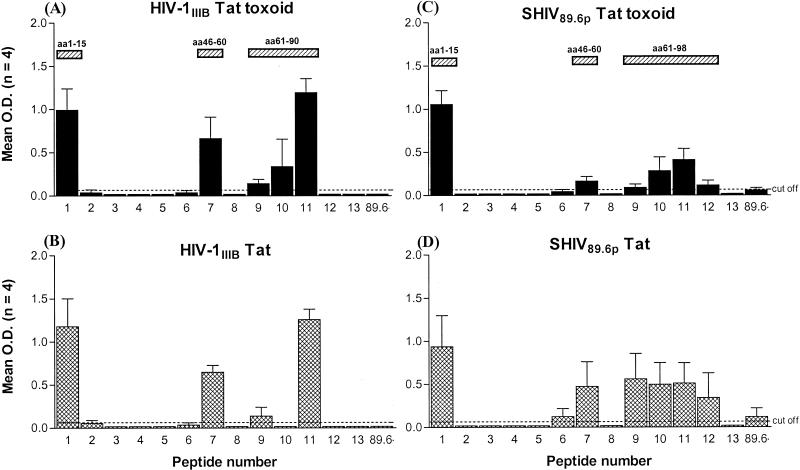
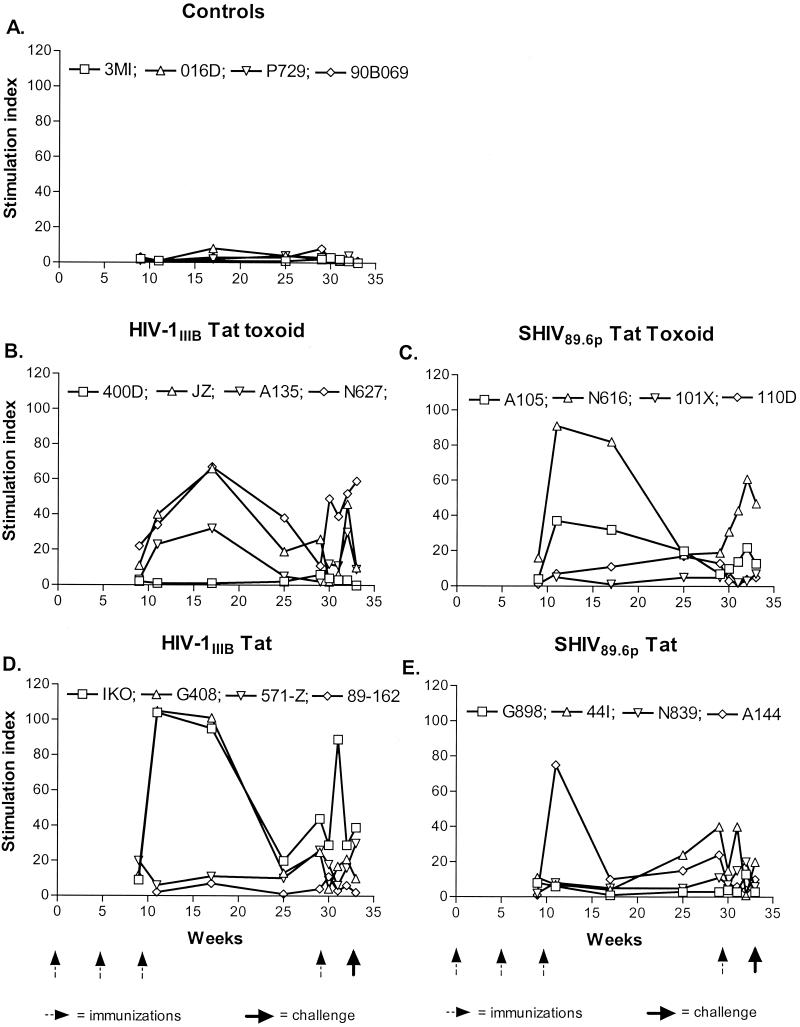
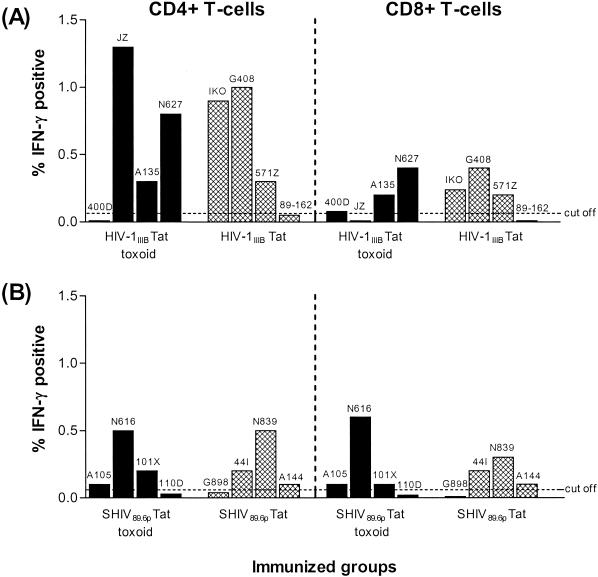
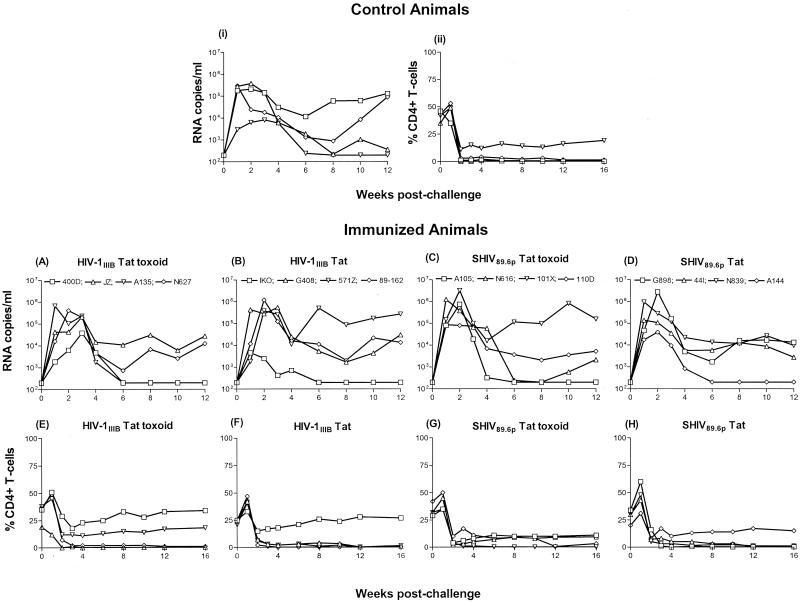
The regulatory proteins Nef, Rev, and Tat of human immunodeficiency virus type 1 (HIV-1) are attractive targets for vaccine development, since induction of effective immune responses targeting these early proteins may best control virus replication. Here we investigated whether vaccination with biologically active Tat or inactive Tat toxoid derived from HIV-1(IIIB) and simian-human immunodeficiency virus (SHIV) strain 89.6p would induce protective immunity in rhesus macaques. Vaccination induced high titers of anti-Tat immunoglobulin G in all immunized animals by week 7, but titers were somewhat lower in the 89.6p Tat group. Dominant B-cell epitopes mapped to the amino terminus, the basic domain, and the carboxy-terminal region. Tat-specific T-helper responses were detected in 50% of immunized animals. T-cell epitopes appeared to map within amino acids (aa) 1 to 24 and aa 37 to 66. In addition, Tat-specific gamma interferon responses were detected in CD4+ and/or CD8+ T lymphocytes in 11 of 16 immunized animals on the day of challenge. However, all animals became infected upon intravenous challenge with 30 50% minimal infective doses of SHIV 89.6p, and there were no significant differences in viral loads or CD4+ T-cell counts between immunized and control animals. Thus, vaccination with HIV-1(IIIB) or SHIV 89.6p Tat or with Tat toxoid preparations failed to confer protection against SHIV 89.6p infection despite robust Tat-specific humoral and cellular immune responses in some animals. Given its apparent immunogenicity, Tat may be more effective as a component of a cocktail vaccine in combination with other regulatory and/or structural proteins of HIV-1.
Figures
References
-
- Addo, M. M., M. Altfeld, E. S. Rosenberg, R. L. Eldridge, M. N. Philips, K. Habeeb, A. Khatri, C. Brander, G. K. Robbins, G. P. Mazzara, P. J. Goulder, and B. D. Walker. 2001. The HIV-1 regulatory proteins Tat and Rev are frequently targeted by cytotoxic T lymphocytes derived from HIV-1-infected individuals. Proc. Natl. Acad. Sci. USA 98:1781-1786. - PMC - PubMed
-
- Allen, T. M., D. H. O'Connor, P. Jing, J. L. Dzuris, B. R. Mothe, T. U. Vogel, E. Dunphy, M. E. Liebl, C. Emerson, N. Wilson, K. J. Kunstman, X. Wang, D. B. Allison, A. L. Hughes, R. C. Desrosiers, J. D. Altman, S. M. Wolinsky, A. Sette, and D. I. Watkins. 2000. Tat-specific cytotoxic T lymphocytes select for SIV escape variants during resolution of primary viraemia. Nature 407:386-390. - PubMed
-
- Almond, N. M., and J. L. Heeney. 1998. AIDS vaccine development in primate models. AIDS 12(Suppl. A):S133-S140. - PubMed
-
- Arya, S. K., C. Guo, S. F. Josephs, and F. Wong-Staal. 1985. Trans-activator gene of human T-lymphotropic virus type III (HTLV-III). Science 229:69-73. - PubMed
-
- Cafaro, A., A. Caputo, C. Fracasso, M. T. Maggiorella, D. Goletti, S. Baroncelli, M. Pace, L. Sernicola, M. L. Koanga-Mogtomo, M. Betti, A. Borsetti, R. Belli, L. Akerblom, F. Corrias, S. Butto, J. Heeney, P. Verani, F. Titti, and B. Ensoli. 1999. Control of SHIV-89.6P infection of cynomolgus monkeys by HIV-1 Tat protein vaccine. Nat. Med. 5:643-650. - PubMed
Publication types
MeSH terms
Substances
Grants and funding
LinkOut - more resources
Full Text Sources
Other Literature Sources
Medical
Research Materials
