. 2002 Apr;76(8):4138-44.
doi: 10.1128/jvi.76.8.4138-4144.2002.

Intrinsic stability of episomal circles formed during human immunodeficiency virus type 1 replication

Affiliations

Intrinsic stability of episomal circles formed during human immunodeficiency virus type 1 replication

Theodore C Pierson et al. J Virol. 2002 Apr.

Abstract

The development of surrogate markers capable of detecting residual ongoing human immunodeficiency virus type 1 (HIV-1) replication in patients receiving highly active antiretroviral therapy is an important step in understanding viral dynamics and in developing new treatment strategies. In this study, we evaluated the utility of circular forms of the viral genome for the detection of recent infection of cells by HIV-1. We measured the fate of both one-long terminal repeat (1-LTR) and 2-LTR circles following in vitro infection of logarithmically growing CD4+ T cells under conditions in which cell death was not a significant contributing factor. Circular forms of the viral genome were found to be highly stable and to decrease in concentration only as a function of dilution resulting from cell division. We conclude that these DNA circles are not intrinsically unstable in all cell types and suggest that the utility of 2-LTR circle assays in measuring recent HIV-1 infection of susceptible cells in vivo needs to be reevaluated.


Figures
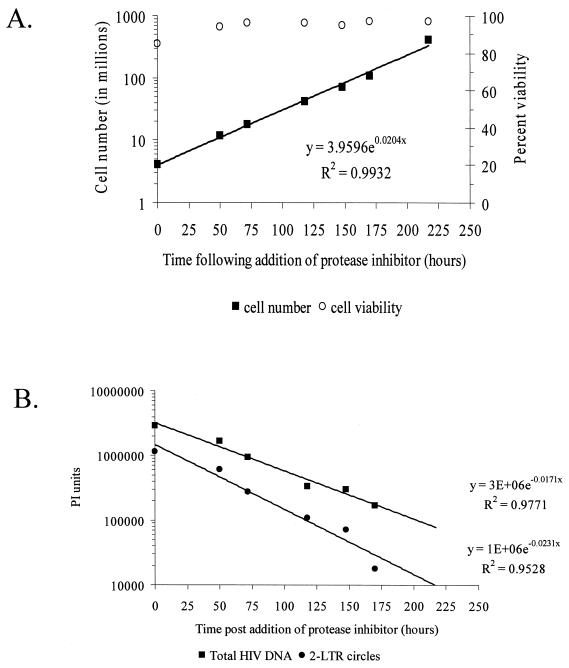
FIG. 1.
FIG. 1.
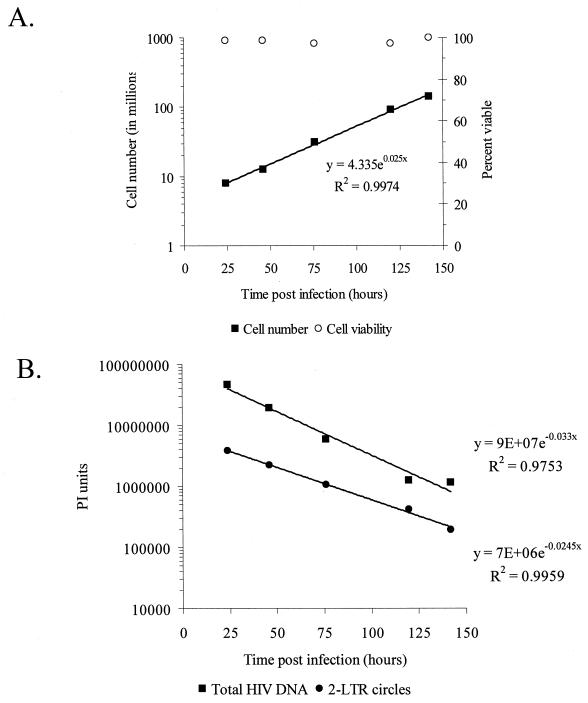
Intrinsic stability of 2-LTR circles following infection of log-phase MT-2 cells. (A) Proliferation of MT-2 cells infected with HIV-1 IIIb. Cells were infected with HIV-1 IIIb (MOI = 0.05) and cultured for 48 h in MM. Indinavir was then added to the culture, and at the indicated times, cells were counted and viability was measured by trypan blue exclusion. Cells were maintained at a concentration of 0.5 million/ml after each count in order to sustain an exponential rate of growth. (B) Analysis of the decay of 2-LTR circles. At the indicated times, cells were harvested and assayed by 28 and 25 cycles of semiquantitative PCR for 2-LTR circles and total HIV-1 DNA, respectively. The observed decay rates of 2-LTR circles and total HIV DNA were measured by phosphorimager analysis. To normalize for DNA input, amplification of β-globin was performed (data not shown).
FIG. 2.
FIG. 2.
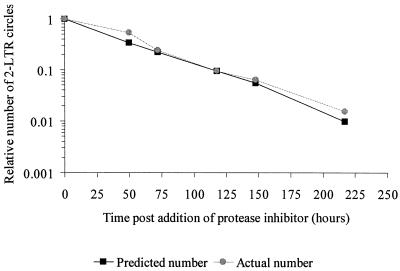
Comparison of the rate of observed decline of the 2-LTR circle signal to the decrease in signal predicted, assuming complete stability of the circles and a decrease in concentration as a consequence of dilution from cell division measured during the course of study. Data are normalized to the signal at time zero.
FIG. 3.
FIG. 3.
Decay of 2-LTR circles following infection with an integrase mutant HIV-1. MT-2 cells were infected as described with a virus carrying a single point mutation in integrase (D64N) that renders it incapable of multiple rounds of replication. (A) At the indicated times, cells were counted to determine the rate of proliferation, and a sample was harvested for quantification of 2-LTR circles and total HIV-1 DNA, as described in the legend to Fig. 1. (B) Observed decay of 2-LTR circles and total HIV-1 DNA measured by phosphorimager analysis.
FIG. 4.
FIG. 4.
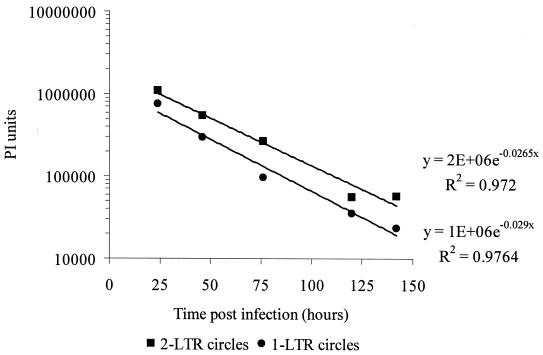
Both 1- and 2-LTR circles decay at similar rates. The decay of circular forms of the viral genome was measured as described following the infection of MT-2 cells with D64N mutant HIV-1 IIIb. The observed decay rates of 2-LTR circles and 1-LTR circles were measured by phosphorimager analysis.

References

    1. Butler, S. L., E. P. Johnson, and F. D. Bushman. 2002. Human immunodeficiency virus cDNA metabolism studied by fluorescence-monitored PCR: notable stability of two-long terminal repeat circles. J. Virol. 76:3739-3747. - PMC - PubMed
    1. Chun, T. W., L. Carruth, D. Finzi, X. Shen, J. A. DiGiuseppe, H. Taylor, M. Hermankova, K. Chadwick, J. Margolick, T. C. Quinn, Y. H. Kuo, R. Brookmeyer, M. A. Zeiger, P. Barditch-Crovo, and R. F. Siliciano. 1997. Quantification of latent tissue reservoirs and total body viral load in HIV-1 infection. Nature 387:183-188. - PubMed
    1. Chun, T. W., L. Stuyver, S. B. Mizell, L. A. Ehler, J. A. Mican, M. Baseler, A. L. Lloyd, M. A. Nowak, and A. S. Fauci. 1997. Presence of an inducible HIV-1 latent reservoir during highly active antiretroviral therapy. Proc. Natl. Acad. Sci. USA 94:13193-13197. - PMC - PubMed
    1. Dornadula, G., H. Zhang, B. VanUitert, J. Stern, L. Livornese, Jr., M. J. Ingerman, J. Witek, R. J. Kedanis, J. Natkin, J. DeSimone, and R. J. Pomerantz. 1999. Residual HIV-1 RNA in blood plasma of patients taking suppressive highly active antiretroviral therapy. JAMA 282:1627-1632. - PubMed
    1. Douek, D. C., R. D. McFarland, P. H. Keiser, E. A. Gage, J. M. Massey, B. F. Haynes, M. A. Polis, A. T. Haase, M. B. Feinberg, J. L. Sullivan, B. D. Jamieson, J. A. Zack, L. J. Picker, and R. A. Koup. 1998. Changes in thymic function with age and during the treatment of HIV infection. Nature 396:690-695. - PubMed

Publication types