. 2002 Apr;22(8):2663-72.
doi: 10.1128/MCB.22.8.2663-2672.2002.

Mutant mouse models reveal the relative roles of E2F1 and E2F3 in vivo

Affiliations

Mutant mouse models reveal the relative roles of E2F1 and E2F3 in vivo

Jennifer E Cloud et al. Mol Cell Biol. 2002 Apr.

Abstract

The E2F1, -2, and -3 transcription factors are key downstream targets of the retinoblastoma protein (pRB) tumor suppressor that drive expression of proliferation-associated genes. Here we use mutant mouse strains to investigate E2F3's role in vivo. We show that E2F3 is essential for embryonic viability in the pure 129/Sv background but the presence of C57BL/6 alleles yields some adult survivors. Although growth retarded, surviving E2f3(-/-) animals are initially healthy. However, they die prematurely, exhibiting no obvious tumor phenotype but with the typical signs of congestive heart failure. The defects are completely distinct from those arising in E2f1 mutant mice (S. J. Field et al., Cell 85:549-561; 1996; L. Yamasaki et al., Cell 85:537-548, 1996), supporting the prevailing view that these E2Fs must have some unique biological functions in vivo. To test this model, we examined the phenotypes of E2f1 E2f3 compound mutant mice. Almost all of the developmental and age-related defects arising in the individual E2f1 or E2f3 mice were exacerbated by the mutation of the other E2f. Thus, E2F1 and E2F3 appear to play critical, overlapping roles in the development and maintenance of a variety of tissues. Importantly, this study did identify one major difference in the properties of E2F1 and E2F3: either alone or in combination with E2F1 loss, E2f3 mutation did not increase the incidence of tumor formation. These data strongly suggest that tumor suppression is a specific property of E2F1 and not E2F3.


Figures
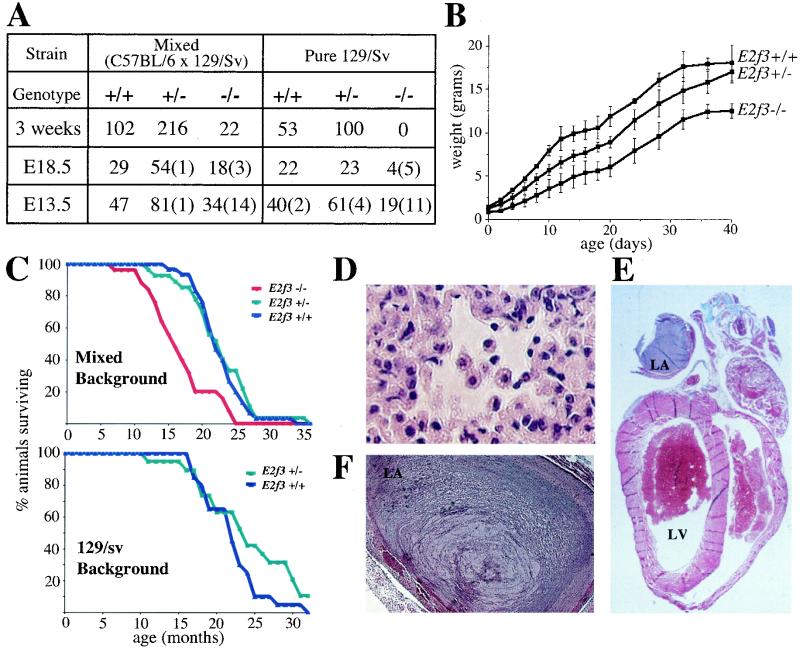
FIG. 1.
FIG. 1.
E2F3 is essential for full embryonic viability, promotes growth in a dose-dependent manner, and is critical for normal cardiac function. (A) Progeny arising from E2f3+/− intercrosses at various stages of embryonic development. Numbers in parentheses indicate numbers of nonviable embryos found at each developmental stage. (B) Representative weight curve of female littermate animals. Similar data was obtained for other litters and for males; however, the number of animals examined was insufficient to allow statistical analysis. (C) Kaplan-Meier plots of wild-type (n = 30), E2f3+/− (n = 27), and E2f3−/− (n = 25) littermates with the mixed (C57/BL6 × 129/Sv) genetic background and wild-type (n = 20) and E2f3+/− (n = 19) littermates with the pure 129/Sv background. (D) Hematoxylin- and eosin-stained sections of the lungs (×40 magnification) of an E2f3−/− animal that died from congestive heart failure, displaying macrophages in the alveolar spaces. (E and F) Sections of hearts (×1 and ×5 magnification, respectively) from E2f3−/− mice, depicting atrial thrombi stained with Gomori's one-step trichrome stain. LA, left atrium. LV, left ventricle.
FIG. 2.
FIG. 2.
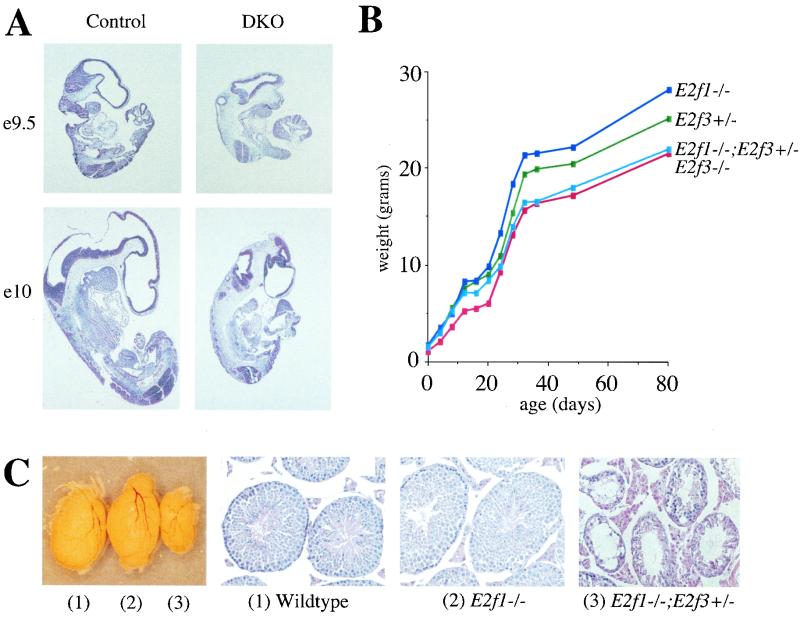
E2F1 and E2F3 have overlapping functions in a variety of tissue types. (A) Hematoxylin- and eosin-stained sections (×4 magnification) of E2f1−/− E2f3−/− embryos and littermate controls at embryonic days 9.5 and 10. (B) Weight curve from a representative litter of sex-matched (male) mice of the indicated genotypes. Similar data were obtained for other litters; however, the number of animals examined was insufficient to allow statistical analysis. (C) External view and hematoxylin- and eosin-stained sections (×20 magnification) of testes from representative four-month-old wild-type, E2f1−/−, and E2f1−/− E2f3+/− littermates.
FIG. 3.
FIG. 3.
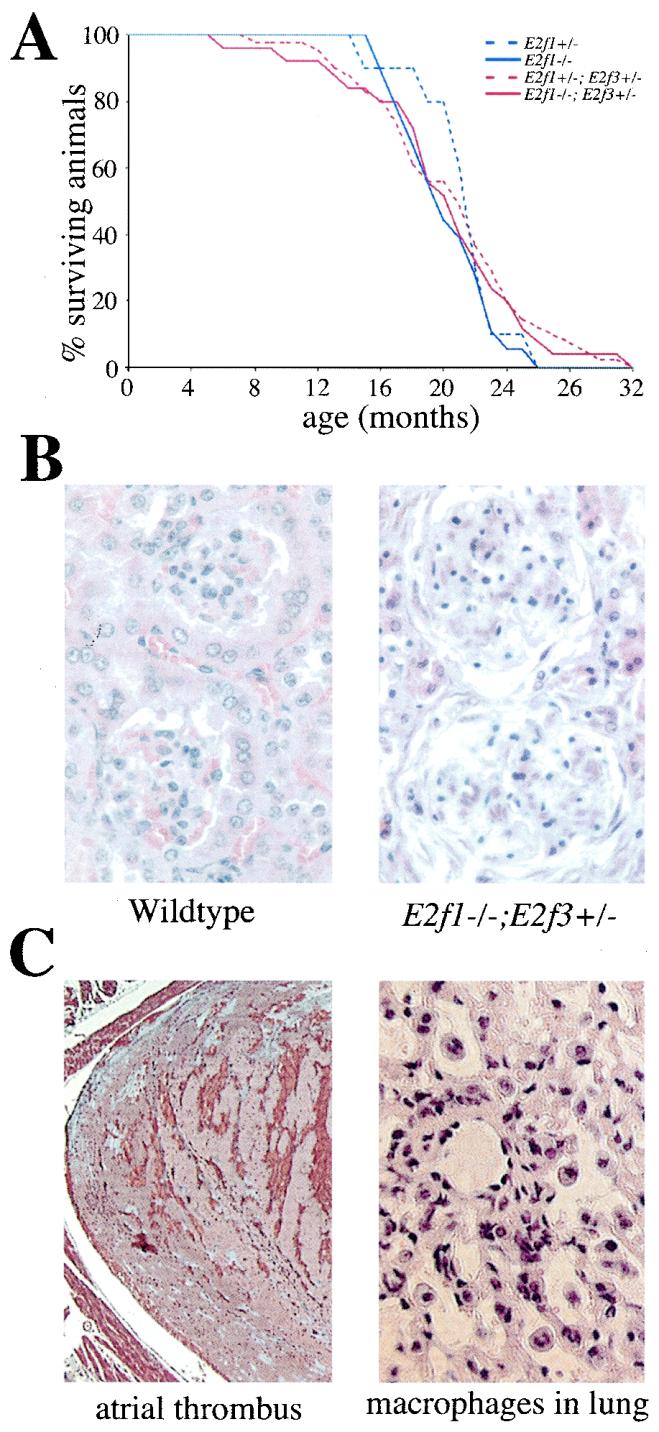
Aging phenotypes of E2f1 E3f3 compound mutant animals. (A) Relative life spans of mixed (C57BL/6 X129/Sv) E2f1+/− (n = 10), E2f1−/− (n = 18), E2f1+/− E2f3+/− (n = 41), and E2f1−/− E2f3+/− (n = 27) mice. (B) Hematoxylin- and eosin-stained sections of kidneys from a control wild-type animal and from an E2f1−/− E2f3+/− animal that died at 6 months of age with severe glomerulonephritis. (C) Signs of congestive heart failure in an E2f1+/− E2f3+/− animal that died at 8 months of age. The histological section of the left atrium of the heart (×5 magnification) was stained with Gomori's one step trichrome stain, and the section of the lung (×40 magnification) was stained with hematoxylin and eosin.
FIG. 4.
FIG. 4.
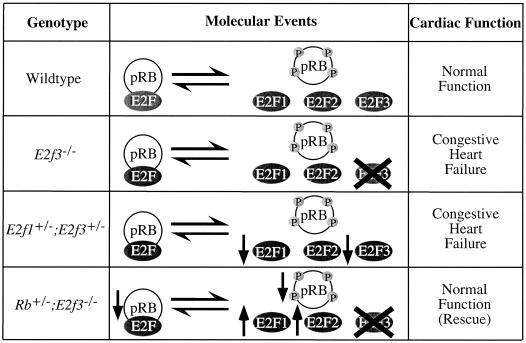
Model of E2F action in cardiac function. As demonstrated by the comparison of wild-type, E2f3−/−, E2f1+/− E2f3+/−, and Rb+/− E2f3−/− mice, the dosage of free activating E2F is critical for normal cardiac function.

References

    1. Adams, M. R., R. Sears, F. Nuckolls, G. Leone, and J. R. Nevins. 2000. Complex transcriptional regulatory mechanisms control expression of the E2F3 locus. Mol. Cell Biol. 20:3633-3639. - PMC - PubMed
    1. Brehm, A., E. A. Miska, D. J. McCance, J. L. Reid, A. J. Bannister, and T. Kouzarides. 1998. Retinoblastoma protein recruits histone deacetylase to repress transcription. Nature 391:597-601. - PubMed
    1. Buchkovich, K., L. A. Duffy, and E. Harlow. 1989. The retinoblastoma protein is phosphorylated during specific phases of the cell cycle. Cell 58:1097-1105. - PubMed
    1. Cartwright, P., H. Muller, C. Wagener, K. Holm, and K. Helin. 1998. E2F-6: a novel member of the E2F family is an inhibitor of E2F-dependent transcription. Oncogene 17:611-623. - PubMed
    1. Chellappan, S. P., S. Hiebert, M. Mudryj, J. M. Horowitz, and J. R. Nevins. 1991. The E2F transcription factor is a cellular target for the RB protein. Cell 65:1053-1061. - PubMed

Publication types

MeSH terms

LinkOut - more resources