. 2002 Mar;14(3):525-35.
doi: 10.1105/tpc.010274.

A comprehensive rice transcript map containing 6591 expressed sequence tag sites

Affiliations

A comprehensive rice transcript map containing 6591 expressed sequence tag sites

Jianzhong Wu et al. Plant Cell. 2002 Mar.

Abstract

To determine the chromosomal positions of expressed rice genes, we have performed an expressed sequence tag (EST) mapping project by polymerase chain reaction-based yeast artificial chromosome (YAC) screening. Specific primers designed from 6713 unique EST sequences derived from 19 cDNA libraries were screened on 4387 YAC clones and used for map construction in combination with genetic analysis. Here, we describe the establishment of a comprehensive YAC-based rice transcript map that contains 6591 EST sites and covers 80.8% of the rice genome. Chromosomes 1, 2, and 3 have relatively high EST densities, approximately twice those of chromosomes 11 and 12, and contain 41% of the total EST sites on the map. Most of the EST-dense regions are distributed on the distal regions of each chromosome arm. Genomic regions flanking the centromeres for most of the chromosomes have lower EST density. Recombination frequency in these regions is suppressed significantly. Our EST mapping also shows that 40% of the assigned ESTs occupy only approximately 21% of the entire genome. The rice transcript map has been a valuable resource for genetic study, gene isolation, and genome sequencing at the Rice Genome Research Program and should become an important tool for comparative analysis of chromosome structure and evolution among the cereals.


Figures
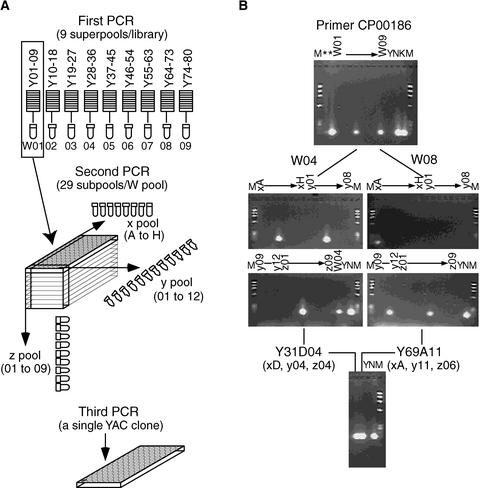
Figure 1.
Figure 1.
Construction of YAC DNA Pools for the Three-Step PCR and YAC Screening Using the EST Primer. (A) YAC DNA pools. (B) Two positive YAC clones, Y31D04 and Y69A11, were screened by the primer pair CP00186 designed from the 3′ end sequences of cDNA clone R3001. On the basis of the chromosomal positions of the two positive YACs, cDNA clone R3001 was assigned to a site ∼200 kb from the genetic marker of C69 (117.0 cM) on chromosome 6. Asterisks indicate special DNA templates pooled from the YAC clones mapped on chromosomes 1 and 6. K, Kasalath rice; M, a size marker (ΦX174 HaeIII digest); N, Nipponbare rice; Y, yeast.
Figure 2.
Figure 2.
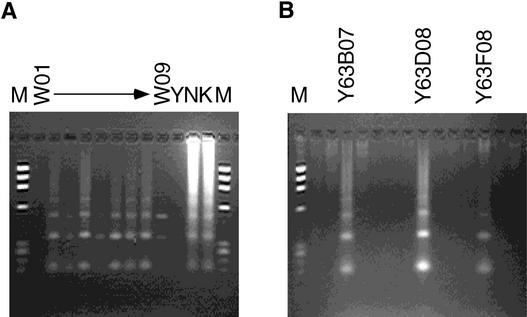
YAC Screening Using the Centromere-Specific Primer RCS2CP02. (A) Screening of YAC superpools (W01 to W09). (B) Confirmation of candidate YACs. Three positive YAC clones, Y63B07, Y63D08, and Y63F08, are shown. These clones were not mapped to the rice physical map because of the absence of associated genetic markers or EST sites. K, Kasalath rice; M, a size marker (ΦX174 HaeIII digest); N, Nipponbare rice; Y, yeast.
Figure 3.
Figure 3.
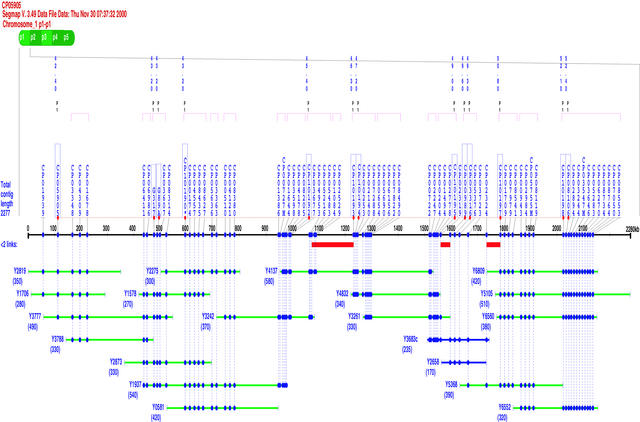
Construction of YAC Contigs and Assignment of EST Sites by SEGMAP Analysis. The map includes the contig name, data file date, and chromosome name at top. Beneath that is a horizontal line representing the chromosome region spanned by the contig. Dots on the line represent the EST sites shown vertically with their primer names (CP). Genetically mapped EST sites are shown with their linkage distances (centimorgans [cM]; the asterisk indicates the floating marker) and chromosomal locations above the names. ESTs assigned to multiple sites on different chromosome regions are indicated by the letter M after the name. YAC clones are displayed under the line with their insert sizes (kb) shown in parentheses under the names. The closed circles on the YAC line indicate the sites corresponding to ESTs. The red lines above some YACs immediately below the scale line indicate that two sites are linked by one YAC. YACs shown in blue represent the new clones mapped in the present study. Chimeric YACs are shown with the letter c after the name. The total physical length is given at left of the scale line. This contig, covering the genomic region of chromosome 1 from 42.4 to 52.4 cM with an estimated physical length of 2277 kb, was made of 20 YAC clones and contained 74 putatively assigned EST sites. The relative order and positions of ESTs that selected the common YACs could not be determined. Two genomic clones (G317 and G89) also were used as framework markers in this region.
Figure 4.
Figure 4.
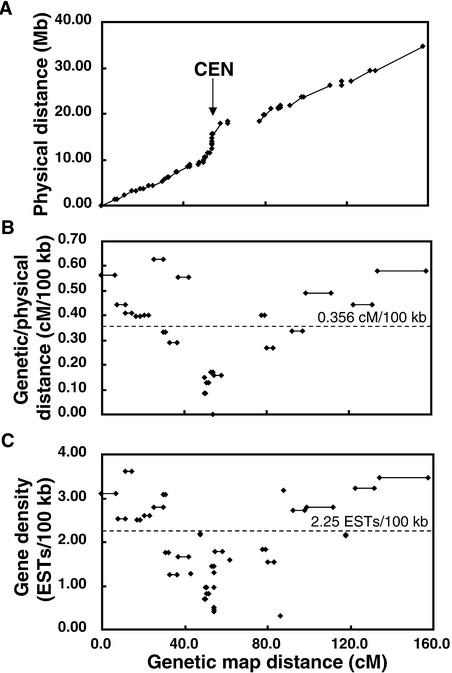
Relationships of Genetic Distance, Physical Distance, and Average EST Density of 32 YAC Contigs on Rice Chromosome 2. The map position of each genetic marker on the rice linkage map is indicated by a diamond. YAC contigs are shown as solid lines linking two markers on two distal ends of each contig. (A) The physical distance of each YAC contig is plotted against the position of each marker on the rice linkage map. The YAC contigs cover 78.1% of the entire chromosome. The physical distance for gaps (indicated by spaces between contigs) is unknown. CEN, rice centromere region. (B) The ratio of genetic to physical distance between marker pairs of each YAC contig is plotted against the map positions of markers on the linkage map. The standard error for the ratio is estimated to be ±9.0%, based on the results of statistical analysis of chromosome 1. The ratio of genetic to physical distance for seven contigs could not be determined, either because markers could not be separated (a YAC clone spanning two markers) or because of the presence of only one marker on a contig. The dotted line indicates the average ratio (0.356 cM/100 kb) of genetic to physical distance calculated from the total genetic distance and the estimated size of the entire rice genome (1530.4 cM/430 Mb). (C) The average gene density of each contig is plotted against the map position of markers on the linkage map. The dotted line indicates the average value (2.25 ESTs/100 kb) of gene density for the entire YAC physical map of this chromosome.
Figure 5.
Figure 5.
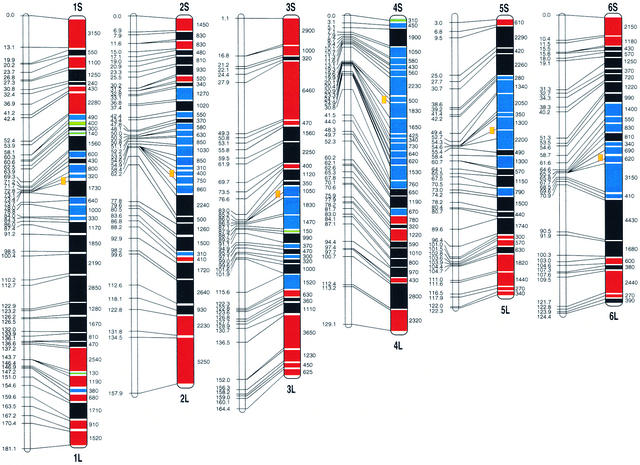
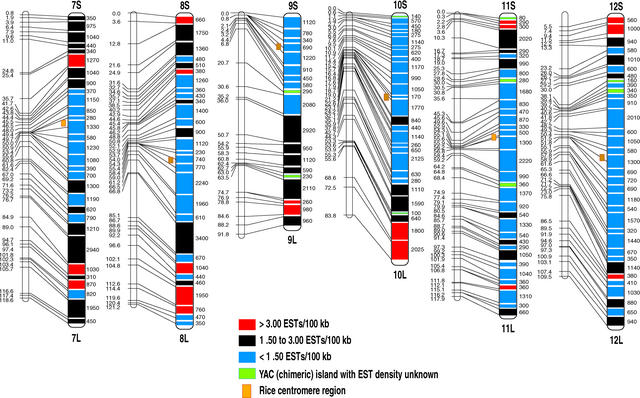
Chromosomal Distribution of the 6591 Rice EST Sites. Genetic (left; cM) and YAC-based physical (right; kb) maps are shown for each chromosome. The solid lines across each chromosome show the positions and regions of YAC contigs on the genetic map. Different colors represent different EST densities observed on the individual contigs.
Figure 5.
Figure 5.
Chromosomal Distribution of the 6591 Rice EST Sites. Genetic (left; cM) and YAC-based physical (right; kb) maps are shown for each chromosome. The solid lines across each chromosome show the positions and regions of YAC contigs on the genetic map. Different colors represent different EST densities observed on the individual contigs.

Comment in

References

    1. Altschul, S.F., Madden, T.L., Schaffer, A.A., Zhang, J., Zhang, Z., Miller, W., and Lipman, D.J. (1997). Gapped BLAST and PSI-BLAST: A new generation of protein database search programs. Nucleic Acids Res. 25, 3389–3402. - PMC - PubMed
    1. Arabidopsis Genome Initiative (2000). Analysis of the genome sequence of the flowering plant Arabidopsis thaliana. Nature 408, 796–815. - PubMed
    1. Ashikari, M., Wu, J., Yano, M., Sasaki, T., and Yoshimura, A. (1999). Rice gibberellin-insensitive dwarf mutant gene Dwarf 1 encodes the α-subunit of GTP-banding protein. Proc. Natl. Acad. Sci. USA 96, 10284–10289. - PMC - PubMed
    1. Barakat, A., Chrels, N., and Bernardi, G. (1997). The distribution of genes in the genomes of Gramineae. Proc. Natl. Acad. Sci. USA 94, 6857–6861. - PMC - PubMed
    1. Deloukas, P., et al. (1998). A physical map of 30,000 human genes. Science 282, 744–746. - PubMed

Publication types

Substances