Comparative Study
. 2002 Mar;14(3):611-8.
doi: 10.1105/tpc.010434.

Cell pattern in the Arabidopsis root epidermis determined by lateral inhibition with feedback

Affiliations
Comparative Study

Cell pattern in the Arabidopsis root epidermis determined by lateral inhibition with feedback

Myeong Min Lee et al. Plant Cell. 2002 Mar.

Abstract

In the root epidermis of Arabidopsis, hair and nonhair cell types are specified in a distinct position-dependent pattern. Here, we show that transcriptional feedback loops between the WEREWOLF (WER), CAPRICE (CPC), and GLABRA2 (GL2) genes help to establish this pattern. Positional cues bias the expression of the WER MYB gene, leading to the induction of CPC and GL2 in cells located in a particular position (N) and adoption of the nonhair fate. The truncated MYB encoded by CPC mediates a lateral inhibition mechanism to negatively regulate WER, GL2, and its own gene in the alternative position (H) to induce the hair fate. These results provide a molecular genetic framework for understanding the determination of a cell-type pattern in plants.


Figures

Figure 1.
Figure 1.
CPC Gene Expression Is Regulated by WER and CPC. (A) RNA gel blot hybridization analysis using a CPC-specific gene probe. RNA was isolated from the root tips of seedlings from the genotypes indicated. The same blot was rehybridized with an 18S rRNA probe as a loading control. (B) Expression of the CPC::GUS reporter in the developing root epidermis of 4-day-old seedlings. This reporter also is expressed in the developing stele near the root tip, but this expression is not associated with the role of CPC in epidermal development (M.M. Lee and J. Schiefelbein, unpublished observations). WT, wild type. Bar in (B) = 50 μm.
Figure 2.
Figure 2.
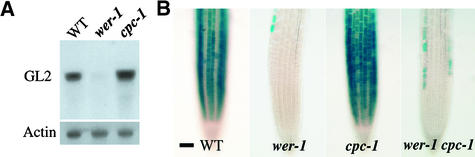
GL2 Gene Expression Is Regulated by WER and CPC. (A) RNA gel blot hybridization analysis using a GL2-specific gene probe. RNA was isolated from root tips from the genotypes indicated and subjected to RNA gel blot analysis. The same blot was rehybridized with an actin probe as a loading control. (B) Expression of the GL2::GUS reporter in the developing root epidermis of 4-day-old seedlings. The wer-1 and wer-1 cpc-1 plants were stained overnight, whereas the other lines were stained for 3 hr. WT, wild type. Bar in (B) = 50 μm.
Figure 3.
Figure 3.
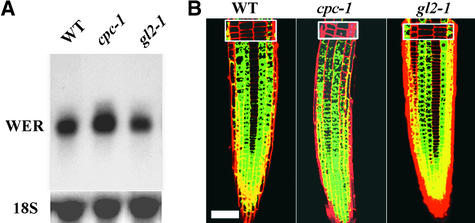
WER Gene Expression Is Regulated by CPC. (A) RNA gel blot hybridization analysis using a WER-specific gene probe. RNA was isolated from root tips from the genotypes indicated and subjected to RNA gel blot analysis. The same blot was rehybridized with an 18S rRNA probe. (B) Expression of the WER::GFP reporter in the developing root epidermis of 4-day-old seedlings analyzed by confocal fluorescence microscopy. Propidium iodide dye (red signal) was included to visualize cell boundaries. The insets are focused on the cortical cell layer and therefore indicate the positions of the epidermal cell files. WT, wild type. Bar in (B) = 50 μm.
Figure 4.
Figure 4.
Model Showing the Regulatory Interactions between WER, CPC, and GL2 That Define Cell Pattern in the Arabidopsis Epidermis. (A) Interactions that occur in cells with equivalent developmental potentials. In the absence of positional cues, all epidermal cells express WER, CPC, and GL2 and use CPC to inhibit their neighbors from expressing these genes. (B) Positional cues generate a bias in WER expression as a result of induction in N cells and/or inhibition in H cells (open symbols). Feedback loops enhance this bias to generate a high level (thick lines) of WER, CPC, and GL2 expression (and the nonhair cell fate) in N cells and a low level (dotted lines) of WER, CPC, and GL2 expression (and the hair cell fate) in H cells.
Figure 5.
Figure 5.
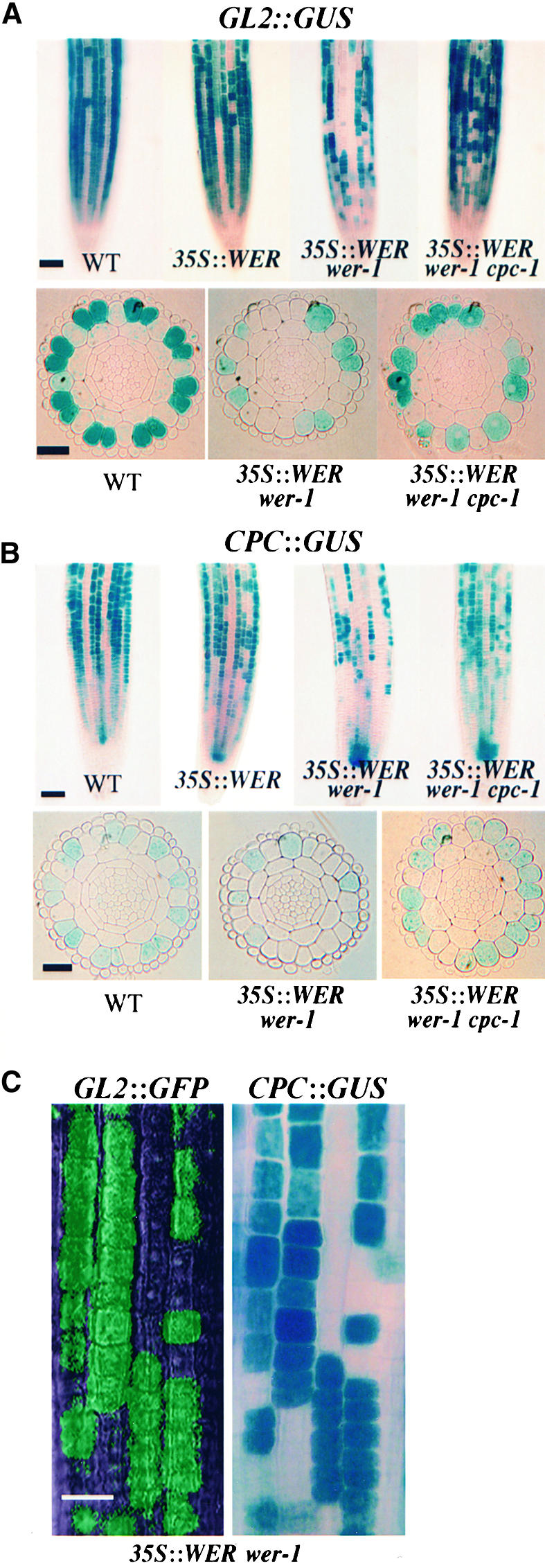
35S::WER Alters the Epidermal Cell Pattern. (A) Expression of the GL2::GUS reporter in the developing root epidermis of 4-day-old seedlings. The top row contains surface views, and the bottom row shows transverse sections from the meristematic region. Note that a single layer of lateral root cap cells surrounds the epidermis in the transverse sections. All lines were stained for the same period of time (3 hr). (B) Expression of the CPC::GUS reporter in the developing root epidermis of 4-day-old seedlings. The top row contains surface views, and the bottom row shows transverse sections from the meristematic region. (C) Coordinate expression of GL2 and CPC in root epidermal cells. The accumulation of GFP and GUS is shown in a 5-day-old seedling root bearing the genotype 35S::WER wer-1 GL2::GFP CPC::GUS. An image was first recorded using fluorescence microscopy (to detect GL2::GFP expression); then, GUS activity was assessed (to detect CPC::GUS expression). WT, wild type. Bars in (A) and (B), top rows = 50 μm; bars in (A) and (B), bottom rows = 25 μm; bar in (C) = 20 μm.
Figure 6.
Figure 6.
35S::CPC Alters the Epidermal Cell Pattern. Expression of the GL2::GUS reporter in the developing root epidermis of 4-day-old seedlings. 35S::CPC and 35S::CPC wer-1 plants were stained overnight, whereas the 35S::CPC cpc-1 line was stained for 3 hr. Bar = 50 μm.

References

    1. Artavanis-Tsakonas, S., Rand, M.D., and Lake, R.J. (1999). Notch signaling: Cell fate control and signal integration in development. Science 284, 770–776. - PubMed
    1. Barlow, P.W., and Carr, D.J. (1984). Positional Controls in Plant Development. (Cambridge, UK: Cambridge University Press).
    1. Berger, F., Haseloff, J., Schiefelbein, J., and Dolan, L. (1998. a). Positional information in root epidermis is defined during embryogenesis and acts in domains with strict boundaries. Curr. Biol. 8, 421–430. - PubMed
    1. Berger, F., Linstead, P., Dolan, L., and Haseloff, J. (1998. b). Stomata patterning on the hypocotyl of Arabidopsis thaliana is controlled by genes involved in the control of root epidermis patterning. Dev. Biol. 194, 226–234. - PubMed
    1. Bunning, E. (1951). Uber die Differenzierungsvorgange in der Cruciferenwurzel. Planta 39, 126–153.

Publication types