


Complementary advantageous substitutions in the evolution of an antiviral RNase of higher primates
- PMID: 11917138
- PMCID: PMC122796
- DOI: 10.1073/pnas.072626199
Complementary advantageous substitutions in the evolution of an antiviral RNase of higher primates
Abstract
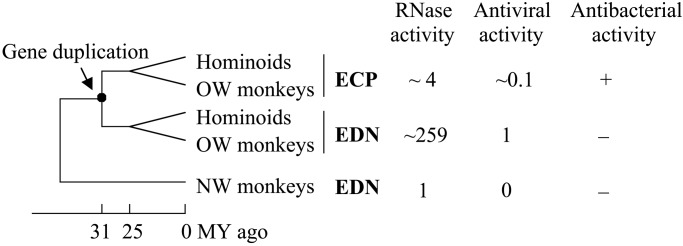
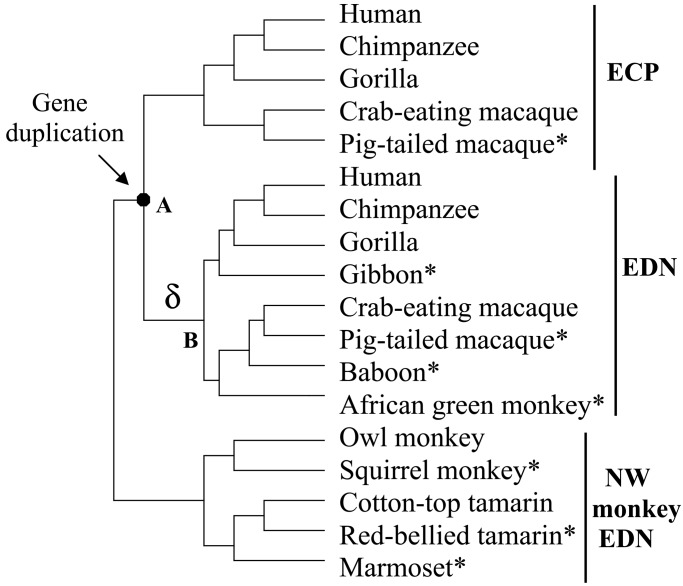
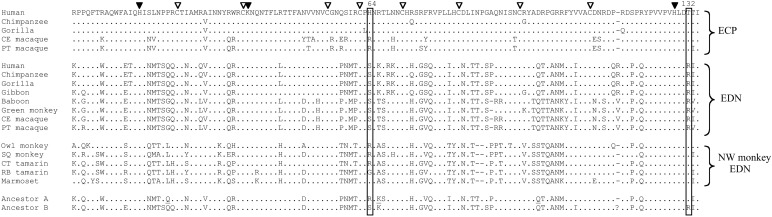
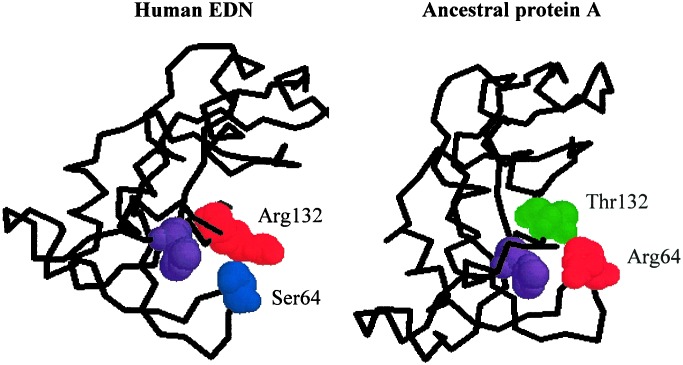
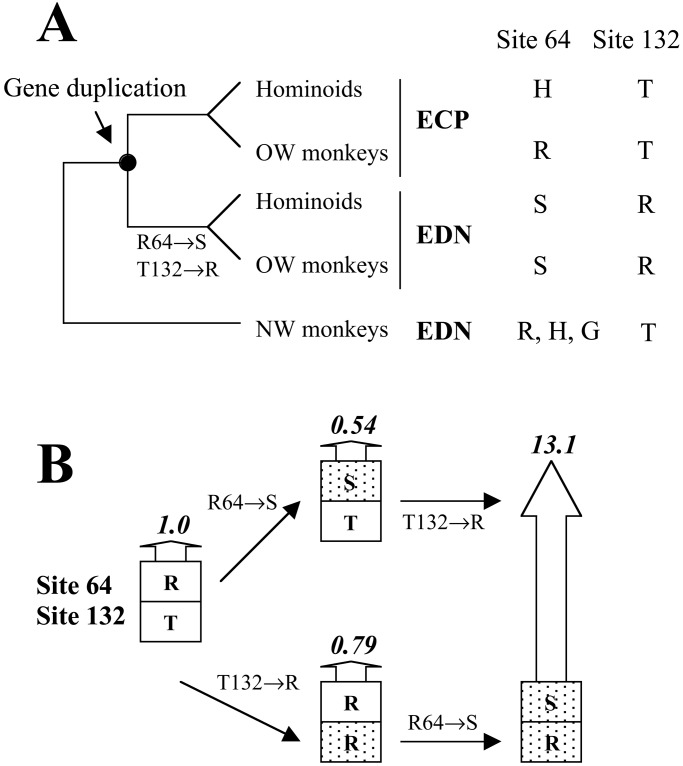
An improved understanding of the evolution of gene function at the molecular level may provide significant insights into the origin of biological novelty and adaptation. With the approach of ancestral protein reconstruction, we here address the question of how a dramatically enhanced ribonucleolytic activity and the related antiviral activity evolved in a recently duplicated ribonuclease (eosinophil-derived neurotoxin) gene of higher primates. We show that the mother gene of the duplicated genes had already possessed a weak antiviral activity before duplication. After duplication, substitutions at two interacting sites (Arg-64-->Ser and Thr-132-->Arg) resulted in a 13-fold enhancement of the ribonucleolytic activity of eosinophil-derived neurotoxin. These substitutions are also necessary for the potent antiviral activity, with contributions from additional amino acid changes at interacting sites. Our observation that a change in eosinophil-derived neurotoxin function occurs only when both interacting sites are altered indicates the importance of complementary substitutions in protein evolution. Thus, neutral substitutions are not simply "noises" in protein evolution, as many have thought. They may play constructive roles by setting the intramolecular microenvironment for further complementary advantageous substitutions, which can lead to improved or altered function. Overall, our study illustrates the power of the "paleomolecular biochemistry" approach in delineating the complex interplays of amino acid substitutions in evolution and in identifying the molecular basis of biological innovation.
Figures
Comment in
-
The past as the key to the present: resurrection of ancient proteins from eosinophils.Proc Natl Acad Sci U S A. 2002 Apr 16;99(8):4760-1. doi: 10.1073/pnas.092143699. Proc Natl Acad Sci U S A. 2002. PMID: 11959927 Free PMC article. No abstract available.
References
Publication types
MeSH terms
Substances
Associated data
- Actions
- Actions
- Actions
- Actions
- Actions
- Actions
- Actions
- Actions
LinkOut - more resources
Full Text Sources
Other Literature Sources
