


Epidemiology of candidemia: 3-year results from the emerging infections and the epidemiology of Iowa organisms study
- PMID: 11923348
- PMCID: PMC140380
- DOI: 10.1128/JCM.40.4.1298-1302.2002
Epidemiology of candidemia: 3-year results from the emerging infections and the epidemiology of Iowa organisms study
Abstract
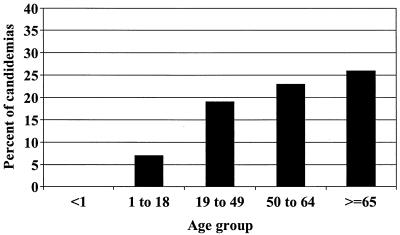
Bloodstream infections due to Candida species cause significant morbidity and mortality. Surveillance for candidemia is necessary to detect trends in species distribution and antifungal resistance. We performed prospective surveillance for candidemia at 16 hospitals in the State of Iowa from 1 July 1998 through 30 June 2001. Using U.S. Census Bureau and Iowa Hospital Association data to estimate a population denominator, we calculated the annual incidence of candidemia in Iowa to be 6.0 per 100,000 of population. Candida albicans was the most common species detected, but 43% of candidemias were due to species other than C. albicans. Overall, only 3% of Candida species were resistant to fluconazole. However, Candida glabrata was the most commonly isolated species other than C. albicans and demonstrated some resistance to azoles (fluconazole MIC at which 90% of the isolates tested are inhibited, 32 microg/ml; 10% resistant, 10% susceptible dose dependent). C. glabrata was more commonly isolated from older patients (P = 0.02) and caused over 25% of candidemias among persons 65 years of age or older. The investigational triazoles posaconazole, ravuconazole, and voriconazole had excellent in vitro activity overall against Candida species. C. albicans is the most important cause of candidemia and remains highly susceptible to available antifungal agents. However, C. glabrata has emerged as an important and potentially antifungal resistant cause of candidemia, particularly among the elderly.
Figures
References
-
- Blumberg, H. M., W. R. Jarvis, J. M. Soucie, J. E. Edwards, J. E. Patterson, M. A. Pfaller, M. S. Rangel-Frausto, M. G. Rinaldi, L. Saiman, R. T. Wiblin, R. P. Wenzel, and the NEMIS Study Group. 2001. Risk factors for candidal bloodstream infections in surgical intensive care unit patients: the NEMIS Prospective Multicenter Study. Clin. Infect. Dis 33:177-186. - PubMed
-
- Collin, B., C. J. Clancy, and M. H. Nguyen. 1999. Antifungal resistance in non-albicans Candida species. Drug Resist. Updates 3:9-14. - PubMed
-
- Diekema, D. J., M. A. Pfaller, S. A. Messer, A. Houston, R. J. Hollis, G. V. Doern, R. N. Jones, and the SENTRY Participants Group. 1999. In vitro activities of BMS-207147 against over 600 contemporary clinical bloodstream isolates of Candida species from the SENTRY Antimicrobial Surveillance Program in North America and Latin America. Antimicrob. Agents Chemother. 43:2236-2239. - PMC - PubMed
-
- Edmond, M. B., S. E. Wallace, D. K. McClish, M. A. Pfaller, R. N. Jones, and R. P. Wenzel. 1999. Nosocomial bloodstream infections in United States hospitals: a three-year analysis. Clin. Infect. Dis 29:239-244. - PubMed
Publication types
MeSH terms
Substances
Grants and funding
LinkOut - more resources
Full Text Sources
Medical
