


Social context of work injury among undocumented day laborers in San Francisco
- PMID: 11929509
- PMCID: PMC1495019
- DOI: 10.1046/j.1525-1497.2002.10501.x
Social context of work injury among undocumented day laborers in San Francisco
Abstract
Objective: To identify ways in which undocumented day laborers' social context affects their risk for occupational injury, and to characterize the ways in which these workers' social context influences their experience of disability.
Design: Qualitative study employing ethnographic techniques of participant-observation, supplemented by semistructured in-depth interviews.
Settings: Street corners in San Francisco's Mission District, a homeless shelter, and a nonprofit day labor hiring hall.
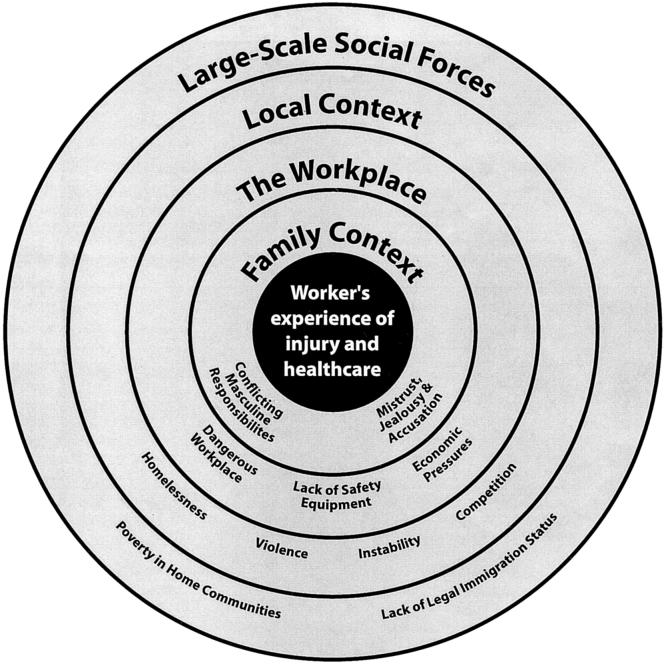
Participants: Thirty-eight Mexican and Central American male day laborers, 11 of whom had been injured. PRIMARY THEMES: Anxiety over the potential for work injury is omnipresent for day laborers. They work in dangerous settings, and a variety of factors such as lack of training, inadequate safety equipment, and economic pressures further increase their risk for work injury. The day laborers are isolated from family and community support, living in a local context of homelessness, competition, and violence. Injuries tend to have severe emotional, social, and economic ramifications. Day laborers frequently perceive injury as a personal failure that threatens their masculinity and their status as patriarch of the family. Their shame and disappointment at failing to fulfill culturally defined masculine responsibilities leads to intense personal stress and can break family bonds. Despite the high incidence of work injuries and prevalence of work-related health conditions, day laborers are frequently reluctant to use health services due to anxiety regarding immigration status, communication barriers, and economic pressure.
Implications: On the basis of these ethnographic data, we recommend strategies to improve ambulatory care services to day laborers in 3 areas: structural changes in ambulatory care delivery, clinical interactions with individual day laborers, and policymaking around immigration and health care issues.
Figures
References
-
- Mena J. Officials reworking rules on day labor; laws: cities try to adjust to court ruling on the right to solicit jobs. The Los Angeles Times; August 25, 2001.
-
- Miller E. Immigrants find the island a mixed blessing; the issue of day workers splinters Farmingville. The New York Times; December 27, 1998.
-
- Gettleman J. Obscure law used to jail day laborers in Georgia; race: influx of Latinos tests state's inclusiveness. Courts have ruled against similar acts elsewhere. The Los Angeles Times; August 21, 2001.
-
- Phillips JA, Massey DS. The new labor market: immigrants and wages after IRCA. Demography. 1999;36:233–46. - PubMed
-
- Census of Fatal Occupational Injuries. Bureau of Labor Statistics. U.S. Department of Labor. 2000. Available at: http://www.bls.gov/oshcfoi1.htm?H6. Accessed September 2001.