. 2002 Apr 16;99(8):5460-5.
doi: 10.1073/pnas.042098799. Epub 2002 Apr 2.

The defective kernel 1 (dek1) gene required for aleurone cell development in the endosperm of maize grains encodes a membrane protein of the calpain gene superfamily

Affiliations

The defective kernel 1 (dek1) gene required for aleurone cell development in the endosperm of maize grains encodes a membrane protein of the calpain gene superfamily

Stein Erik Lid et al. Proc Natl Acad Sci U S A. .

Abstract

Endosperm of cereal grains is one of the most important renewable resources for food, feed, and industrial raw material. It consists of four triploid cell types, i.e., aleurone, starchy endosperm, transfer cells, and cells of the embryo surrounding region. In maize, the aleurone layer is one cell layer thick and covers most of the perimeter of the endosperm. Specification of maize aleurone cell fate is proposed to occur through activation of the tumor necrosis factor receptor-like receptor kinase CRINKLY4. A second maize gene essential for aleurone cell development is defective kernel 1 (dek1). Here we show that DEK1 shares high homology with animal calpains. The predicted 2,159-aa DEK1 protein has 21 transmembrane regions, an extracellular loop, and a cysteine proteinase domain that shares high homology with domain II of m-calpain from animals. We propose that DEK1 functions to maintain and restrict the aleurone cell fate imposed by CR4 through activation of its cysteine proteinase by contact with the outer endosperm surface. DEK1 seems to be the only member of the calpain superfamily in plants, Arabidopsis DEK1 sharing 70% overall identity with maize DEK1. The expression of dek1 in most plant tissues in maize and Arabidopsis, as well as its presence in a variety of higher plants, including angiosperms and gymnosperms, suggests that DEK1 plays a conserved role in plant signal transduction.


Figures
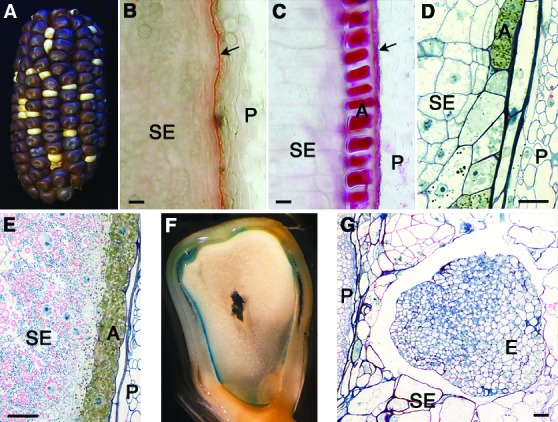
Figure 1
Figure 1
The phenotype of dek1-mum1 homozygous maize kernels. (A) F1-ear from the cross dek1-mum1/+ × dek1–1394/+. The ear segregates 3:1 for wild-type (dark) and dek1 (white) grains, demonstrating that the two mutations are both in the dek1 gene. (B) Hand section of dek1-mum1 kernel stained with the lipid stain Sudan red 7B (31). Starchy endosperm cells (SE) are located in the periphery of the endosperm close to the remnants of the nucellus (arrow). The maternal pericarp (P) is seen to the right. (C) Transverse hand section of wild-type kernel with peripheral aleurone cells (A) adjacent to the remnants of the maternal nucellus (arrow). (D) Transverse section of 15 DAP homozyogous dek1-mum1 endosperm embedded in Spurr resin (13) showing partial presence of aleurone cells (A) with dark cytoplasm in the periphery of the endosperm. (E) Wild-type endosperm (15 DAP) with normal aleurone layer. (F) dek1-mum1 grain showing blue stain from the Gus reporter driven by the aleurone-specific barley Ltp2-promoter. (G) Homozygous dek1-mum1 embryo (E) at 15 DAP. The shape of the embryo is globular, lacking the embryo axis found in wild-type embryos.
Figure 2
Figure 2
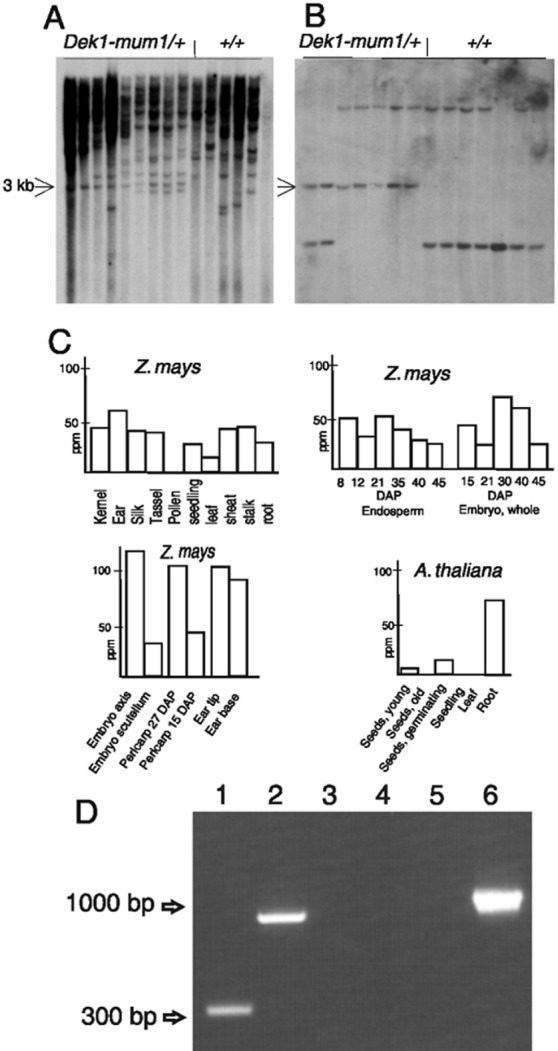
Cosegregation and expression analysis of dek1. (A) DNA blot from heterozygous dek1-mum1/+ and homozygous +/+ plants digested with KpnI and probed with a Mu1-specific probe. The blot identifies a 3-kb band cosegregating with the dek1-mum1 phenotype (arrow). (B) DNA blot from the same segregating population as in A probed with dek1 cDNA. (C) Massively parallel signature-sequencing experiments measuring dek1 transcript abundance in ppm in maize and Arabidopsis tissues. (D) Reverse transcription–PCR analysis of the dek1 transcript in dek1-mum1 homozygous endosperms. Combinations with a Mu-TIR primer and a dek1-specific primer from the 5′ side (lane 1) and the 3′ side (lane 2) of the Mu1 insertion site give bands of expected sizes, showing the presence of Mu1 in the dek1-mum1 transcript. A combination of the two dek1-specific primers from both sides of the insertion site (lane 3) fails to give a product, demonstrating the lack of wild-type dek1 transcript without Mu1 in dek1-mum1 homozygous mutant endosperm. Lanes 4–6 contain control reactions with poly(A)+ RNA from B73 endosperm with use of the same primer combinations as in lanes 1–3, respectively.
Figure 3
Figure 3
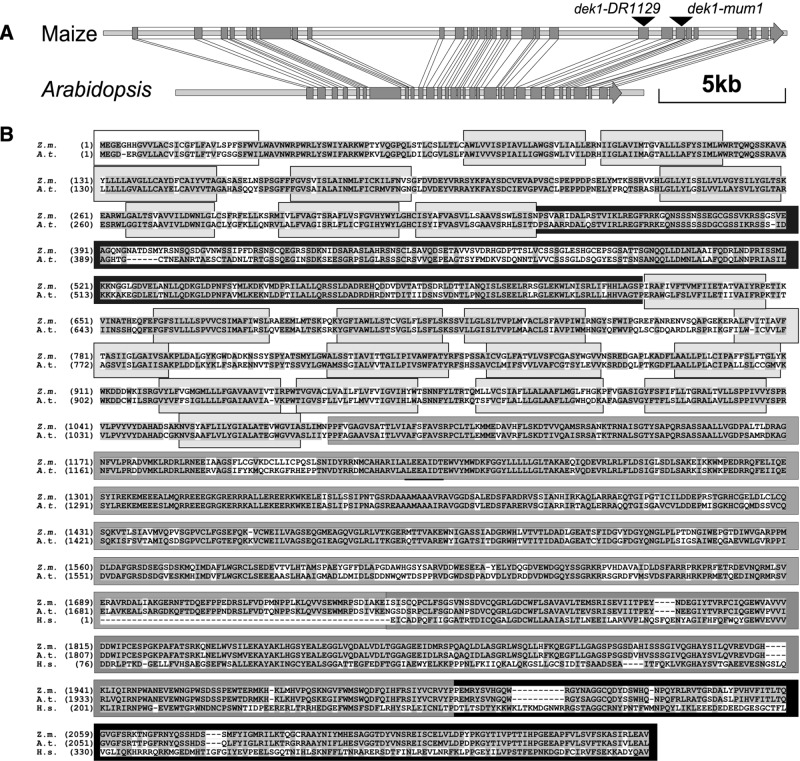
dek1 gene and protein structure. (A) Intron–exon structure of maize and Arabidopsis dek1 genes. Exons are shown in gray. The dek1-mum1 allele has a Mu1 inserted between base pairs 18954 and 18955, dek1-DR1129 a Mu8-insertion between base pairs 17827 and 17828. (B) Alignment of predicted maize and A. thaliana DEK1 proteins. Alignment with human calpain (H.s) domain II and III is shown (Lower). Similar and identical residues are shaded. Shades in grayscale identify the sequence of the DEK1 domains shown in Fig. 4.
Figure 4
Figure 4
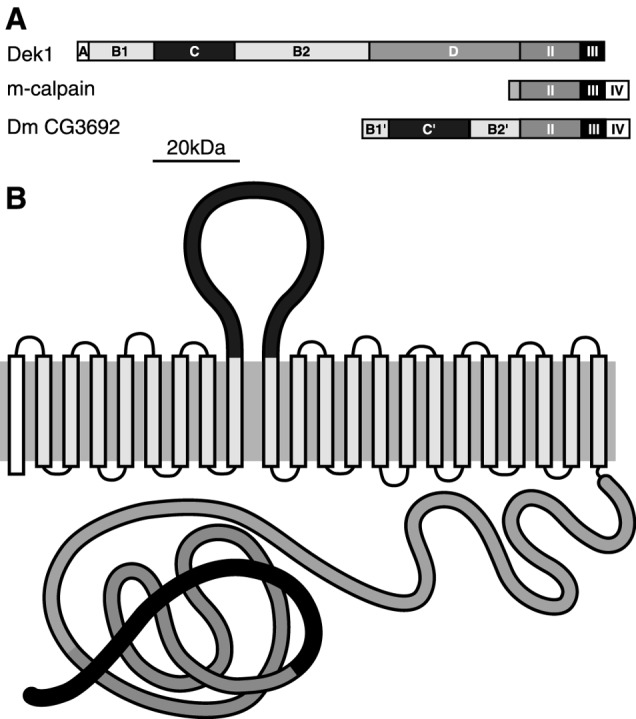
Domain structure of DEK1. (A) Domain structure of maize DEK1, m-calpain, and Drosophila CG3692 calpain. (B) Predicted maize DEK1 structure showing the loop region on the outside of the cell and the cysteine proteinase domain on the inside. The model is based on the TMHMM2.0 program (32).

References

    1. Olsen O-A. Annu Rev Plant Physiol Plant Mol Biol. 2001;52:233–267. - PubMed
    1. Lopes M A, Larkins B A. Plant Cell. 1993;5:1383–1399. - PMC - PubMed
    1. Berger F. Curr Opin Plant Biol. 1999;2:28–32. - PubMed
    1. Becraft P W, Stinard P S, McCarty D. Science. 1996;273:1406–1409. - PubMed
    1. Olsen O-A, Lemmon B E, Brown R C. Trends Plant Sci. 1998;3:168–169.

Publication types

MeSH terms