. 2002 Apr 16;99(8):5738-43.
doi: 10.1073/pnas.072644999. Epub 2002 Apr 2.

The plant-specific function of 2-Cys peroxiredoxin-mediated detoxification of peroxides in the redox-hierarchy of photosynthetic electron flux

Affiliations

The plant-specific function of 2-Cys peroxiredoxin-mediated detoxification of peroxides in the redox-hierarchy of photosynthetic electron flux

Janine König et al. Proc Natl Acad Sci U S A. .

Abstract

The 2-cysteine peroxiredoxins (2-Cys Prx) constitute an ancient family of peroxide detoxifying enzymes and have acquired a plant-specific function in the oxygenic environment of the chloroplast. Immunocytochemical analysis and work with isolated intact chloroplasts revealed a reversible binding of the oligomeric form of 2-Cys Prx to the thylakoid membrane. The oligomeric form of the enzyme was enhanced under stress. The 2-Cys Prx has a broad substrate specificity with activity toward hydrogen peroxides and complex alkyl hydroperoxides. During the peroxide reduction reaction, 2-Cys Prx is alternatively oxidized and reduced as it catalyzes an electron flow from an electron donor to peroxide. Escherichia coli thioredoxin, but also spinach thioredoxin f and m were able to reduce oxidized 2-Cys Prx. The midpoint redox potential of -315 mV places 2-Cys Prx reduction after Calvin cycle activation and before switching the malate valve for export of excess reduction equivalents to the cytosol. Thus the 2-Cys Prx has a defined and preferential place in the hierarchy of photosynthetic electron transport. The activity of 2-Cys Prx also is linked to chloroplastic NAD(P)H metabolism as indicated by the presence of the reduced form of the enzyme after feeding dihydroxyacetone phosphate to intact chloroplasts. The function of the 2-Cys Prx is therefore not confined to its role in the water-water cycle pathway for energy dissipation in photosynthesis but also mediates peroxide detoxification in the plastids during the dark phase.


Figures
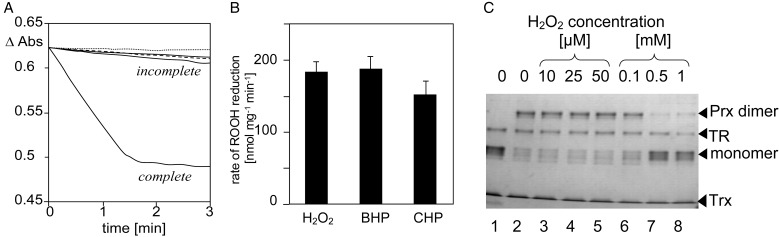
Figure 1
Figure 1
Peroxide reduction by recombinant Hv-2-Cys Prx. (A) Kinetics of reduction as measured by time-dependent absorption changes in an assay containing 2-Cys Prx. E. coli-Trx, E. coli-TR, NADPH, and H2O2 (complete system) or in the absence of each single component (incomplete system, traces from the top: −H2O2, −TR, −Trx, and −2-Cys Prx). (B) Comparison of initial rates of reduction of H2O2, butylhydroperoxide (BHP), and cumenehydroperoxide (CHP) at a concentration of 25 μM. The stoichiometry between peroxide reduction and NADPH oxidation was shown to be unity. (C) Inactivation of recombinant 2-Cys Prx at high H2O2 concentrations as investigated by nonreducing SDS/PAGE. Lane 1 shows the reduced 2-Cys PRX in the complete reconstitution system. For lanes 2–8, the reconstitution system was supplemented with increasing H2O2 concentrations and dialyzed for 4 h to 40 mM K-Pi for a mild oxidizing of 2-Cys Prx and dimer formation.
Figure 2
Figure 2
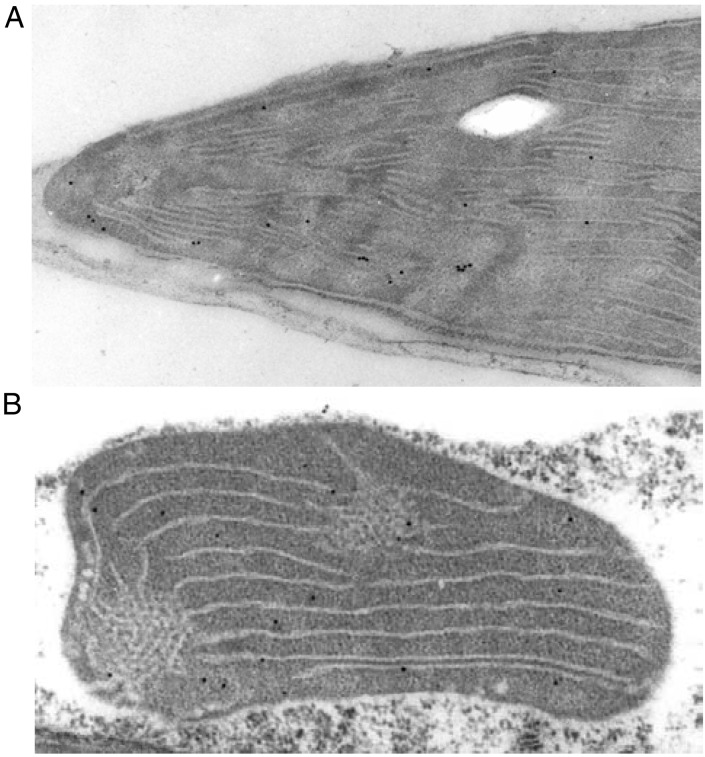
Immunocytochemical detection of 2-Cys Prx protein in a leaf cross section of light-grown or etiolated 8-day-old barley seedling. ImmunoGold labeling in a partial section of a mesophyll cell from light-grown leaves (A) and from etiolated leaves (B).
Figure 3
Figure 3
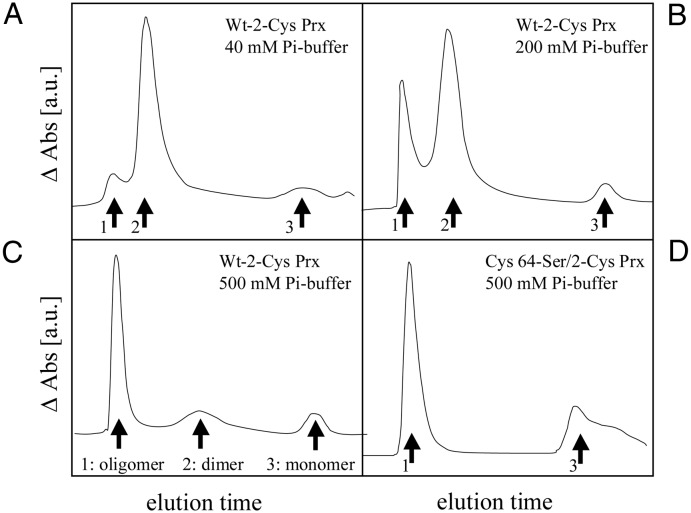
Salt concentration dependence of 2-Cys Prx oligomerization state. Heterologously expressed wild-type and Cys-64→Ser mutant form, respectively, was separated by size exclusion chromatography. The peak labeled as oligomeric form run in the exclusion volume of the Superdex 75 column. On Superose 12 material, the oligomeric form separated as a complex of ≈500 kDa (result not shown). Wild-type 2-Cys Prx in Pi buffer at 40 mM concentration (A), wild-type 2-Cys Prx in Pi buffer (200 mM) (B), wild-type 2-Cys Prx in Pi buffer (500 mM) (C), and Cys-64→Ser mutant form of 2-Cys Prx in Pi buffer of 500 mM concentration (D).
Figure 4
Figure 4
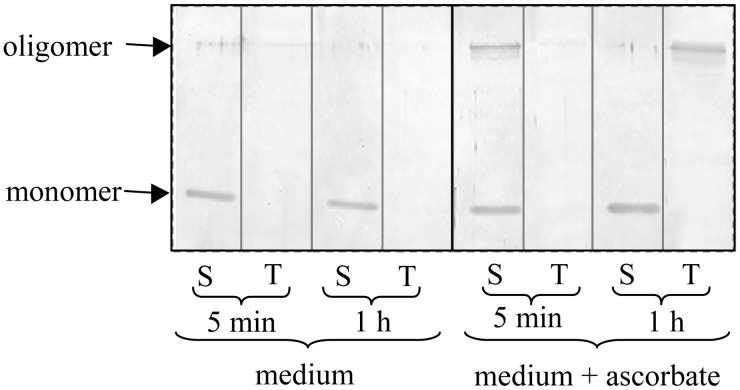
Attachment of oligomerized 2-Cys Prx to the thylakoid membrane in intact chloroplasts. Chloroplasts were isolated from Hordeum leaves and incubated in the absence (lanes 1–4) or presence (lanes 5–8) of 10 mM ascorbic acid. After 5 or 60 min, the chloroplasts were lysed by hypoosmotic shock and the thylakoids (T) separated from the soluble stroma (S) by centrifugation. Proteins from both fractions were separated by SDS/PAGE and analyzed in a Western blot analysis with anti-2-Cys Prx.
Figure 5
Figure 5
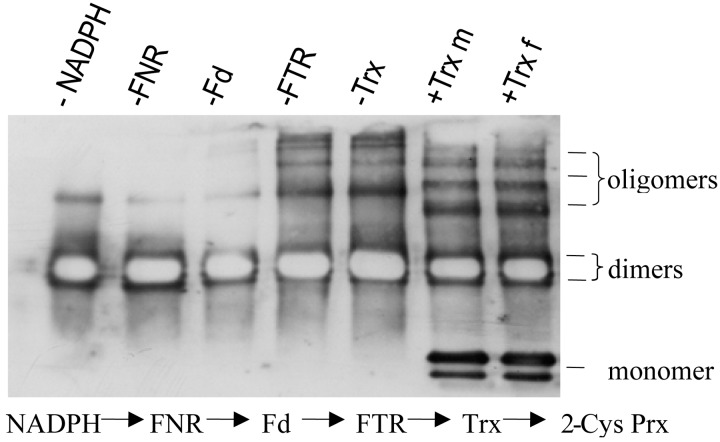
Reduction of heterologously expressed 2-Cys Prx in an enzymic system containing spinach Trx f or m. The complete electron transport chain is also depicted. After incubation for 30 min, the samples were separated by denaturing nonreducing SDS/PAGE and analyzed in a Western blot analysis with anti-2-Cys Prx. Lanes 1–5 represent samples in which each one component of the complete system had been omitted as indicated on top of each lane. Lane 6 depicts the result with Trx m and lane 7 with Trx f. The position of monomeric reduced 2-Cys Prx is shown. The protein band beneath the monomer indicates degradation. It was a repeated observation that the reduced 2-Cys Prx exhibited a higher propensity for degradation.
Figure 6
Figure 6
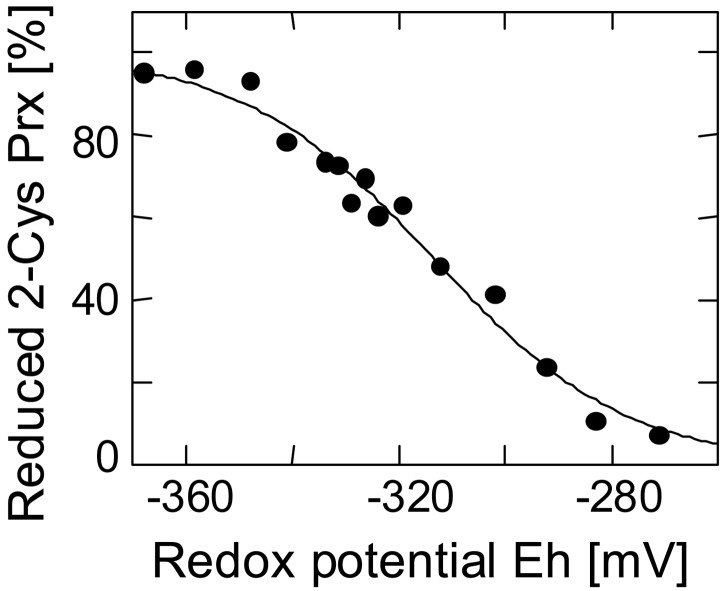
Titration of the redox midpoint potential of heterologously expressed 2-Cys Prx. The redox potential of the samples was adjusted by varying the ratio of DTToxidized/DTTreduced. After reacting reduced thiol groups with monobromobimane, the samples were analyzed for bound fluorophore.
Figure 7
Figure 7
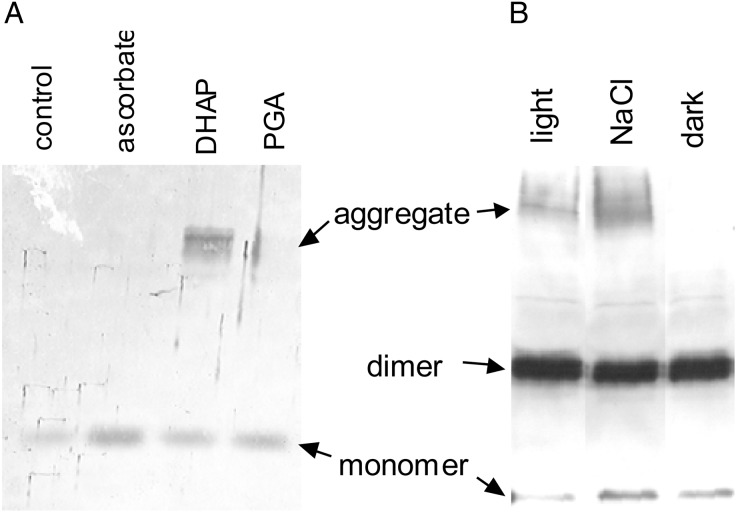
Aggregate formation of 2-Cys Prx in intact chloroplast by exogenous DHAP and oligomerization under stress. (A) Isolated barley chloroplasts were incubated either without any further addition (lane 1) or with 10 mM ascorbic acid (lane 2), 20 mM dihydroxyacetone phosphate (lane 3) or 20 mM 3-PGA (lane 4) for 15 min. The samples were analyzed by denaturing reducing SDS/PAGE and Western blotting with anti-2-Cys Prx Ab. (B) Barley plants were subjected to salt stress (250 mM for 2 d) and extracted with N-ethylmaleimide. The control and NaCl-stressed leaves were harvested under illumination. Additionally, nonstressed leaves were analyzed after incubation for 4 h in the dark.
Figure 8
Figure 8
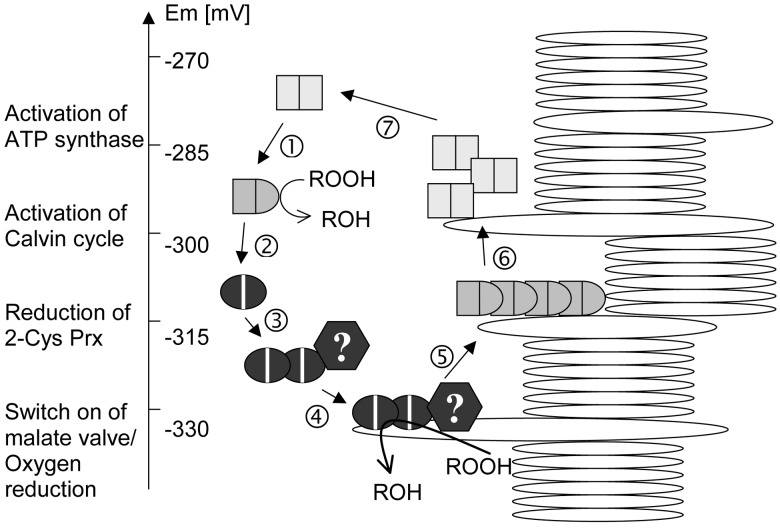
Model for the regulation of the 2-Cys Prx activity in the chloroplast. The basic unit is the dimer which can either exist fully oxidized (square), fully reduced (oval), or partially oxidized (bullet shaped). The reduced dimer can oligomerize and attach to the thylakoid membrane. The regulatory cycle is linked to the redox potential as indicated by the scale at the left. The 2-Cys Prx cycle is integrated into the hierarchy of electron flow as exemplified with some key processes. See text for further details.

References

    1. Elstner E F. Der Sauerstoff: Biochemie, Biologie, Medizin. Wienheim, Germany: Verlag Chemie; 1990.
    1. Dietz K J, Link G, Pistorius E K, Scheibe R. Prog Bot. 2002;63:207–245.
    1. Davies K J A. Biochem Soc Symp. 1994;61:1–32. - PubMed
    1. Baier M, Dietz K J. Prog Bot. 1998;60:283–314.
    1. Noctor G, Foyer C H. Annu Rev Plant Physiol Plant Mol Biol. 1998;49:249–279. - PubMed

Publication types

MeSH terms

LinkOut - more resources