. 2002 May;22(9):2883-92.
doi: 10.1128/MCB.22.9.2883-2892.2002.

Enhanced expression of the transcription factor Nrf2 by cancer chemopreventive agents: role of antioxidant response element-like sequences in the nrf2 promoter

Affiliations

Enhanced expression of the transcription factor Nrf2 by cancer chemopreventive agents: role of antioxidant response element-like sequences in the nrf2 promoter

Mi-Kyoung Kwak et al. Mol Cell Biol. 2002 May.

Abstract

Induction of phase 2 enzymes, which neutralize reactive electrophiles and act as indirect antioxidants, is an important mechanism for protection against carcinogenesis. The transcription factor Nrf2, which binds to the antioxidant response element (ARE) found in the upstream regulatory region of many phase 2 genes, is essential for the induction of these enzymes. We have investigated the effect of the potent enzyme inducer and anticarcinogen 3H-1,2-dithiole-3-thione (D3T) on the fate of Nrf2 in murine keratinocytes. Both total and nuclear Nrf2 levels increased rapidly and persistently after treatment with D3T but could be blocked by cotreatment with cycloheximide. Nrf2 mRNA levels increased approximately 2-fold 6 h after D3T treatment. To examine the transcriptional activation of Nrf2 by D3T, the proximal region (1 kb) of the nrf2 promoter was isolated. Deletion and mutagenesis analyses demonstrated that nrf2 promoter-luciferase reporter activity was enhanced by treatment with D3T and that ARE-like sequences were required for this activation. Gel shift assays with nuclear extracts from PE cells indicated that common factors bind to typical AREs and the ARE-like sequences of the nrf2 promoter. Direct binding of Nrf2 to its own promoter was demonstrated by chromatin immunoprecipitation assay. Overexpression of Nrf2 increased the activity of the nrf2 promoter-luciferase reporter, while expression of mutant Nrf2 protein repressed activity. Thus, Nrf2 appears to autoregulate its own expression through an ARE-like element located in the proximal region of its promoter, leading to persistent nuclear accumulation of Nrf2 and protracted induction of phase 2 genes in response to chemopreventive agents.


Figures
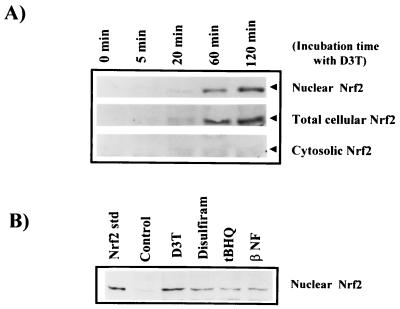
FIG. 1.
FIG. 1.
Effects of D3T on levels of Nrf2 in PE cells. (A) Nrf2 levels were examined in nuclear extracts, total cellular homogenates, and cytosolic fractions after treatment with D3T for different incubation times. Each lane contains three pooled samples. (B) Nuclear extracts were isolated from dimethyl sulfoxide (control)-, D3T (10 μM)-, disulfiram (50 μM)-, tert-butylhydroxyquinone (tBHQ) (50 μM)-, or β-naphthofalvone (β NF) (20 μM)-treated cells 6 h after treatment. Immunoblot analyses were performed with Nrf2 antibody. A positive standard for the immunoblot was prepared from Nrf2-overexpressing cells (Nrf2 std).
FIG. 2.
FIG. 2.
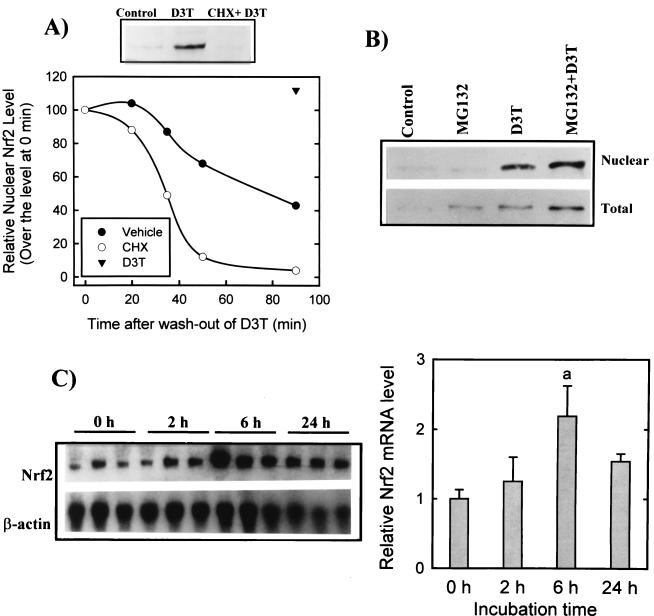
Effects of protein synthesis inhibitor, CHX, and proteasome inhibitor, MG132, on the accumulation of Nrf2 and effect of D3T on levels of Nrf2 mRNA. (A) In the upper panel, cells were treated with vehicle, D3T (10 μM), or D3T plus CHX (1 μg/ml) for 3 h. Immunoblotting with Nrf2 antibody was carried out with nuclear extracts. In the lower panel, cells were washed after treatment with D3T for 3 h, and either vehicle or CHX was added to the culture medium for the indicated times. ▾, Level of nuclear Nrf2 after incubation with D3T for 4.5 h without washout at 3 h. Nuclear Nrf2 levels were measured by immunoblot analysis of three pooled samples at each time point. (B) Nrf2 levels after treatment for 6 h with vehicle, MG132 (15 μM), D3T (10 μM), or MG132 plus D3T were measured in nuclear and total cellular fractions. Each lane contains three pooled samples, and three separate immunoblots were carried out. (C) Nrf2 mRNA levels measured in PE cells by Northern blot hybridization. The histogram on the right represents the mean ± the standard error (SE) from three different experiments.
FIG. 3.
FIG. 3.
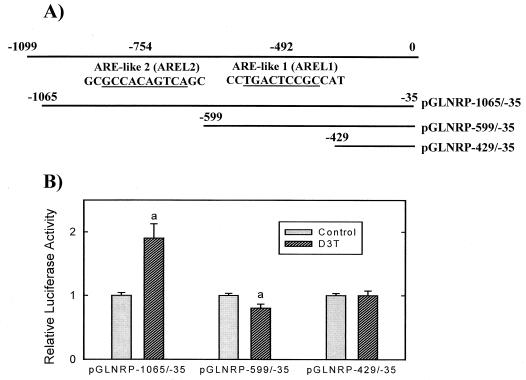
Effect of D3T on nrf2 promoter activity in PE cells. (A) A 1-kb portion of the promoter of nrf2 was isolated from murine liver and ligated into a luciferase reporter vector (pGLNRP−1065/−35) to monitor the activity of this promoter. ARE-like sequences (AREL1; −492, AREL2; −754) are found in the promoter of Nrf2. Different 5′-deletion constructs (pGLNRP−599/−35 and pGLNRP−429/−35) were also prepared by PCR. (B) Luciferase reporter plasmids containing the nrf2 promoter (pGLNRP−1065/−35) or truncated promoter constructs (pGLNRP−599/−35 and pGLNRP−429/−35) were transiently transfected into PE cells, and the luciferase activities were measured after treatment with D3T (10 μM) for 5 h. Luciferase activities were normalized by cotransfecting Renilla luciferase control vectors. Values are means ± the SE from five to seven different experiments. a, P < 0.05 compared to vehicle-treated control.
FIG. 4.
FIG. 4.
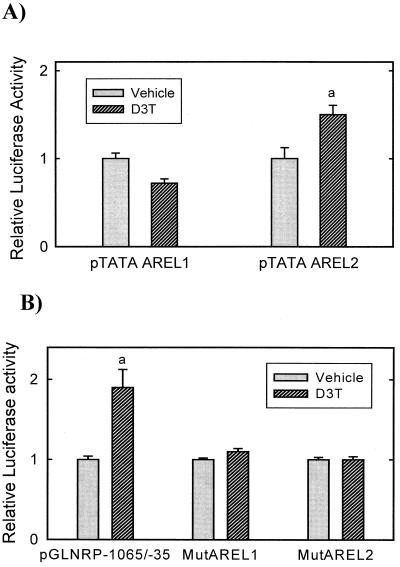
Effects of D3T on ARE-like-mediated luciferase activity and site-directed mutagenesis studies of the nrf2 promoter. (A) Luciferase plasmids containing ARE-like sequences from nrf2 promoter (pTATA AREL1 and pTATA AREL2) were transfected, and the luciferase activities were measured after D3T treatment for 5 h. Luciferase activities were normalized by measuring the Renilla luciferase activity from a cotransfected reporter vector. Values are means ± the SE from four different experiments. a, P < 0.05 compared to vehicle-treated control. (B) Mutated AREL1- or AREL2-containing promoters were transfected and luciferase activities measured following treatment with D3T for 5 h. Values are means ± the SE from five different experiments. a, P < 0.05 compared to vehicle-treated control.
FIG. 5.
FIG. 5.
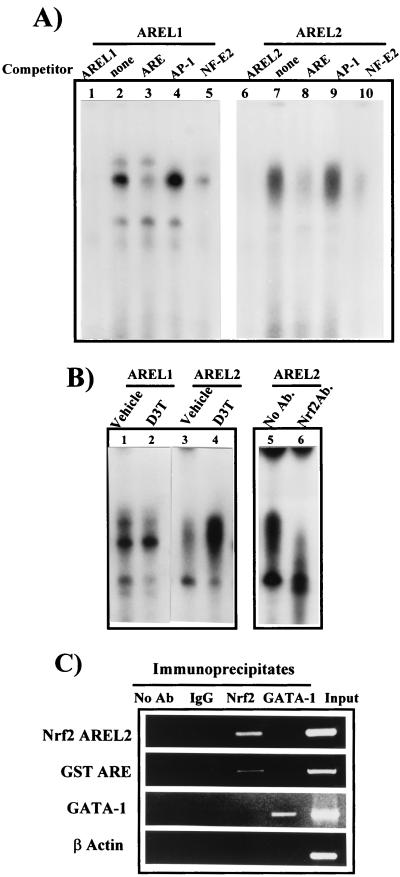
EMSA analyses with AREL1 and AREL2 sequences and ChIP assay. (A) Competitive binding of AREL1 (lanes 1 to 5) and AREL2 (lanes 6 to 10) with consensus sequences of human NQO1 ARE, AP-1, or NF-E2 with nuclear extracts from D3T-treated cells. (B) Total binding of nuclear extracts from vehicle- or D3T-treated cells to AREL1 (lanes 1 and 2) and AREL2 (lanes 3 and 4). The effects of immunodepletion of nuclear extracts from D3T-treated cells with Nrf2 antibody are shown in lanes 5 and 6. Each lane represents three pooled samples. (C) ChIP assay performed in D3T-treated PE cells with Nrf2 antibody. Intact protein-DNA complexes were cross-linked by adding formaldehyde into the culture medium. Immunoprecipitates from control (incubated without antibody) and nonspecific immunoglobulin (IgG)-, Nrf2 antibody-, or GATA-1 antibody-incubated cells were isolated and analyzed by PCR with primers specific for the GST, nrf2, GATA-1, and β-actin promoters. The supernatant from the control nuclear extract was prepared as the total input of chromatin, and 0.1% of total input was used as the input DNA. Each sample was prepared from three pooled plates.
FIG. 6.
FIG. 6.
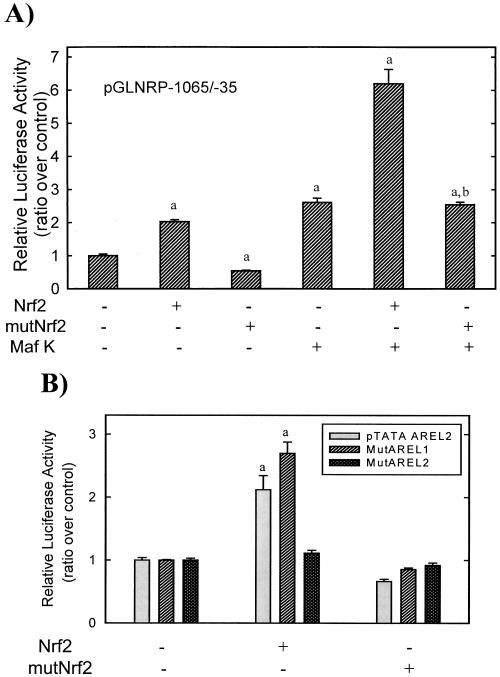
Effect of overexpression of Nrf2 on the activity of the nrf2 promoter. (A) Nrf2 promoter luciferase activity was measured after transfection of wild-type or mutant Nrf2 with or without MafK. Values are means ± the SE from four different experiments. a, P < 0.05 compared to blank plasmid-transfected control. b, P < 0.05 compared to the wild-type Nrf2 and MafK-transfected group. (B) Luciferase activities of pTATA AREL2, mutated AREL2 promoter (MutAREL2), or mutated AREL1 promoter (MutAREL1) after overexpression of wild-type and mutant Nrf2. Values are means ± the SE from 4 different experiments. a, P < 0.05 compared to blank plasmid-transfected control.

References

    1. Alam, J., D. Stewart, C. Touchard, S. Boinapally, A. M. K. Choi, and J. L. Cook. 1999. Nrf2, a cap'n'collar transcription factor, regulates induction of the heme oxygenase-1 gene. J. Biol. Chem. 274:26071-26078. - PubMed
    1. Angel, P., K. Hattori, T. Smeal, and M. Karin. 1988. The jun proto-oncogene is positively autoregulated by its product, Jun/AP-1. Cell 55:875-885. - PubMed
    1. Boyd, K., J. Wells, J. Gutman, S. M. Bartley, and P. J. Farnham. 1998. c-Myc target gene specificity is determined by a post-DNA-binding mechanism. Proc. Natl. Acad. Sci. USA 95:13887-13892. - PMC - PubMed
    1. Chan, K., and Y. W. Kan. 1999. Nrf2 is essential for protection against acute pulmonary injury in mice. Proc. Natl. Acad. Sci. USA 96:12731-12736. - PMC - PubMed
    1. Chan, K., R. Lu, J. C. Chang, and Y. W. Kan. 1996. NRF2, a member of the NFE2 family of transcription factors, is not essential for murine erythropoiesis, growth, and development. Proc. Natl. Acad. Sci. USA 93:13943-13948. - PMC - PubMed

Publication types

MeSH terms