. 2002 Apr 16;99(8):5539-44.
doi: 10.1073/pnas.082120099. Epub 2002 Apr 9.

Induction and acceleration of insulitis/diabetes in mice with a viral mimic (polyinosinic-polycytidylic acid) and an insulin self-peptide

Affiliations

Induction and acceleration of insulitis/diabetes in mice with a viral mimic (polyinosinic-polycytidylic acid) and an insulin self-peptide

Hiroaki Moriyama et al. Proc Natl Acad Sci U S A. .

Abstract

Polyinosinic-polycytidylic acid (PolyIC), a "mimic" of double-stranded viral RNA, can induce diabetes when administered to rats with RT1(u), and immunization of normal H-2(d) mice (e.g., BALB/c) with insulin B:9-23 peptide (but not H-2(b)) results in the rapid induction of insulin autoantibodies. Because a mouse model of PolyIC/antigen-induced diabetes is lacking, we sought to produce insulitis and diabetes with either PolyIC and/or B:9-23 peptide immunization. Simultaneous administration of PolyIC and B:9-23 peptide to BALB/c mice (but with neither alone) induced insulitis. CD4 T lymphocytes predominated within islets, and the mice did not progress to hyperglycemia. Islets with transgene-induced expression of the costimulatory B7-1 molecule have enhanced diabetes susceptibility. Diabetes was frequently induced in B7-1 transgenic mice with H-2(d) in contrast to H-2(b) mice after PolyIC administration. Disease induction was accelerated by adding B:9-23 immunization to PolyIC. These studies demonstrate that "normal" mice have autoreactive T lymphocytes able to rapidly target islets and insulin given appropriate MHC alleles and that a peripherally administered insulin peptide (an altered peptide ligand of which is in clinical trials) can enhance specific anti-islet autoimmunity. These first PolyIC/insulin-induced murine models should provide an important tool to study the pathogenesis of type 1 diabetes with experimental autoimmune diabetes.


Figures
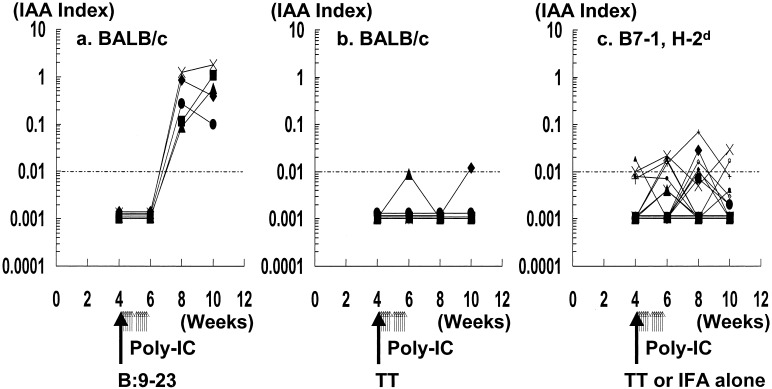
Figure 1
Figure 1
IAA expression following peptide in IFA with PolyIC treatment in BALB/c mice. Each of five mice were s.c. injected at 4 weeks of age (day 1) with 100 μg of B:9–23 (a) or TT (b) peptide in IFA. They were also injected i.p. with 7.5 μg/g body weight of PolyIC (days 1–5 and 8–13). (c) IAA plotted for B7–1 transgenic mice with H-2d injected with PolyIC and control TT peptide in IFA or IFA alone (n = 16). Longer arrows indicate the time of immunization of peptide in IFA. Shorter arrows indicate the time of administration of PolyIC. Levels of IAA were then determined every 2 weeks.
Figure 2
Figure 2
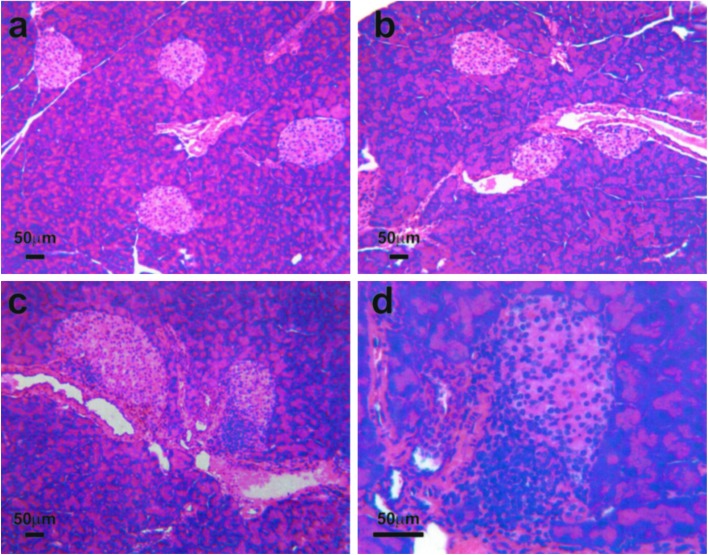
Histopathology of insulitis in BALB/c mice. Hematoxylin/eosin staining of pancreatic islets. (a) Insulin peptide B:9–23 immunization alone (low magnification): no insulitis. (b) Tetanus toxin immunization with PolyIC (low magnification): no insulitis. (c) B:9–23 immunization with PolyIC (low magnification): with induced insulitis. (d) B:9–23 immunization with PolyIC (high magnification) with induced insulitis. Five mice in each group were examined for histopathology of insulitis in BALB/c mice. All mice examined showed the same results for the presence of insulitis.
Figure 3
Figure 3
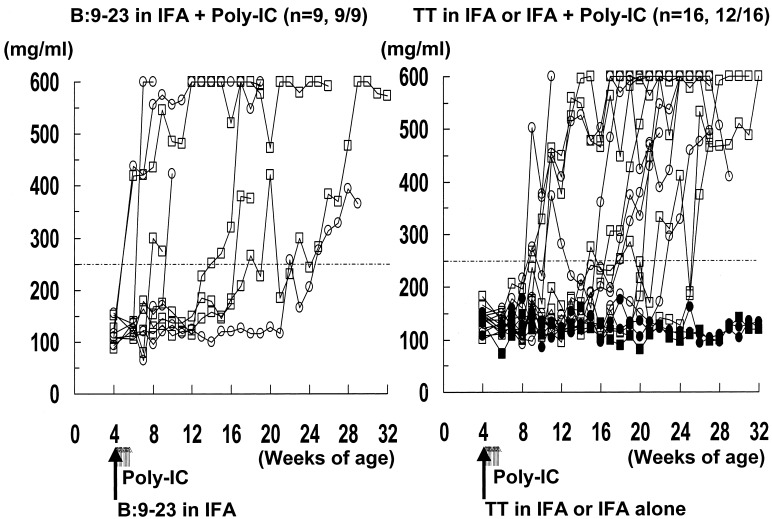
Blood glucose levels in B7–1 mice with H-2d (d/d or d/b). These mice were s.c. injected with 100 μg of peptide in IFA or just IFA at 4 weeks of age (day 1). They were also injected i.p. with 7.5 μg/g body weight of PolyIC (days 1–5 and 8–13). Longer arrows indicate the time of immunization of peptide in IFA. Shorter arrows indicate the time of administration of PolyIC. Blood glucose was measured weekly. The mice were considered diabetic after two consecutive blood glucose values above 250 mg/dl. Closed squares (H-2d/b) and circles (H-2d/d) indicate nondiabetic mice. Open squares (H-2d/b) and circles (H-2d/d) indicate diabetic mice. (Left) B:9–23 in IFA + PolyIC. (Right) Tetanus toxin (TT) in IFA or IFA alone + PolyIC.
Figure 5
Figure 5
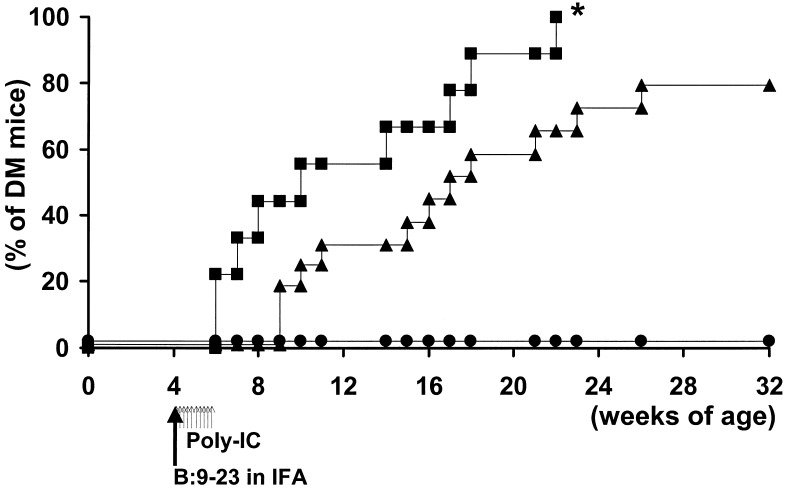
The induction of diabetes in PolyIC-treated H-2d, B7–1 mice immunized with insulin peptide B:9–23 in IFA, or IFA alone, or IFA with control tetanus toxin (TT) peptide. The solid line with closed squares represents B:9–23 in IFA. The solid line with closed triangles represents TT in IFA or IFA alone; the solid line with closed circles represents untreated mice. Longer arrows indicate the time of immunization of peptide in IFA. Shorter arrows indicate the time of administration of PolyIC. *, P < 0.05 by log-rank test when compared with TT or nonimmunized group.
Figure 4
Figure 4
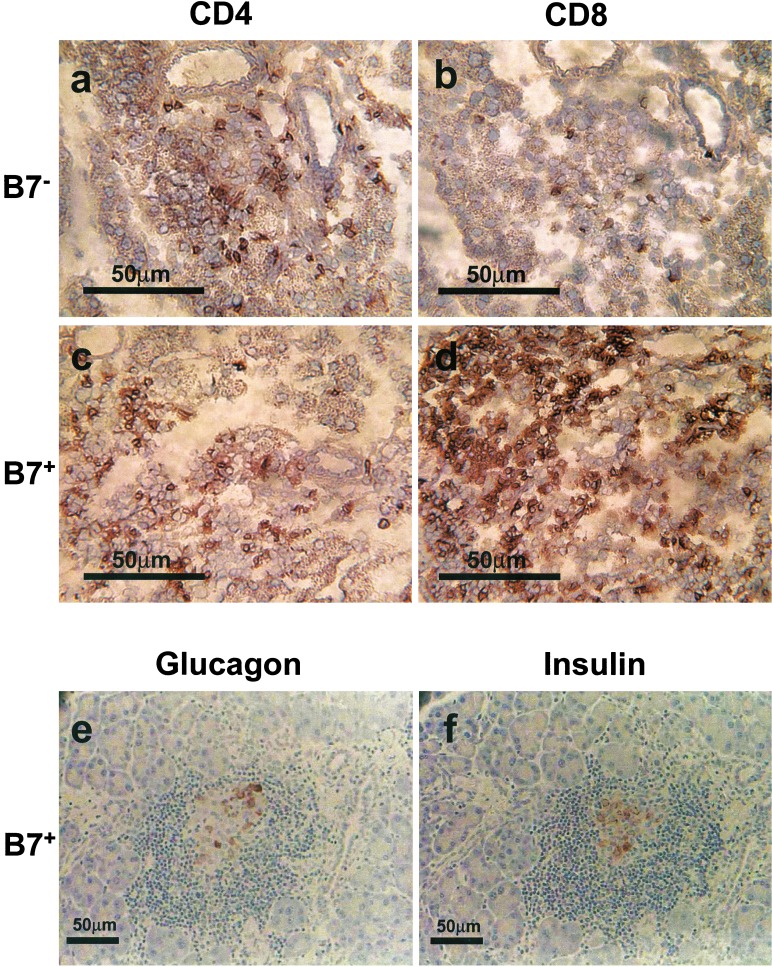
Immunohistochemistry of pancreatic sections of B7–1 BALB/c mouse (a and b) and B7–1+ diabetic mouse having H-2d (cf). Mice received immunization with B:9–23 peptide and PolyIC treatments and were killed for the examination of islets histology at 13 weeks of age. (a and c) CD4+ cells. (b and d) CD8+ cells. Islet-infiltrating cells in B7–1 mice were primarily CD4+ with fewer CD8 T cells. Islet infiltrating cells in B7–1+ mice contained a marked CD8 T cell infiltration with fewer CD4 T cells. e is stained for glucagon-producing cells and f for insulin. Relatively few remaining β cells were observed with approximately an equal number of α cells.

References

    1. Rose N R, Bona C. Immunol Today. 1993;14:426–430. - PubMed
    1. Mordes J P, Greiner D L, Rossini A A. In: Diabetes Mellitus: A Fundamental and Clinical Text. LeRoith D, Taylor S I, Olefsky J M, editors. Philadelphia: Lippincott; 1996. pp. 349–360.
    1. Salomon B, Lenschow D J, Rhee L, Ashourian N, Singh B, Sharpe A, Bluestone J A. Immunity. 2000;12:431–440. - PubMed
    1. Bach J F. In: Contemporary Endocrinology: Autoimmune Endocrinopathies. Volpe R, editor. Totowa, NJ: Humana; 1999. pp. 293–307.
    1. Atkinson M A, Eisenbarth G S. Lancet. 2001;358:221–229. - PubMed

Publication types