Use of ICD-9 coding for estimating the occurrence of cerebrovascular malformations
- PMID: 11950672
- PMCID: PMC7975112
Use of ICD-9 coding for estimating the occurrence of cerebrovascular malformations
Abstract
Background and purpose: Accurate epidemiologic data concerning cerebrovascular malformations are scarce. Our goals were to determine the distribution of lesions in the International Classification of Diseases, Ninth Revision, (ICD-9) code for cerebrovascular malformations and to evaluate the use of state discharge registries for estimating their detection rate.
Methods: We reviewed records of all patients discharged from our center between January 1, 1992, and June 30, 1999, whose diagnoses included the ICD-9 code for cerebrovascular anomaly (code 747.81) to determine the accuracy of the coding. Hospital admission rates for cerebrovascular anomaly were calculated by using the 1995-1999 state discharge databases of California and New York.
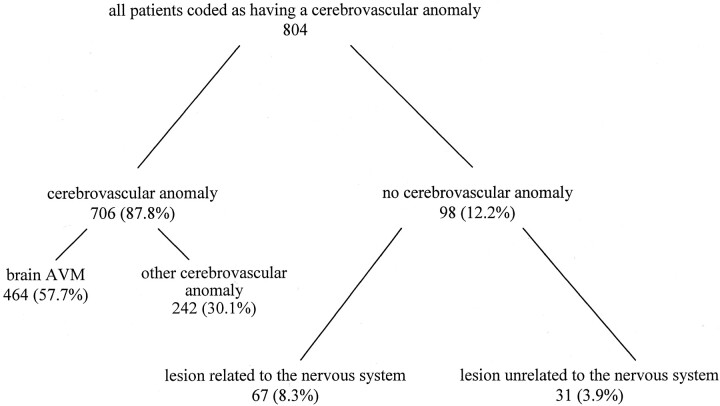
Results: Of 804 patients with this code, 706 (88%) had a lesion consistent with the diagnosis. Five lesions accounted for 99% of the diagnoses; the two most common were AVM (66%) and cavernous malformation (13%). The ratio of AVMs to all cerebrovascular anomalies was similar to that in a prior population-based study. The sensitivity of identifying a patient with cerebrovascular malformation by using ICD-9 coding was 94%; the false-positive rate was 1.7 cases per 100,000 person-years. For California and New York, rates of first hospital admission for cerebrovascular malformation were 1.5 and 1.8 cases per 100,000 person-years, respectively.
Conclusion: Rates of admission for cerebrovascular malformations calculated from state discharge databases are consistent with disease detection rates in the range of 1 case per 100,000 person-years. However, the false-positive rate for coding is in the same range as the disease detection rate. Thus, current state discharge registries cannot serve as sources of detailed epidemiologic data.
Figures
References
-
- McCormick WF. Pathology of vascular malformations of the brain. In: Wilson CB, Stein BM, ed. Intracranial Arteriovenous Malformations. Baltimore, Md: Williams & Wilkins;1984;44–63
-
- Brown RD Jr, Wiebers DO, Torner JC, O’Fallon WM. Incidence and prevalence of intracranial vascular malformations in Olmsted County, Minnesota, 1965 to 1992. Neurology 1996;46:949–952 - PubMed
-
- Jellinger K. Vascular malformations of the central nervous system: a morphological overview. Neurosurg Rev 1986;9:177–216 - PubMed
-
- Michelsen WJ. Natural history and pathophysiology of arteriovenous malformations. Clinical Neurosurgery. Vol 26 .1978;307–313 - PubMed
-
- Berman MF, Sciacca RR, Pile-Spellman J, et al. The epidemiology of brain arteriovenous malformations. Neurosurgery 2000;47:389–397 - PubMed
Publication types
MeSH terms
Grants and funding
LinkOut - more resources
Full Text Sources