The risk of subsequent primary cancers after colorectal cancer in southeast England
- PMID: 11950810
- PMCID: PMC1773208
- DOI: 10.1136/gut.50.5.647
The risk of subsequent primary cancers after colorectal cancer in southeast England
Abstract
Background: Multiple cancers may occur in an individual because of a genetic predisposition, environmental exposure, cancer therapy, or immunological deficiency. Colorectal cancer is one of the most commonly diagnosed cancers, and inherited factors play an important role in its aetiology.
Aims: To characterise the occurrence of multiple primary cancers in patients diagnosed with colorectal cancer and explore the possibility of a common aetiology for different cancer sites.
Patients: The Thames Cancer Registry database was used to identify patients with a first colorectal cancer, resident in the North or South Thames region, diagnosed between 1 January 1961 and 31 December 1995. A total of 127 281 patients were included, 61 433 men and 65 848 women.
Methods: Observed numbers of cancers occurring after the diagnosis of colorectal cancer were compared with expected numbers, calculated using appropriate age, sex, and period specific rates, to obtain standardised incidence ratios. The occurrence of colorectal cancers subsequent to cancers at other sites was also examined.
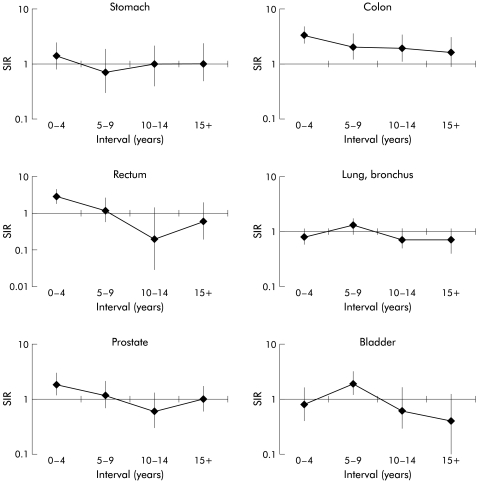
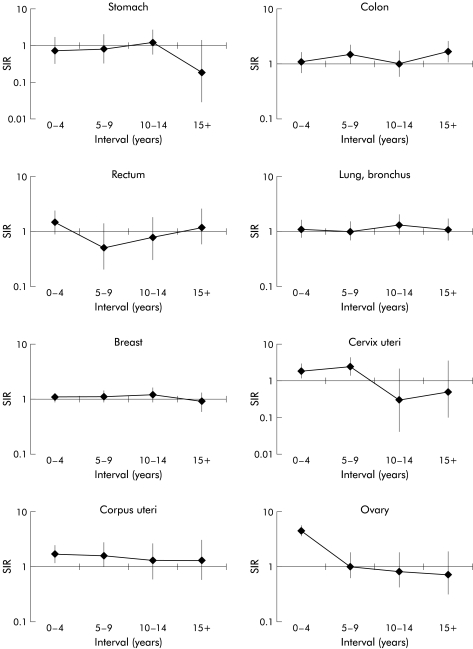
Results: Small intestinal cancer was significantly increased in men diagnosed with colorectal cancer before the age of 60 years and in women diagnosed with colorectal cancer after the age of 65 years. Colorectal cancer was also significantly increased after a first diagnosis of cancer of the small intestine. Other cancer sites with a significant increase after colorectal cancer included the cervix uteri, corpus uteri, and ovary.
Conclusions: Patients with colorectal cancer are at increased risk of developing cancer at a number of other sites. Some of these associations are consistent with the effects of known inherited cancer susceptibility genes.
Figures
References
-
- Lynch HT, Smyrk T. Hereditary nonpolyposis colorectal cancer (Lynch syndrome). An updated review. Cancer 1996;76:1149–67. - PubMed
-
- Mecklin P, Jarvinen HJ. Tumor spectrum in cancer family syndrome (hereditary nonpolyposis colorectal cancer). Cancer 1991;68:1109–12. - PubMed
-
- Vasen HFA, Wijnen JT, Menko FH, et al. Cancer risk in families with hereditary nonpolyposis colorectal cancer diagnosed by mutation analysis. Gastroenterology 1996;110:1020–7. - PubMed
-
- Aarnio M, Mecklin J-P, Aaltonen LA, et al. Life-time risk of different cancers in hereditary non-polyposis colorectal cancer (HNPCC) syndrome. Int J Cancer 1995;64:430–3. - PubMed
Publication types
MeSH terms
LinkOut - more resources
Full Text Sources
Medical