


A presenilin-1/gamma-secretase cleavage releases the E-cadherin intracellular domain and regulates disassembly of adherens junctions
- PMID: 11953314
- PMCID: PMC125968
- DOI: 10.1093/emboj/21.8.1948
A presenilin-1/gamma-secretase cleavage releases the E-cadherin intracellular domain and regulates disassembly of adherens junctions
Abstract
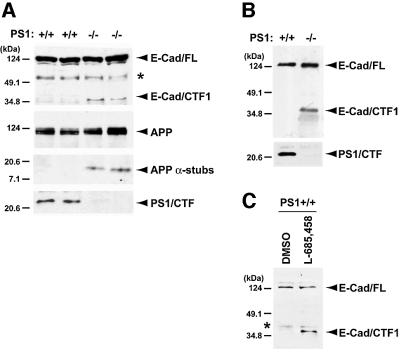
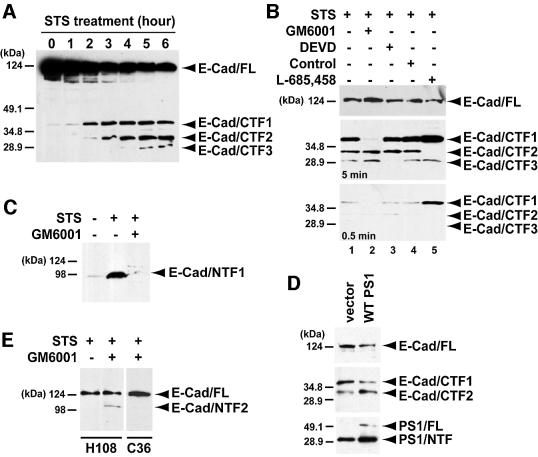
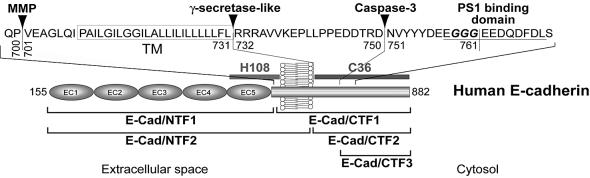
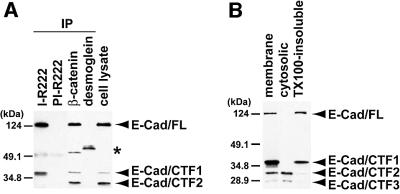
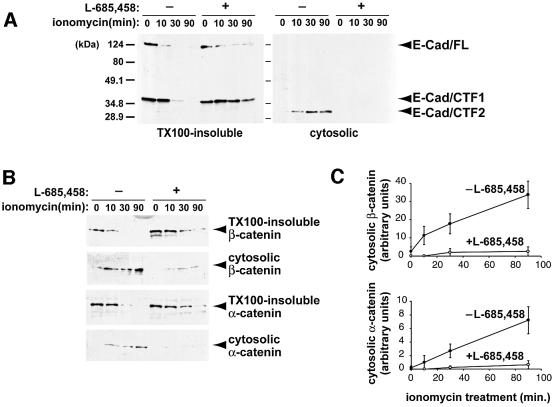
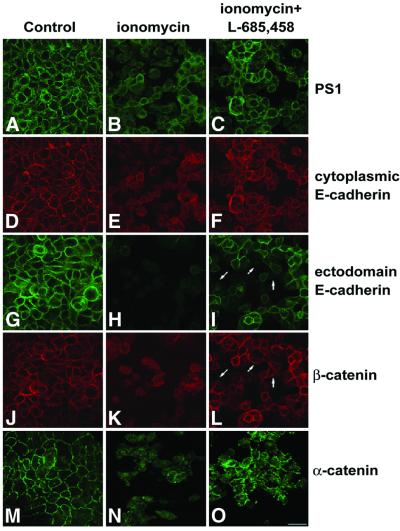
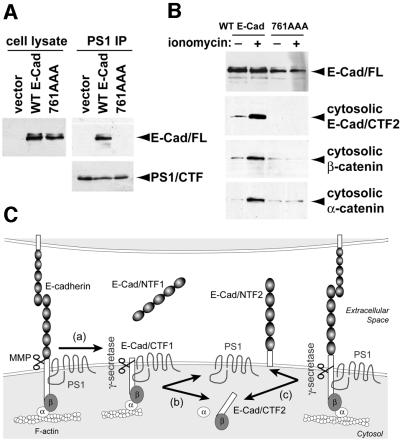
E-cadherin controls a wide array of cellular behaviors including cell-cell adhesion, differentiation and tissue development. Here we show that presenilin-1 (PS1), a protein involved in Alzheimer's disease, controls a gamma-secretase-like cleavage of E-cadherin. This cleavage is stimulated by apoptosis or calcium influx and occurs between human E-cadherin residues Leu731 and Arg732 at the membrane-cytoplasm interface. The PS1/gamma-secretase system cleaves both the full-length E-cadherin and a transmembrane C-terminal fragment, derived from a metalloproteinase cleavage after the E-cadherin ectodomain residue Pro700. The PS1/gamma-secretase cleavage dissociates E-cadherins, beta-catenin and alpha-catenin from the cytoskeleton, thus promoting disassembly of the E-cadherin-catenin adhesion complex. Furthermore, this cleavage releases the cytoplasmic E-cadherin to the cytosol and increases the levels of soluble beta- and alpha-catenins. Thus, the PS1/gamma-secretase system stimulates disassembly of the E-cadherin- catenin complex and increases the cytosolic pool of beta-catenin, a key regulator of the Wnt signaling pathway.
Figures
References
-
- Carmeliet P. et al. (1999) Targeted deficiency or cytosolic truncation of the VE-cadherin gene in mice impairs VEGF-mediated endothelial survival and angiogenesis. Cell, 98, 147–157. - PubMed
-
- Christofori G. and Semb,H. (1999) The role of the cell-adhesion molecule E-cadherin as a tumour-suppressor gene. Trends Biochem. Sci., 24, 73–76. - PubMed
Publication types
MeSH terms
Substances
Grants and funding
LinkOut - more resources
Full Text Sources
Other Literature Sources
Molecular Biology Databases
