. 2002 May;70(5):2311-8.
doi: 10.1128/IAI.70.5.2311-2318.2002.

Global analysis of outer membrane proteins from Leptospira interrogans serovar Lai

Affiliations

Global analysis of outer membrane proteins from Leptospira interrogans serovar Lai

Paul A Cullen et al. Infect Immun. 2002 May.

Abstract

Recombinant leptospiral outer membrane proteins (OMPs) can elicit immunity to leptospirosis in a hamster infection model. Previously characterized OMPs appear highly conserved, and thus their potential to stimulate heterologous immunity is of critical importance. In this study we undertook a global analysis of leptospiral OMPs, which were obtained by Triton X-114 extraction and phase partitioning. Outer membrane fractions were isolated from Leptospira interrogans serovar Lai grown at 20, 30, and 37 degrees C with or without 10% fetal calf serum and, finally, in iron-depleted medium. The OMPs were separated by two-dimensional gel electrophoresis. Gel patterns from each of the five conditions were compared via image analysis, and 37 gel-purified proteins were tryptically digested and characterized by mass spectrometry (MS). Matrix-assisted laser desorption ionization-time-of-flight MS was used to rapidly identify leptospiral OMPs present in sequence databases. Proteins identified by this approach included the outer membrane lipoproteins LipL32, LipL36, LipL41, and LipL48. No known proteins from any cellular location other than the outer membrane were identified. Tandem electrospray MS was used to obtain peptide sequence information from eight novel proteins designated pL18, pL21, pL22, pL24, pL45, pL47/49, pL50, and pL55. The expression of LipL36 and pL50 was not apparent at temperatures above 30 degrees C or under iron-depleted conditions. The expression of pL24 was also downregulated after iron depletion. The leptospiral major OMP LipL32 was observed to undergo substantial cleavage under all conditions except iron depletion. Additionally, significant downregulation of these mass forms was observed under iron limitation at 30 degrees C, but not at 30 degrees C alone, suggesting that LipL32 processing is dependent on iron-regulated extracellular proteases. However, separate cleavage products responded differently to changes in growth temperature and medium constituents, indicating that more than one process may be involved in LipL32 processing. Furthermore, under iron-depleted conditions there was no concomitant increase in the levels of the intact form of LipL32. The temperature- and iron-regulated expression of LipL36 and the iron-dependent cleavage of LipL32 were confirmed by immunoblotting with specific antisera. Global analysis of the cellular location and expression of leptospiral proteins will be useful in the annotation of genomic sequence data and in providing insight into the biology of Leptospira.


Figures
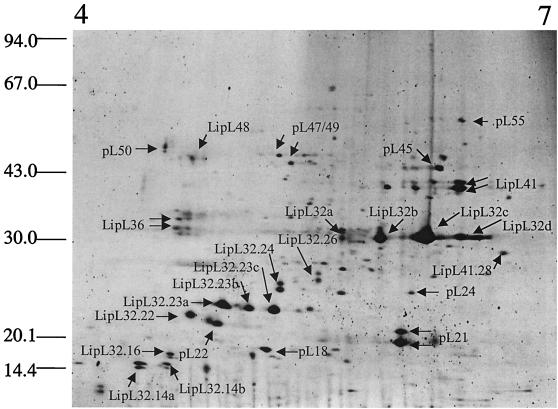
FIG. 1.
FIG. 1.
Separation of L. interrogans serovar Lai OMPs by 2-DGE utilizing a 4 to 7 IPG. Previously characterized proteins were identified by peptide mass matching and are indicated with the correct nomenclature on the gel image. Novel proteins for which peptide sequence was obtained were assigned a temporary name with the prefix pL (leptospiral protein) and a suffix indicating their approximate relative molecular masses. Cleavage products of the previously characterized proteins LipL32 and LipL41 are noted with the correct nomenclature followed by a period and the relative molecular mass of the cleavage product. When there is more than one isoform of a protein of the same molecular mass they are each arbitrarily assigned a letter. When one arrow alludes to more than one protein spot, the proteins where found to be indistinguishable, and they were considered to be an artifact of the 2-DGE. The positions of standard molecular mass markers in kilodaltons are indicated on the left.
FIG. 2.
FIG. 2.
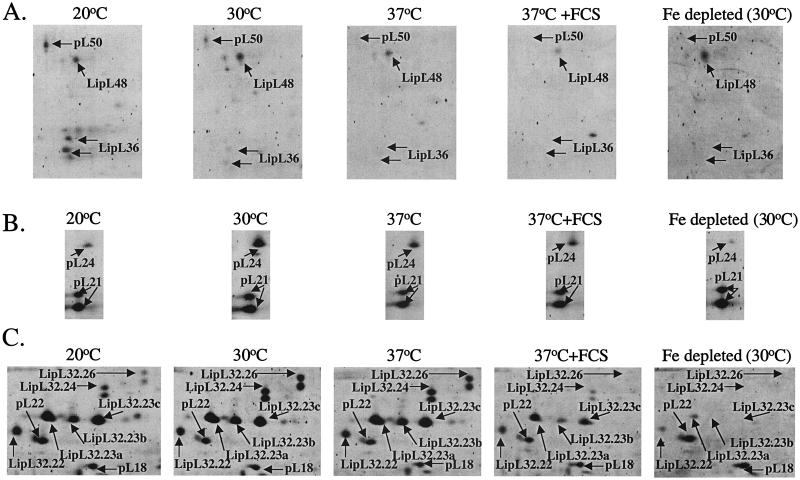
Comparisons of gel regions where differences in leptospiral OMP expression were observed. (A) Iron- and temperature-dependent expression of LipL36 and pL50. (B) Iron- and temperature-dependent expression of pL24. (C) Reduced expression and/or absence of LipL32 cleavage products under iron-depleted conditions and the reduced expression of some of the LipL32 cleavage products in the presence of fetal calf serum. For comparison, the locations of other proteins for which expression remained unchanged are indicated on the gel regions. FCS, cultures grown in the presence of 10% fetal calf serum; Fe depleted, cultures grown in iron-depleted medium.
FIG. 3.
FIG. 3.
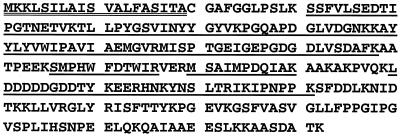
LipL32 protein sequence and the corresponding peptide mass matches obtained by MADLI-TOF MS on analysis of a tryptic digest of the lower-molecular-mass forms of LipL32, termed LipL32.23a,b,c (peptide mass matches are underlined). The double-underlined signal peptide does not form part of the mature protein and thus provides no peptide mass match. After cleavage of the signal peptide, the N-terminal tryptic peptide of the mature protein is lipidated and was unable to be detected by MALDI-TOF MS. Peaks corresponding to the smaller peptides were not detected in the MALDI-TOF MS spectrum since they were not within the mass gate analyzed. The absence of any mass matches to C-terminal peptides indicates that LipL32.23a,b,c is truncated at the C terminus.
FIG. 4.
FIG. 4.
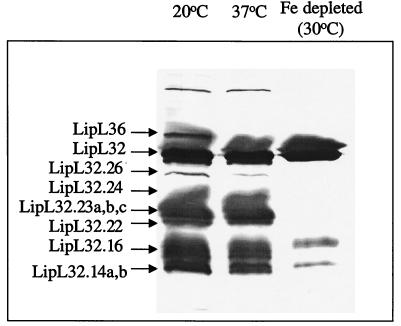
Dual immunoblot of leptospiral outer membrane preparations separated by SDS-PAGE probed with anti-LipL32 and anti-LipL36 polyclonal antisera. Expression of LipL36 was observed at 20°C but not at 37°C or under iron-limiting conditions. The presence of LipL32.26, LipL32.24, and LipL32.22 and the C-terminally truncated LipL32.23a,b,c was detected at 20 and 37°C but not under iron-limiting conditions. The cleavage products of LipL36 are indicated by arrows on the left. Fe depleted, cultures grown in iron-depleted media.

References

    1. Adler, B., and S. Faine. 1977. Host immunological mechanisms in the resistance of mice to leptospiral infections. Infect. Immun. 17:67-72. - PMC - PubMed
    1. Altschul, S. F., G. Warren, W. Miller, E. Myers, and D. J. Lipman. 1990. Basic local alignment search tool. J. Mol. Biol. 215:403-410. - PubMed
    1. Barnett, J. K., D. Barnett, C. A. Bolin, T. A. Summers, E. A. Wagar, N. F. Cheville, R. A. Hartskeerl, and D. A. Haake. 1999. Expression and distribution of leptospiral outer membrane components during renal infection of hamsters. Infect. Immun. 67:853-861. - PMC - PubMed
    1. Branger, C., C. Sonrier, B. Chatrenet, B. Klonjkowski, N. Ruvoen-Clouet, A. Aubert, G. Andre-Fontaine, and M. Eloit. 2001. Identification of the hemolysis-associated protein 1 as a cross-protective immunogen of Leptospira interrogans by adenovirus-mediated vaccination. Infect. Immun. 69:6831-6838. - PMC - PubMed
    1. Bulach, D. M., T. Kalambaheti, A. de la Pena-Moctezuma, and B. Adler. 2000. Functional analysis of genes in the rfb locus of Leptospira borgpetersenii serovar Hardjo subtype Hardjobovis. Infect. Immun. 68:3793-3798. - PMC - PubMed

Publication types

MeSH terms

Substances

LinkOut - more resources