


Prognostic significance of a complete pathological response after induction chemotherapy in operable breast cancer
- PMID: 11953845
- PMCID: PMC2364175
- DOI: 10.1038/sj.bjc.6600210
Prognostic significance of a complete pathological response after induction chemotherapy in operable breast cancer
Abstract
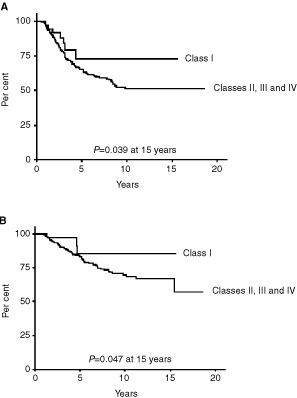
Only a few papers have been published concerning the incidence and outcome of patients with a pathological complete response after cytotoxic treatment in breast cancer. The purpose of this retrospective study was to assess the outcome of patients found to have a pathological complete response in both the breast and axillary lymph nodes after neoadjuvant chemotherapy for operable breast cancer. Our goal was also to determine whether the residual pathological size of the tumour in breast could be correlated with pathological node status. Between 1982 and 2000, 451 consecutive patients were registered into five prospective phase II trials. After six cycles, 396 patients underwent surgery with axillary dissection for 277 patients (69.9%). Pathological response was evaluated according to the Chevallier's classification. At a median follow-up of 8 years, survival was analysed as a function of pathological response. A pathological complete response rate was obtained in 60 patients (15.2%) after induction chemotherapy. Breast tumour persistence was significantly related to positive axillary nodes (P=5.10(-6)). At 15 years, overall survival and disease-free survival rates were significantly higher in the group who had a pathological complete response than in the group who had less than a pathological complete response (P=0.047 and P=0.024, respectively). In the absence of pathological complete response and furthermore when there is a notable remaining pathological disease, axillary dissection is still important to determine a major prognostic factor and subsequently, a second non cross resistant adjuvant regimen or high dose chemotherapy could lead to a survival benefit.
Figures
References
-
- BelembaogoEFeillelVCholletPCuréHVerrellePKwiatkowskiFAchardJ-lLe BouëdecGChassagneJBignonY-Jde LatourMLafayeCDauplatJ1992Neoadjuvant chemotherapy in 126 operable breast cancers Eur J Cancer 28A4/5896900 - PubMed
-
- BonadonnaGValagussaPBrambillaCFerrariLMoliterniATerenzianiMZambettiM1998Primary chemotherapy in operable breast cancer: Eight-year experience at the Milan Cancer Institute J Clin Oncol 16193100 - PubMed
-
- ChevallierBRocheHOlivierJPCholletPHurteloupP1993Inflammatory breast cancer. Pilot study of intensive induction chemotherapy (FEC-HD) results in a high histologic response rate Am J Clin Oncol 16223228 - PubMed
-
- CholletPAmatSPenault-LlorcaFFetissolFBodyGMouret-ReynierBonsJMCuréHDauplatJBougnouxP2000High pathological response rate induced by primary docetaxel monotherapy in operable breast cancer Breast Cancer Res Treat 6467[abstract No. 251]
Publication types
MeSH terms
LinkOut - more resources
Full Text Sources
Medical
