. 2002 Apr 30;99(9):6382-5.
doi: 10.1073/pnas.092654299. Epub 2002 Apr 16.

Decreased expression of the transcription factor NURR1 in dopamine neurons of cocaine abusers

Affiliations

Decreased expression of the transcription factor NURR1 in dopamine neurons of cocaine abusers

Michael J Bannon et al. Proc Natl Acad Sci U S A. .

Abstract

Chronic exposure to cocaine induces long-term adaptations that are likely to involve changes in transcription factor expression. This possibility has not been examined in the cocaine-exposed human brain. The transcription factor nurr1 is highly expressed in rodent midbrain dopamine neurons and is essential for their proper phenotypic development. Here we show that human NURR1 gene expression is robust within control subjects and reduced markedly within the dopamine neurons of human cocaine abusers. NURR1 is known to regulate transcription of the gene encoding the cocaine-sensitive dopamine transporter (DAT). We show here that DAT gene expression also is reduced markedly in the dopamine neurons of NURR1-deficient cocaine abusers, suggesting that NURR1 plays a critical role in vivo in controlling human DAT gene expression and adaptation to repeated exposure to cocaine.


Figures
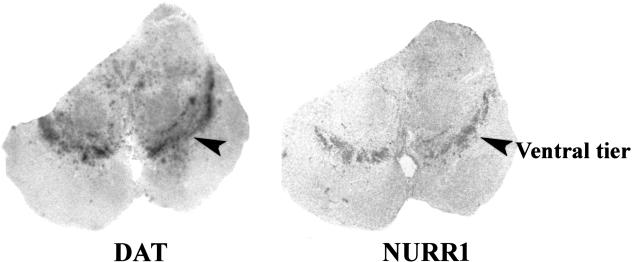
Figure 1
Figure 1
Distribution of DAT and NURR1 gene expression in human midbrain. Autoradiographic experiments revealed a parallel distribution of DAT mRNA and NURR1 mRNA in adjacent coronal sections of adult human midbrain. The region of highest signal intensity, the ventral tier of the substantia nigra (indicated by the arrowheads), was subjected to further analyses.
Figure 2
Figure 2
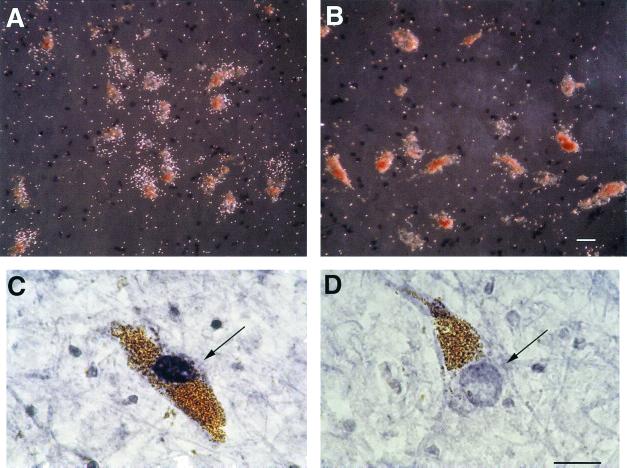
Decreased NURR1 mRNA and protein abundances within the dopamine neurons of cocaine abusers. (A and B) NURR1 mRNA, visualized as grains overlying neuromelanin-containing dopamine neurons, in a representative drug-free subject (A) and cocaine abuser (B). (C and D) NURR1 immunoreactivity (indicated by the arrows) within the nucleus of a dopamine neuron from a drug-free control subject (C) and a cocaine abuser (D). (Scale bars, 25 μm.)
Figure 3
Figure 3
Decreased DAT mRNA but unchanged VMAT2 mRNA levels within dopamine neurons of cocaine abusers. (A and B) DAT mRNA in a control subject (A) and cocaine abuser (B). (C and D) VMAT2 mRNA in a control subject (C) and cocaine abuser (D). (Scale bar, 25 μm.)
Figure 4
Figure 4
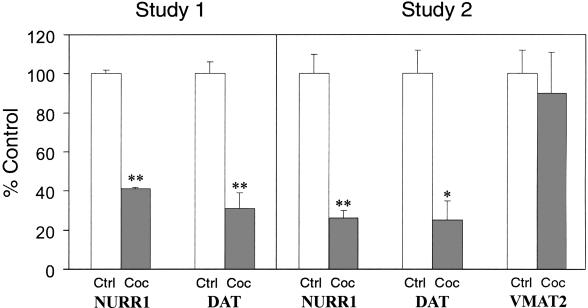
Summary of changes in gene expression within the dopamine neurons of cocaine abusers. Bars represent the means ± SE (n = 5–7 for study 1; n = 6–9 for study 2). *, P < 0.001; **, P < 0.0001. Ctrl, control subjects; Coc, cocaine abusers.

References

    1. Hyman S E. Nat Neurosci. 1999;2:855–856. - PubMed
    1. Mages H W, Rilke O, Bravo R, Senger G, Kroczek R A. Mol Endocrinol. 1994;8:1583–1591. - PubMed
    1. Mangelsdorf D J, Thummel C, Beato M, Herrlich P, Schutz G, Umesono K, Blumberg B, Kastner P, Mark M, Chambon P. Cell. 1995;83:835–839. - PMC - PubMed
    1. Zetterstrom R H, Solomin L, Jansson L, Hoffer B J, Olson L, Perlmann T. Science. 1997;276:248–250. - PubMed
    1. Saucedo-Cardenas O, Quintana-Hau J D, Le W D, Smidt M P, Cox J J, De Mayo F, Burbach J P, Conneely O M. Proc Natl Acad Sci USA. 1998;95:4013–4018. - PMC - PubMed

Publication types

MeSH terms

LinkOut - more resources