. 2002 Apr 16;99(8):5664-8.
doi: 10.1073/pnas.082102599.

Fighting fruit flies: a model system for the study of aggression

Affiliations

Fighting fruit flies: a model system for the study of aggression

Selby Chen et al. Proc Natl Acad Sci U S A. .

Abstract

Despite the importance of aggression in the behavioral repertoire of most animals, relatively little is known of its proximate causation and control. To take advantage of modern methods of genetic analysis for studying this complex behavior, we have developed a quantitative framework for studying aggression in common laboratory strains of the fruit fly, Drosophila melanogaster. In the present study we analyze 73 experiments in which socially naive male fruit flies interacted in more than 2,000 individual agonistic interactions. This allows us to (i) generate an ethogram of the behaviors that occur during agonistic interactions; (ii) calculate descriptive statistics for these behaviors; and (iii) identify their temporal patterns by using sequence analysis. Thirty-minute paired trials between flies contained an average of 27 individual agonistic interactions, lasting a mean of 11 seconds and featuring a variety of intensity levels. Only few fights progressed to the highest intensity levels (boxing and tussling). A sequential analysis demonstrated the existence of recurrent patterns in behaviors with some similarity to those seen during courtship. Based on the patterns characterized in the present report, a detailed examination of aggressive behavior by using mutant strains and other techniques of genetic analysis becomes possible.


Figures
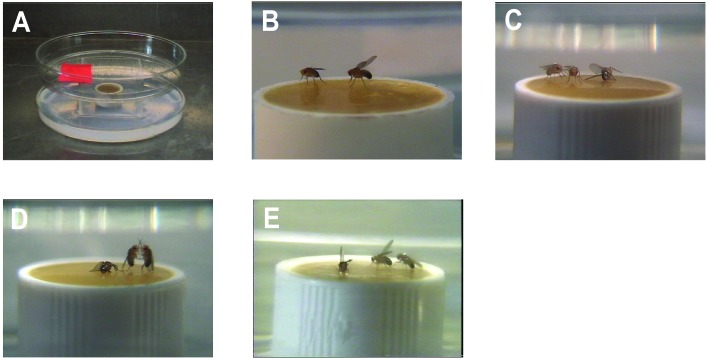
Figure 1
Figure 1
Experimental chamber and components of fruit fly fighting. (A) The chamber used in all fights. The black filter paper with a cutout limiting light to the food dish surface is not illustrated here. (B) “Wing threat” seen during the progression of fights. No decapitated female is seen in this frame. (C) High-level “fencing” in which animals push against the opponent with the forelegs. (D) “Boxing,” a high-intensity component that is rarely seen in fights. Animals stand on their hind legs and strike at each other with their forelegs. (E) “Defensive wing threat” during “chase” by the winner of an encounter. This is one of the patterns seen during “retreat” of the fly losing an encounter.
Figure 2
Figure 2
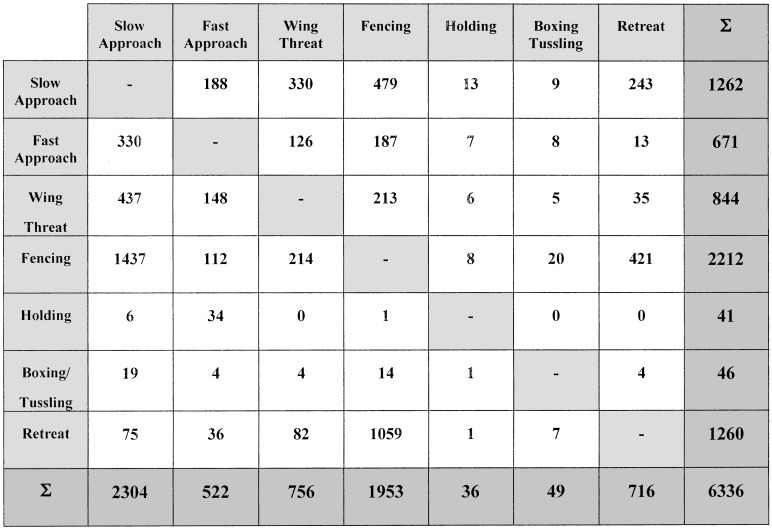
Transition matrix. This matrix summarizes how often each agonistic behavior (y axis) was followed by any other behavior (x axis). By comparing these frequencies with a null distribution from a model of independence, we identified those transitions that occurred more or less frequently than predicted by chance (see Fig. 3).
Figure 3
Figure 3
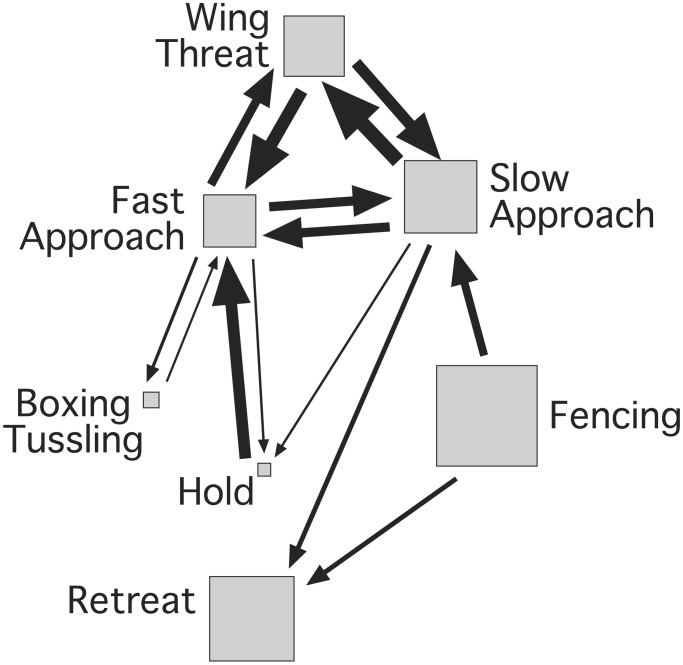
Analysis of fighting behavior in D. melanogaster. The figure represents a first-order Markov chain analysis of a combined transition matrix constructed from 9,031 behavior patterns during 2,074 encounters in 73 fights between pairs of flies. The size of bounding boxes around the behaviors is proportional to the relative frequency of occurrence of a particular behavioral pattern. Sequences (or chains) of behaviors are depicted as arrows when transitions occur significantly more often than predicted by chance. The size of the arrows indicates the degree to which particular transitions are over-represented.

References

    1. Ayre D J, Grosberg R K. Am Nat. 1995;146:427–453.
    1. Loeber R, Hay D. Ann Rev Psychol. 1997;48:371–410. - PubMed
    1. Sturtevant H. J Anim Behav. 1915;5:351–366.
    1. Spieth H T. Evol Biol. 1968;2:157–193.
    1. Spieth H T. Annu Rev Entomol. 1974;19:385–405. - PubMed

Publication types

LinkOut - more resources