. 2002 Apr 30;99(9):5988-92.
doi: 10.1073/pnas.092133899. Epub 2002 Apr 23.

Mechanisms of noise-resistance in genetic oscillators

Affiliations

Mechanisms of noise-resistance in genetic oscillators

José M G Vilar et al. Proc Natl Acad Sci U S A. .

Abstract

A wide range of organisms use circadian clocks to keep internal sense of daily time and regulate their behavior accordingly. Most of these clocks use intracellular genetic networks based on positive and negative regulatory elements. The integration of these "circuits" at the cellular level imposes strong constraints on their functioning and design. Here, we study a recently proposed model [Barkai, N. & Leibler, S. (2000) Nature (London), 403, 267-268] that incorporates just the essential elements found experimentally. We show that this type of oscillator is driven mainly by two elements: the concentration of a repressor protein and the dynamics of an activator protein forming an inactive complex with the repressor. Thus, the clock does not need to rely on mRNA dynamics to oscillate, which makes it especially resistant to fluctuations. Oscillations can be present even when the time average of the number of mRNA molecules goes below one. Under some conditions, this oscillator is not only resistant to but, paradoxically, also enhanced by the intrinsic biochemical noise.


Figures
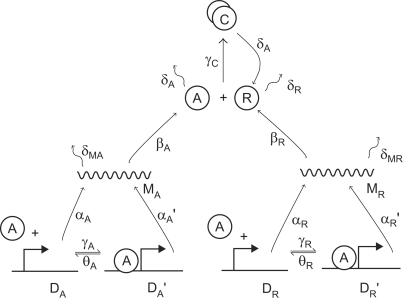
Figure 1
Figure 1
Biochemical network of the circadian oscillator model. DA' and DA denote the number of activator genes with and without A bound to its promoter respectively; similarly, DR' and DR refer to the repressor promoter; MA and MR denote mRNA of A and R; A and R correspond to the activator and repressor proteins; and C corresponds to the inactivated complex formed by A and R. The constants α and α' denote the basal and activated rates of transcription, β the rates of translation, δ the rates of spontaneous degradation, γ the rates of binding of A to other components, and θ denotes the rates of unbinding of A from those components. Except if otherwise stated, in this paper we have assumed the following values for the reaction rates: αA = 50 h−1, αA' = 500 h−1, αR = 0.01 h−1, αR' = 50 h−1, βA = 50 h−1, βR = 5 h−1, δMA = 10 h−1, δMR = 0.5 h−1, δA = 1 h−1, δR = 0.2 h−1, γA = 1 mol−1 hr−1, γR = 1 mol−1 hr−1, γC = 2 mol−1 hr−1, θA = 50 h−1, θR = 100 h−1, where mol means number of molecules. The initial conditions are DA = DR = 1 mol, DA' = DR' = MA = MR = A = R = C = 0, which require that the cell has a single copy of the activator and repressor genes: DA + DA' = 1 mol and DR + DR' = 1 mol. The cellular volume is assumed to be the unity so that concentrations and number of molecules are equivalent. Notice that we assume that the complex breaks into R because of the degradation of A and, therefore, the parameter δA appears twice in the model.
Figure 2
Figure 2
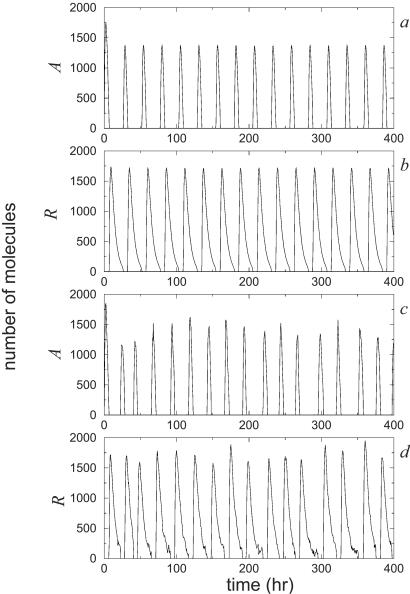
Oscillations in repressor and activator protein numbers obtained from numerical simulations of the deterministic (a and b) and stochastic (c and d) descriptions of the model.
Figure 3
Figure 3
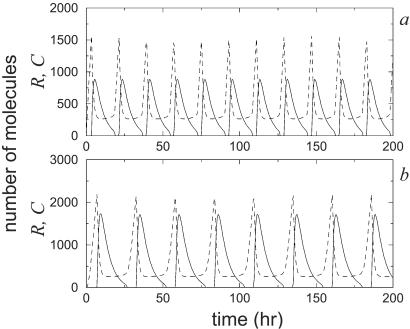
Time evolution of the quantities R (solid line) and C (dashed line) for the system reduced to two variables (a) by various quasi−steady-state assumptions and for the complete system (b).
Figure 4
Figure 4
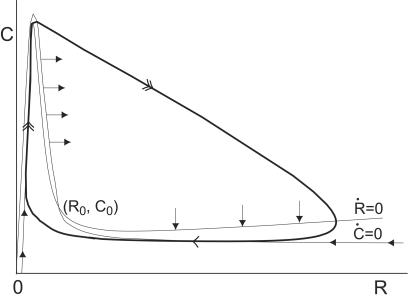
Phase portrait of the two variable oscillator Eq. [2] for the parameter values given in the caption for Fig. 1 (the drawing is not to scale). The thick line illustrates the trajectory of system. (R0,C0) is the fixed point of the system, and formula image dR/dt = 0 and Ċ formula image dC/dt = 0 are the R and C nullclines, respectively. The solid arrows give the orientation of the direction field on the nullclines.
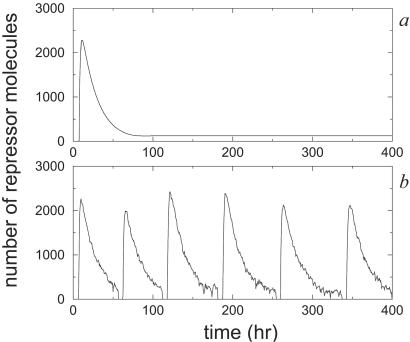
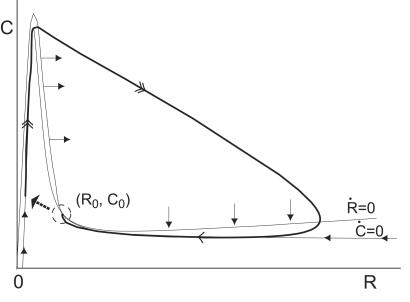
Figure 5
Figure 5
Time evolution of R for the deterministic Eq. [1] (a) and stochastic (b) versions of the model. The values of the parameters are as in the caption of Fig. 1, except that now we set δR = 0.05 h−1. For these parameter values, τ < 0, so that the fixed point is stable.
Figure 6
Figure 6
Phase portrait as in Fig. 4 but for a situation in which the system falls into the stable fixed point (R0,C0). The dotted arrow to the left of the fixed point illustrates a perturbation that would initiate a single sweep of the (former) oscillatory trajectory.
Figure 7
Figure 7
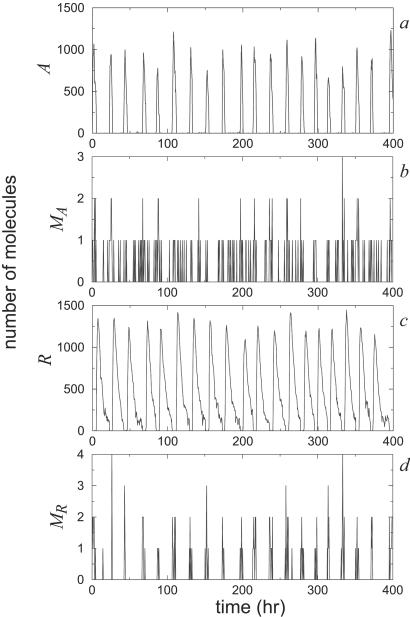
Stochastic time evolution of the number of activator (a) and repressor (c) molecules, and the number of activator (b) and repressor (d) mRNA molecules. The values of the parameters are as in the caption for Fig. 1 but now with βA = 5000 h−1, βR = 500 h−1, δMA = 1000 h−1, and δMR = 50 h−1.

References

    1. Edmunds L N. Cellular and Molecular Bases of Biological Clocks. New York: Springer; 1988.
    1. Dunlap J C. Cell. 1999;96:271–290. - PubMed
    1. Barkai N, Leibler S. Nature (London) 2000;403:267–268. - PubMed
    1. McAdams H H, Arkin A. Trends Genet. 1999;15:65–69. - PubMed
    1. van Kampen N G. Stochastic Processes in Physics and Chemistry. Amsterdam: North−Holland; 1981.

Publication types