. 2002 May;68(5):2214-28.
doi: 10.1128/AEM.68.5.2214-2228.2002.

Partitioning of bacterial communities between seawater and healthy, black band diseased, and dead coral surfaces

Affiliations

Partitioning of bacterial communities between seawater and healthy, black band diseased, and dead coral surfaces

Jorge Frias-Lopez et al. Appl Environ Microbiol. 2002 May.

Abstract

Distinct partitioning has been observed in the composition and diversity of bacterial communities inhabiting the surface and overlying seawater of three coral species infected with black band disease (BBD) on the southern Caribbean island of Curaçao, Netherlands Antilles. PCR amplification and sequencing of bacterial 16S rRNA genes (rDNA) with universally conserved primers have identified over 524 unique bacterial sequences affiliated with 12 bacterial divisions. The molecular sequences exhibited less than 5% similarity in bacterial community composition between seawater and the healthy, black band diseased, and dead coral surfaces. The BBD bacterial mat rapidly migrates across and kills the coral tissue. Clone libraries constructed from the BBD mat were comprised of eight bacterial divisions and 13% unknowns. Several sequences representing bacteria previously found in other marine and terrestrial organisms (including humans) were isolated from the infected coral surfaces, including Clostridium spp., Arcobacter spp., Campylobacter spp., Cytophaga fermentans, Cytophaga columnaris, and Trichodesmium tenue.


Figures
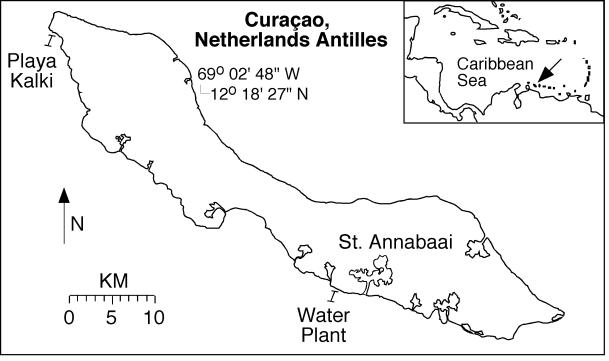
FIG. 1.
FIG. 1.
Map of Curaçao, Netherlands Antilles, in the southern Caribbean Sea. The regional location of the island is shown with an arrow on the inset map. Study sites were on the leeward reef tract at Water Plant and Playa Kalki. Also shown is the location of the St. Annabaai seaport.
FIG. 2.
FIG. 2.
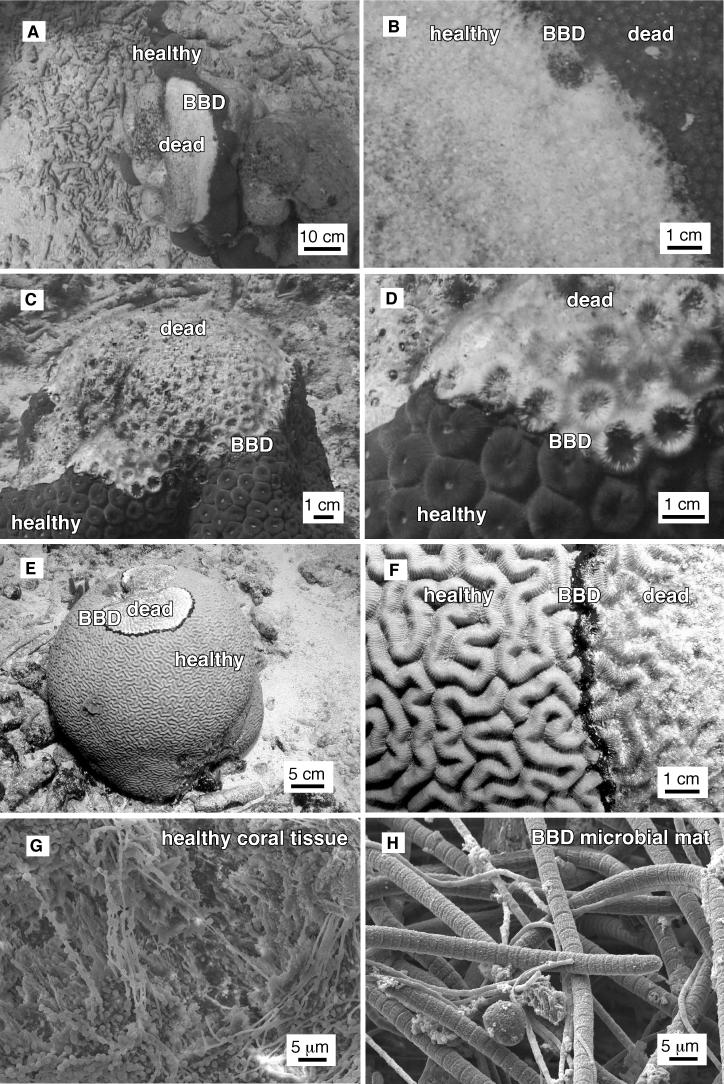
Underwater photographs of BBD infection in colonies of M. annularis (panels A and B), M. cavernosa (panels C and D), and D. strigosa (panels E and F). (G) SEM image of healthy tissue from the infected colony of D. strigosa shown in panels E and F. (H) SEM image of the BBD mat from the infected colony of D. strigosa shown in panels E and F.
FIG. 3.
FIG. 3.
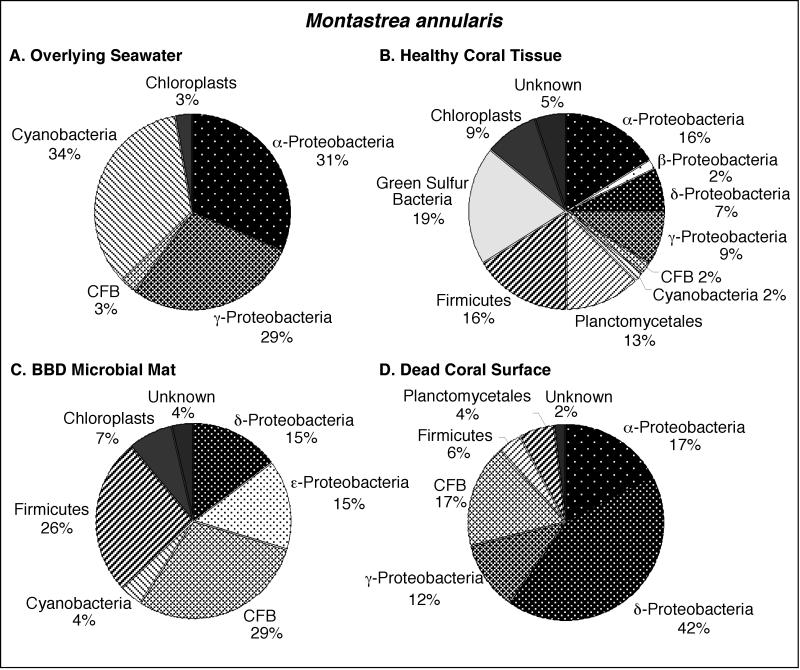
Pie diagrams illustrating the division-level diversity of the partial 16S rRNA bacterial sequences comprising the clone libraries associated with M. annularis. The colony was growing in the back reef environment at Playa Kalki at a 5-m water depth. The seawater at the time and location of sampling in August 2000 was at a temperature of 27.5°C.
FIG. 4.
FIG. 4.
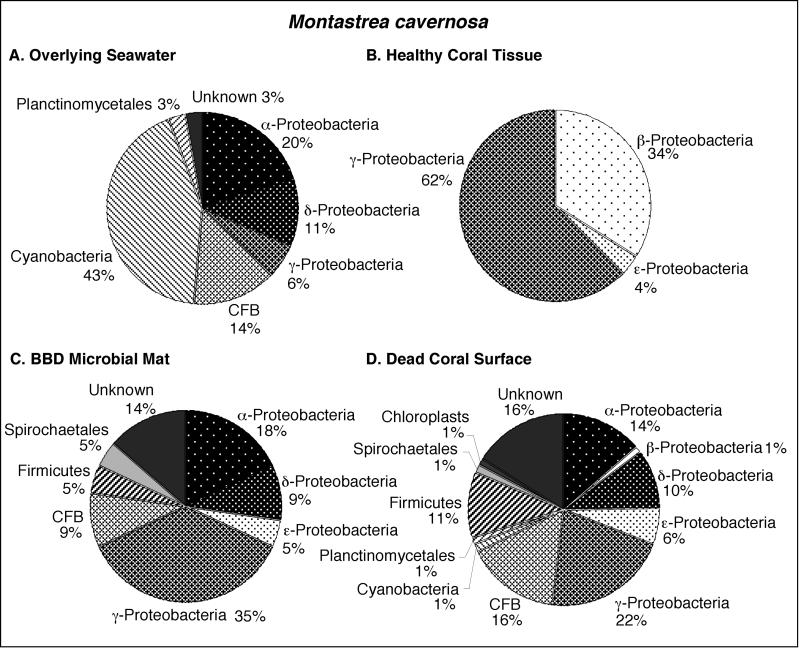
Pie diagrams illustrating the division-level diversity of the partial 16S rRNA bacterial sequences comprising the clone libraries associated with M. cavernosa. The colony was growing in the back reef environment at Playa Kalki at a 5-m water depth. The seawater at the time and location of sampling in August 2000 was at a temperature of 27.5°C.
FIG. 5.
FIG. 5.
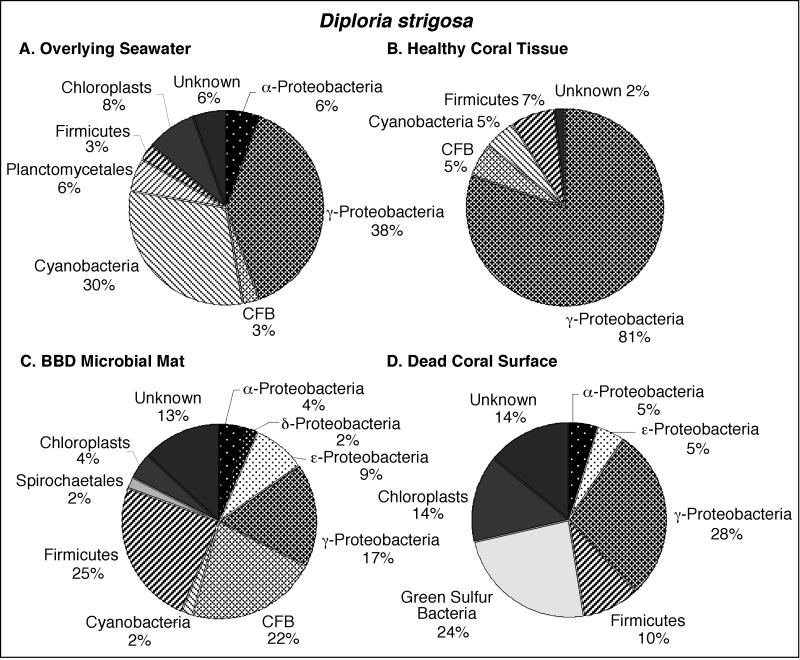
Pie diagrams illustrating the division-level diversity of the partial 16S rRNA bacterial sequences comprising the clone libraries associated with D. strigosa. The colony was growing in the back reef environment at Water Plant at a 4-m water depth. The seawater at the time and location of sampling in August 2000 was at a temperature of 27.5°C.

References

    1. Acinas, S. G., F. Rodriguez-Valera, and C. Pedros-Alio. 1997. Spatial and temporal variation in marine bacterioplankton diversity as shown by RFLP fingerprinting of PCR amplified 16S rRNA. FEMS Microb. Ecol. 24:27-40.
    1. Acinas, S. G., J. Anton, and F. Rodriguez-Valera. 1999. Diversity of free-living and attached bacteria in offshore western Mediterranean waters as depicted by analysis of genes encoding 16S rRNA. Appl. Environ. Microbiol. 65:514-522. - PMC - PubMed
    1. Ahmad, A., J. P. Barry, and D. C. Nelson. 1999. Phylogenetic affinity of a wide, vacuolate, nitrate-accumulating Beggiatoa sp. from Monterey Canyon, California, with Thioploca spp. Appl. Environ. Microbiol. 65:270-277. - PMC - PubMed
    1. Altschul, S. F., W. Gish, W. Miller, E. W. Meyers, and D. J. Lipman. 1990. Basic local alignment search tool. J. Mol. Biol. 59:143-169. - PubMed
    1. Anderson, J. I. W., and D. A. Conroy. 1969. The pathogenic myxobacteria with special reference to fish diseases. J. Appl. Bacteriol. 32:30-39. - PubMed

Publication types

MeSH terms

Substances

LinkOut - more resources