. 2002 May;68(5):2285-93.
doi: 10.1128/AEM.68.5.2285-2293.2002.

Spatial distribution of total, ammonia-oxidizing, and denitrifying bacteria in biological wastewater treatment reactors for bioregenerative life support

Collaborators, Affiliations

Spatial distribution of total, ammonia-oxidizing, and denitrifying bacteria in biological wastewater treatment reactors for bioregenerative life support

Yuko Sakano et al. Appl Environ Microbiol. 2002 May.

Abstract

Bioregenerative life support systems may be necessary for long-term space missions due to the high cost of lifting supplies and equipment into orbit. In this study, we investigated two biological wastewater treatment reactors designed to recover potable water for a spacefaring crew being tested at Johnson Space Center. The experiment (Lunar-Mars Life Support Test Project-Phase III) consisted of four crew members confined in a test chamber for 91 days. In order to recycle all water during the experiment, an immobilized cell bioreactor (ICB) was employed for organic carbon removal and a trickling filter bioreactor (TFB) was utilized for ammonia removal, followed by physical-chemical treatment. In this study, the spatial distribution of various microorganisms within each bioreactor was analyzed by using biofilm samples taken from four locations in the ICB and three locations in the TFB. Three target genes were used for characterization of bacteria: the 16S rRNA gene for the total bacterial community, the ammonia monooxygenase (amoA) gene for ammonia-oxidizing bacteria, and the nitrous oxide reductase (nosZ) gene for denitrifying bacteria. A combination of terminal restriction fragment length polymorphism (T-RFLP), sequence, and phylogenetic analyses indicated that the microbial community composition in the ICB and the TFB consisted mainly of Proteobacteria, low-G+C gram-positive bacteria, and a Cytophaga-Flexibacter-Bacteroides group. Fifty-seven novel 16S rRNA genes, 8 novel amoA genes, and 12 new nosZ genes were identified in this study. Temporal shifts in the species composition of total bacteria in both the ICB and the TFB and ammonia-oxidizing and denitrifying bacteria in the TFB were also detected when the biofilms were compared with the inocula after 91 days. This result suggests that specific microbial populations were either brought in by the crew or enriched in the reactors during the course of operation.


Figures

FIG. 1.
FIG. 1.
Schematic of biological wastewater treatment reactors for Phase III test. Table 2 contains the wastewater characteristics at various places within the reactors indicated by the numbers. P/C, physicochemical treatment.
FIG. 2.
FIG. 2.
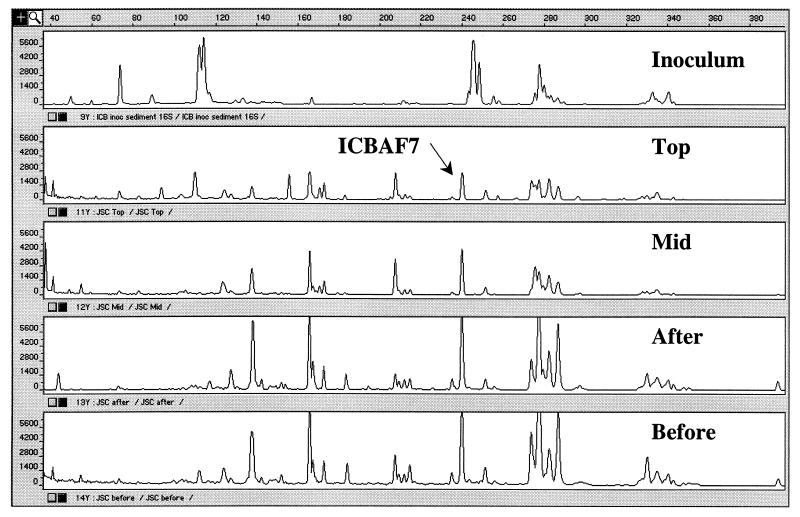
T-RFLP profiles of 16S rRNA genes from biofilm samples of the ICB after digestion with MnlI. A unique peak (clone ICBAF7) not detectable in the inoculum but found in the final samples is indicated.
FIG. 3.
FIG. 3.
Cluster analyses of the T-RFLP profiles in the ICB and TFB based on the 16S rRNA, amoA, and nosZ genes. The samples from the ICB are indicated by the following suffixes: I, inoculum; T, top layer; M, middle layer; A, after-air injection layer; B, before-air injection layer. For the TFB, the following similar suffixes are used: T, top layer; M, middle layer; B, bottom layer. The cluster analyses were performed with the Combinatorial Polythetic Agglomerative Hierarchical clustering package (COMPAH96; http://www.es.umb.edu/edgwebp.htm).
FIG. 4.
FIG. 4.
Phylogenetic tree based on the partial amoA genes (513-bp alignment) in the ICB and TFB reconstructed by the neighbor-joining method. Nodes with more than 50 bootstrap iterations (of 100) are highlighted by circles. Clonal sequences obtained in this study are highlighted. The accession numbers of the amoA genes are as follows: Nitrosomonas europaea, L08050; Nitrosomonas eutropha, U51630; Nitrosomonas sp., AB031869; Nitrosospira briensis, U76553; Nitrosospira multiformis, AF042171; Nitrosospira multiformis, U89833; Nitrosospira sp. strain AHB1, X90821; Nitrosospira sp. strain Np39-19, AF006692; Nitrosospira sp. strain NpAV, AF016003; Nitrosospira tenuis, U76552; Nitrosococcus oceani, U96611; bioreactor samples with an ABIA prefix, AF070983 to AF070987.
FIG. 5.
FIG. 5.
Phylogenetic tree based on the partial nosZ genes (489-bp alignment) in the ICB and TFB reconstructed by the neighbor-joining method. Nodes with more than 50 bootstrap iterations (of 100) are highlighted by circles. Designations of clonal sequences obtained in this study start with ICB or TFB. The accession numbers of the nosZ genes are as follows: Achromobacter cycloclastes, AF047429; Bradyrhizobium japonicum, AJ002531; Paracoccus denitrificans, X74792; Pseudomonas aeruginosa, X65277; Pseudomonas denitrificans, AF016059; Pseudomonas fluorescens, AF056319; Pseudomonas stutzeri, M22628; Ralstonia eutropha, X65278; Rhodobacter sphaeroides, AF125260; Sinorhizobium meliloti, U47133; 696C, AF119951; 696E, AF119949; 696L, AF119927; 696H, AF119947; ProJ, AF119934; ProO, AF119933; ProR, AF119937.

References

    1. Altschul, S. F., W. Gish, W. Miller, E. W. Myers, and D. L. Lipman. 1990. Basic local alignment search tool. J. Mol. Biol. 215:403-410. - PubMed
    1. Avaniss-Aghajani, E., K. Jones, D. Chapman, and C. Brunk. 1994. A molecular technique for identification of bacteria using small subunit ribosomal RNA sequences. BioTechniques 17:144-149. - PubMed
    1. Berardesco, G., S. Dyhrman, E. Gallagher, and M. P. Shiaris. 1998. Spatial and temporal variation of phenanthrene-degrading bacteria in intertidal sediments. Appl. Environ. Microbiol. 64:2560-2565. - PMC - PubMed
    1. Bruce, K. D. 1997. Analysis of mer gene subclasses within bacterial communities in soils and sediments resolved by fluorescent-PCR-restriction fragment length polymorphism profiling. Appl. Environ. Microbiol. 63:4914-4919. - PMC - PubMed
    1. Felsenstein, J. 1981. Evolutionary trees from DNA sequences: a maximum likelihood approach. J. Mol. Evol. 17:368-376. - PubMed

Publication types

LinkOut - more resources