Treating Helicobacter pylori infection in primary care patients with uninvestigated dyspepsia: the Canadian adult dyspepsia empiric treatment-Helicobacter pylori positive (CADET-Hp) randomised controlled trial
- PMID: 11976244
- PMCID: PMC102778
- DOI: 10.1136/bmj.324.7344.1012
Treating Helicobacter pylori infection in primary care patients with uninvestigated dyspepsia: the Canadian adult dyspepsia empiric treatment-Helicobacter pylori positive (CADET-Hp) randomised controlled trial
Abstract
Objective: To determine whether a "test for Helicobacter pylori and treat" strategy improves symptoms in patients with uninvestigated dyspepsia in primary care.
Design: Randomised placebo controlled trial.
Setting: 36 family practices in Canada.
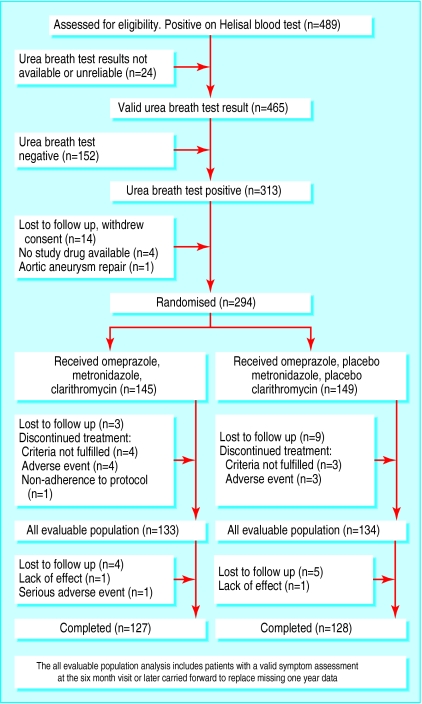
Participants: 294 patients positive for H pylori ((13)C- urea breath test) with symptoms of dyspepsia of at least moderate severity in the preceding month.
Intervention: PARTICIPANTS were randomised to twice daily treatment for 7 days with omeprazole 20 mg, metronidazole 500 mg, and clarithromycin 250 mg or omeprazole 20 mg, placebo metronidazole, and placebo clarithromycin. Patients were then managed by their family physicians according to their usual care.
Main outcome measures: Treatment success defined as no symptoms or minimal symptoms of dyspepsia at the end of one year. Societal healthcare costs collected prospectively for a secondary evaluation of actual mean costs.
Results: In the intention to treat population (n=294), eradication treatment was significantly more effective than placebo in achieving treatment success (50% v 36%; P=0.02; absolute risk reduction=14%; number needed to treat=7, 95% confidence interval 4 to 63). Eradication treatment cured H pylori infection in 80% of evaluable patients. Treatment success at one year was greater in patients negative for H pylori than in those positive for H pylori (54% v 39%; P=0.02). Eradication treatment reduced mean annual cost by $C53 (-86 to 180) per patient.
Conclusions: A "test for H pylori with (13)C-urea breath test and eradicate" strategy shows significant symptomatic benefit at 12 months in the management of primary care patients with uninvestigated dyspepsia.
Figures
Comment in
-
Management of dyspepsia should be individualised.BMJ. 2002 Aug 3;325(7358):281. doi: 10.1136/bmj.325.7358.281/a. BMJ. 2002. PMID: 12153934 Free PMC article. No abstract available.
-
Helicobacter pylori eradication improved dyspepsia symptoms.ACP J Club. 2003 Jan-Feb;138(1):16-7. ACP J Club. 2003. PMID: 12511129 No abstract available.
-
Dyspepsia results may not apply in primary care.BMJ. 2003 Oct 4;327(7418):811. doi: 10.1136/bmj.327.7418.811-a. BMJ. 2003. PMID: 14525899 Free PMC article. No abstract available.
References
-
- Tougas G, Chen Y, Hwang P, Liu MM, Eggleston A. Prevalence and impact of upper gastrointestinal symptoms in the Canadian population: findings from the DIGEST study. Am J Gastroenterol. 1999;94:2845–2854. - PubMed
-
- Chiba N, Bernard L, O'Brien BJ, Goeree R, Hunt RH. A Canadian physician survey of dyspepsia management. Can J Gastroenterol. 1998;12:83–90. - PubMed
-
- Talley NJ, Silverstein MD, Agreus L, Nyren O, Sonnenberg A, Holtmann G. AGA technical review: evaluation of dyspepsia. Gastroenterology. 1998;114:582–595. - PubMed
-
- Laine L, Schoenfeld P, Fennerty MB. Therapy for Helicobacter pylori in patients with nonulcer dyspepsia. A meta-analysis of randomized, controlled trials. Ann Intern Med. 2001;134:361–369. - PubMed
Publication types
MeSH terms
Substances
LinkOut - more resources
Full Text Sources
Medical
Research Materials
Miscellaneous