


Real-time PCR for detection and quantitation of leishmania in mouse tissues
- PMID: 11980939
- PMCID: PMC130941
- DOI: 10.1128/JCM.40.5.1666-1669.2002
Real-time PCR for detection and quantitation of leishmania in mouse tissues
Abstract
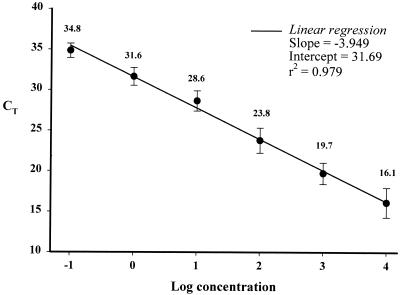
Leishmania spp. are intracellular protozoan parasites that cause a wide spectrum of diseases in humans and dogs worldwide. However, monitoring of the Leishmania burden in its different hosts is still based on cumbersome and poorly sensitive methods. Here we have developed a highly accurate real-time PCR assay with which to reproducibly detect and quantify the relative Leishmania major burden in mouse tissue samples. The assay is performed with the LightCycler system using SYBR Green I and primers amplifying a ca. 120-bp fragment from minicircles of the kinetoplast DNA (kDNA). The assay was able to detect as little as 100 fg of L. major DNA per reaction, which is equivalent to 0.1 parasite. The standard curve designed for quantitation of parasites showed linearity over an at least 6-log DNA concentration range, corresponding to 0.1 to 10(4) parasites per reaction, with a correlation coefficient of 0.979. The assay also proved to have a detection range of the same magnitude as that used for detection of L. donovani and L. amazonensis, but it was 100-fold less sensitive for L. mexicana. When applied to tissues from experimentally infected mice, the real-time PCR assay is not only as sensitive as a conventional PCR assay for detection of Leishmania kDNA but also more rapid. Results indicate that this assay is compatible with the clinical diagnosis of leishmaniasis and will be a great help to scientists who use animals to monitor the efficacy of antileishmanial drugs or vaccines or decipher the unique properties of the life cycle of Leishmania spp.
Figures
References
-
- Aebischer, T. 1994. Recurrent cutaneous leishmaniasis: a role for persistent parasites. Parasitol. Today 10:25-28. - PubMed
-
- Ashford, R. W. 2000. The leishmaniases as emerging and reemerging zoonoses. Int. J. Parasitol. 30:1269-1281. - PubMed
-
- Berens, R. L., and J. J. Marr. 1978. An easily prepared defined medium for cultivation of Leishmania donovani promastigotes. J. Parasitol. 64:160.. - PubMed
-
- Blackwell, J. M. 1996. Genetic susceptibility to leishmanial infections: studies in mice and man. Parasitology 112Suppl.:S67-S74. - PubMed
Publication types
MeSH terms
LinkOut - more resources
Full Text Sources
Other Literature Sources
Medical
Miscellaneous
