


Sequence analysis of the ribosomal DNA intergenic spacer 1 regions of Trichosporon species
- PMID: 11980969
- PMCID: PMC130926
- DOI: 10.1128/JCM.40.5.1826-1830.2002
Sequence analysis of the ribosomal DNA intergenic spacer 1 regions of Trichosporon species
Abstract
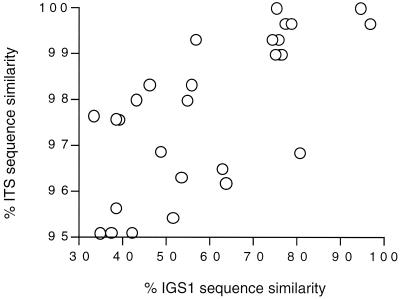
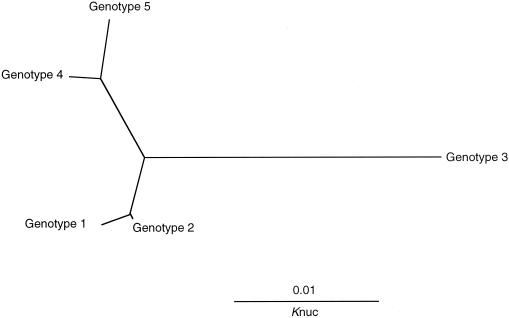
We determined the sequence of the intergenic spacer (IGS) 1 region, which is located between the 26S and 5S rRNA genes, in 25 species of the genus TRICHOSPORON: IGS 1 sequences varied in length from 195 to 719 bp. Comparative sequence analysis suggested that the divergence of IGS 1 sequences has been greater than that of the internal transcribed spacer regions. We also identified five genotypes of T. asahii, which is a major causative agent of deep-seated trichosporonosis, based on the IGS 1 sequences of 43 strains. Most of the isolates that originated in Japan were of genotype 1, whereas the American isolates were of genotype 3 or 5. Our results suggest that analysis of IGS regions provides a powerful method to distinguish between phylogenetically closely related species and that a geographic substructure may exist among T. asahii clinical isolates.
Figures

References
-
- Chen, Y. C., J. D. Eisner, M. M. Kattar, S. L. Rassoulian-Barret, K. LaFe, S. L. Yarfitz, A. P. Limaye, and B. T. Cookson. 2000. Identification of medically important yeasts using PCR-based detection of DNA sequence polymorphisms in the internal transcribed spacer 2 region of the rRNA genes. J. Clin. Microbiol. 38:2302-2310. - PMC - PubMed
-
- Diaz, M. R., T. Boekhout, B. Theelen, and J. W. Fell. 2000. Molecular sequence analyses of the intergenic spacer (IGS) associated with rDNA of the two varieties of the pathogenic yeast, Cryptococcus neoformans. Syst. Appl. Microbiol. 23:535-545. - PubMed
-
- Fell, J. W., T. Boekhout, A. Fonseca, G. Scorzetti, and A. Statzell-Tallman. 2000. Biodiversity and systematics of basidiomycetous yeasts as determined by large-subunit rDNA D1/D2 domain sequence analysis. Int. J. Syst. E vol. Microbiol. 50:1351-1571. - PubMed
-
- Guého, E., L. Improvisi, G. S. de Hoog, and B. Dupont. 1994. Trichosporon on humans: a practical account. Mycoses 37:3-10. - PubMed
Publication types
MeSH terms
Substances
LinkOut - more resources
Full Text Sources
Medical
