


doi: 10.1128/jvi.76.11.5829-5834.2002.
Diarrhea-inducing activity of avian rotavirus NSP4 glycoproteins, which differ greatly from mammalian rotavirus NSP4 glycoproteins in deduced amino acid sequence in suckling mice
Affiliations
- PMID: 11992013
- PMCID: PMC137017
- DOI: 10.1128/jvi.76.11.5829-5834.2002
Item in Clipboard
Diarrhea-inducing activity of avian rotavirus NSP4 glycoproteins, which differ greatly from mammalian rotavirus NSP4 glycoproteins in deduced amino acid sequence in suckling mice
J Virol.
2002 Jun.
Abstract
Avian rotavirus NSP4 glycoproteins expressed in Escherichia coli acted as enterotoxins in suckling mice, as did mammalian rotavirus NSP4 glycoproteins, despite great differences in the amino acid sequences. The enterotoxin domain of PO-13 NSP4 exists in amino acid residues 109 to 135, a region similar to that reported in SA11 NSP4.
Figures
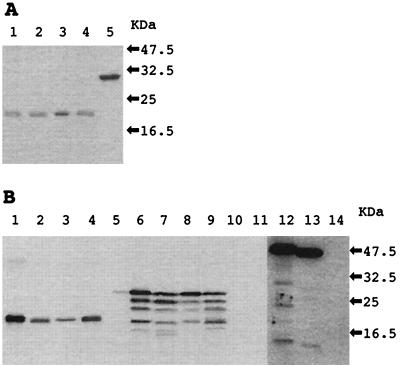
Expression and purification of the recombinant avian rotavirus NSP4s and PO-13 VP8: CBB staining (A) and Western blotting (B) of PO-13 NSP4, Ty-3 NSP4, Ty-1 NSP4, Ch-1 NSP4, and PO-13 VP8 from E. coli extracts. Aliquots of 20 pmol for CBB staining and 0.1 pmol for Western blotting of the purified NSP4s and VP8 were separated on an SDS-15% polyacrylamide gel. In Western blotting, the lysates of MA104 cells infected with avian rotaviruses and simian rotavirus SA11 were also analyzed. These proteins were reacted with anti-PO-13 NSP4 guinea pig serum (lanes 1 to 11) or anti-PO-13 VP6 monoclonal antibody P3-1 (lanes 12 to 14). Lane 1, PO-13 NSP4; lane 2, Ty-3 NSP4; lane 3, Ty-1 NSP4; lane 4, Ch-1 NSP4; lane 5, PO-13 VP8; lanes 6 and 12, the lysate of MA104 cells infected with PO-13; lane 7, the lysate of MA104 cells infected with Ty-3; lane 8, the lysate of MA104 cells infected with Ty-1; lane 9, the lysate of MA104 cells infected with Ch-1; lanes 10 and 13, the lysate of MA104 cells infected with SA11; lanes 11 and 14, the lysate of MA104 cells mock inoculated.
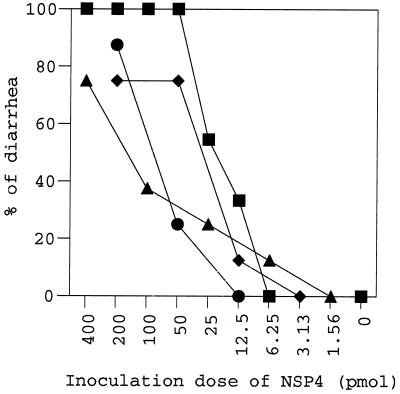
Percentages of suckling ddY mice with diarrhea after inoculation with various doses of the purified NSP4s of avian rotaviruses. The mice scored as positive were observed to have diarrhea once and more during the observation times. Each dose group consisted of more than eight mice. ▪, PO-13 NSP4; •, Ty-3 NSP4; ▴, Ty-1 NSP4; ♦, Ch-1 NSP4.
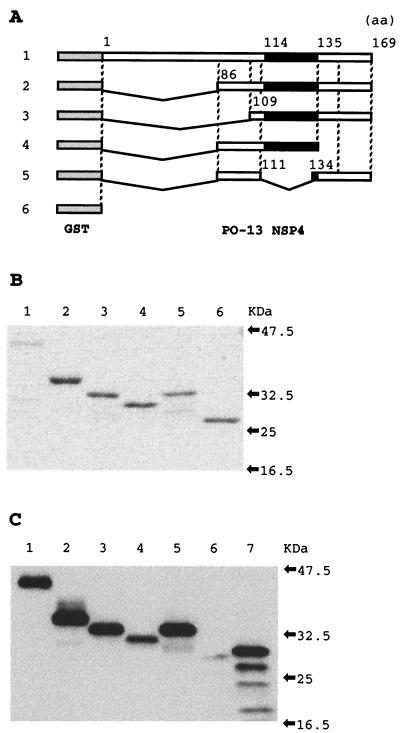
Expression and purification of GST-full-length and truncated PO-13 NSP4 fusion proteins and GST. (A) Schematic representation of GST-PO-13 NSP4, four GST-truncated PO-13 NSP4s, and GST. Shaded boxes represent GST and black boxes represent the region corresponding to the enterotoxin domain (aa 114 to 135) of the SA11 NSP4 (1). (B and C) CBB staining (B) and Western blotting (C) of GST-PO-13 NSP4, four GST-truncated PO-13 NSP4s, and GST from E. coli extracts. For CBB staining, aliquots of 10 pmol of the purified GST-PO-13 NSP4 and 50 pmol of the purified GST-truncated PO-13 NSP4s and the purified GST were separated on an SDS-10% polyacrylamide gel. For Western blotting, 0.5 pmol of these proteins was reacted with anti-PO-13 NSP4 guinea pig serum. Lane 1, GST-PO-13 NSP4; lane 2, PONSP486-169; lane 3, PONSP4109-169; lane 4, PONSP486-135; lane 5, PONSP486-169Δ112-133; lane 6, GST.
References
-
- Ball, J. M., P. Tian, C. Zeng, A. P. Morris, and M. K. Estes. 1996. Age-dependent diarrhea induced by a rotaviral nonstructural glycoprotein. Science 272:101-104. - PubMed
-
- Both, G. W., A. R. Bellamy, and D. B. Mitchell. 1994. Rotavirus protein structure and function. Curr. Top. Microbiol. Immunol. 185:67-105. - PubMed
-
- Bowman, G. D., I. M. Nodelman, O. Levy, S. L. Lin, P. Tian, T. J. Zamb, S. A. Udem, B. Venkataraghavan, and C. E. Schutt. 2000. Crystal structure of the oligomerization domain of NSP4 from rotavirus reveals a core metal-binding site. J. Mol. Biol. 304:861-871. - PubMed
Publication types
MeSH terms
Substances
LinkOut - more resources
Full Text Sources
Medical
