


Paternally transmitted FMR1 alleles are less stable than maternally transmitted alleles in the common and intermediate size range
- PMID: 11992259
- PMCID: PMC379140
- DOI: 10.1086/340846
Paternally transmitted FMR1 alleles are less stable than maternally transmitted alleles in the common and intermediate size range
Abstract
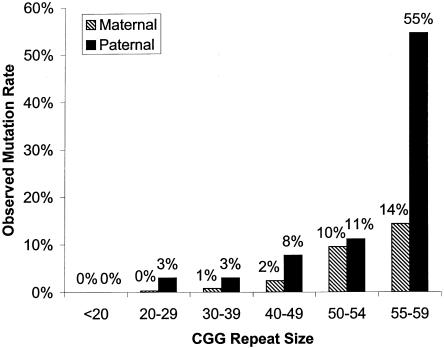
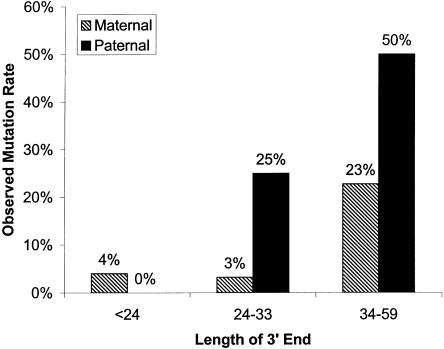
Fragile X syndrome, a form of X-linked mental retardation, results from the hyperexpansion of a CGG trinucleotide repeat located in the 5' untranslated region of the fragile X mental retardation (FMR1) gene. Relatively little is known about the initial mutation that causes a stable allele to become unstable and, eventually, to expand to the full mutation. In the present study, we have examined 1,452 parent-child transmissions of alleles of common (< or =39 repeats) or intermediate (40-59 repeats) sizes to study the initial mutation events. Of these, 201 have been sequenced and haplotyped. Using logistic regression analysis, we found that parental origin of transmission, repeat size (for unsequenced alleles), and number of the 3' CGGs (for sequenced alleles) were significant risk factors for repeat instability. Interestingly, transmission of the repeat through males was less stable than that through females, at the common- and intermediate-size level. This pattern differs from that seen for premutation-size alleles: paternally transmitted alleles are far more stable than maternally transmitted alleles. This difference that depends on repeat size suggests either a different mutational mechanism of instability or an increase in selection against sperm as their repeat size increases.
Figures
References
Electronic-Database Information
-
- Online Mendelian Inheritance in Man (OMIM), http://www.ncbi.nlm.nih.gov/Omim/ (for fragile X syndrome [MIM 309550])
References
-
- Ashley CT Jr, Warren ST (1995) Trinucleotide repeat expansion and human disease. Annu Rev Genet 29:703–728 - PubMed
-
- Brown WT, Houck GE Jr, Jeziorowska A, Levinson FN, Ding X, Dobkin C, Zhong N, Henderson J, Brooks SS, Jenkins EC (1993) Rapid fragile X carrier screening and prenatal diagnosis using a nonradioactive PCR test. JAMA 270:1569–1575 - PubMed
-
- Burman RW, Anoe KS, Popovich BW (2000) Fragile X full mutations are more similar in siblings than in unrelated patients: further evidence for a familial factor in CGG repeat dynamics. Genet Med 2:242–248 - PubMed
-
- Chakravarti A (1992) Fragile X founder effect? Nat Genet 1:237–238 - PubMed
Publication types
MeSH terms
Substances
Associated data
- Actions
Grants and funding
LinkOut - more resources
Full Text Sources
Medical
Molecular Biology Databases
