


Evidence for in vivo transport of bioactive nitric oxide in human plasma
- PMID: 11994413
- PMCID: PMC150967
- DOI: 10.1172/JCI14995
Evidence for in vivo transport of bioactive nitric oxide in human plasma
Abstract
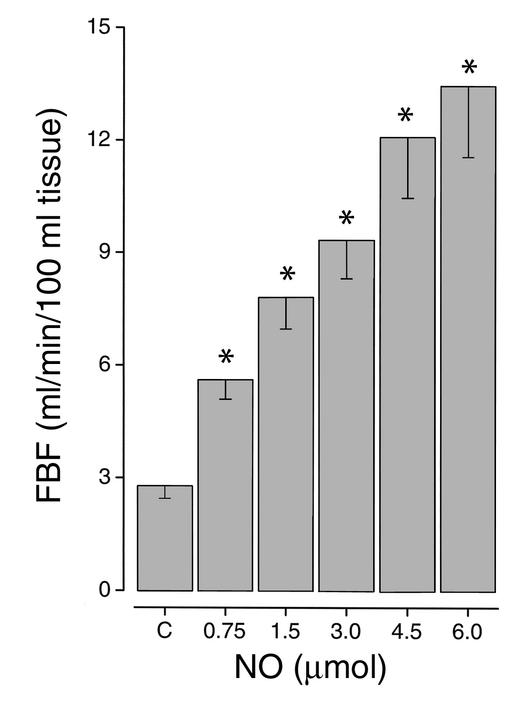
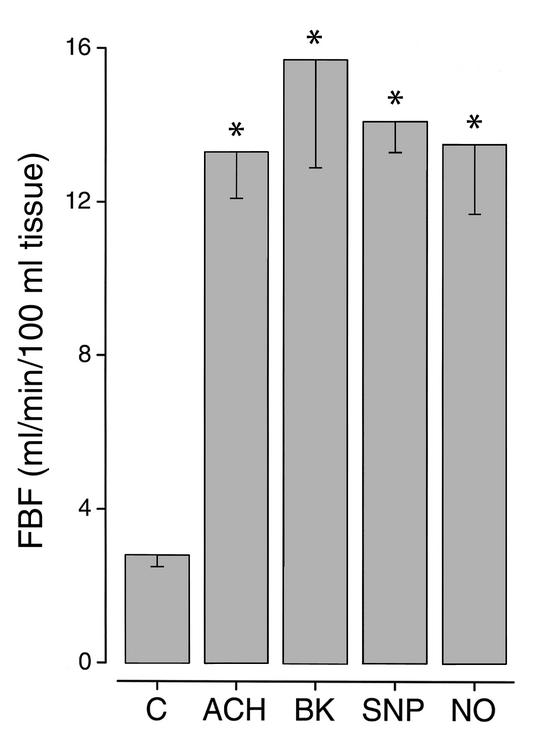
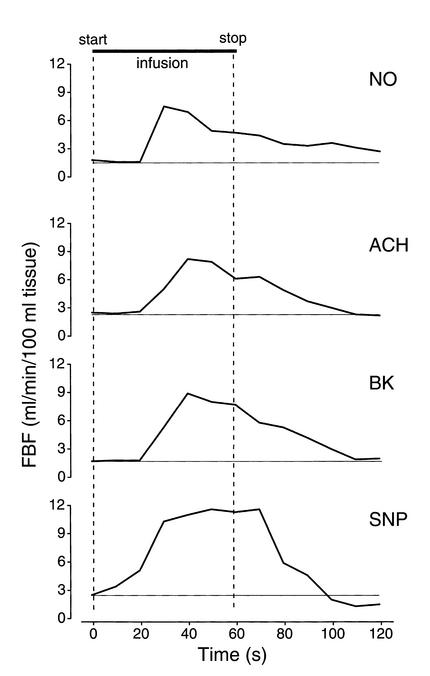
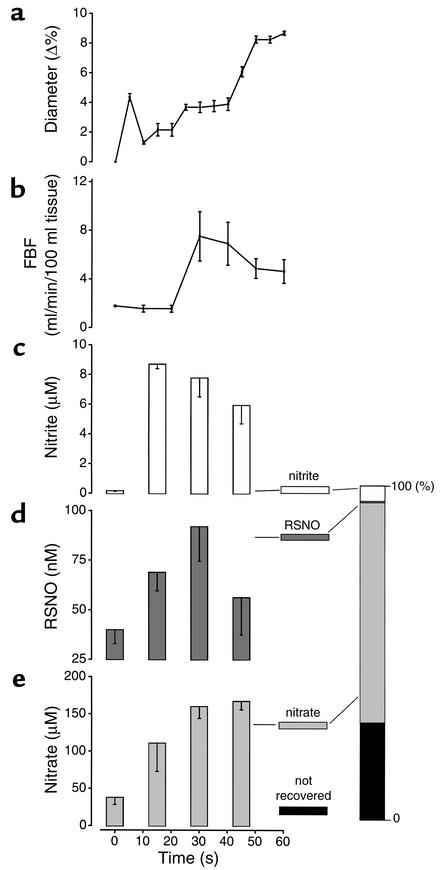
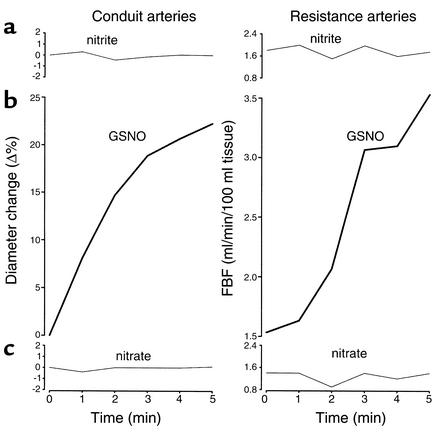
Although hitherto considered as a strictly locally acting vasodilator, results from recent clinical studies with inhaled nitric oxide (NO) indicate that NO can exert effects beyond the pulmonary circulation. We therefore sought to investigate potential remote vascular effects of intra-arterially applied aqueous NO solution and to identify the mechanisms involved. On bolus application of NO into the brachial artery of 32 healthy volunteers, both diameter of the downstream radial artery and forearm blood flow increased in a dose-dependent manner. Maximum dilator responses were comparable to those after stimulation of endogenous NO formation with acetylcholine and bradykinin. Response kinetics and pattern of NO decomposition suggested that despite the presence of hemoglobin-containing erythrocytes, a significant portion of NO was transported in its unbound form. Infusion of NO (36 micromol/min) into the brachial artery increased levels of plasma nitroso species, nitrite, and nitrate in the draining antecubital vein (by < 2-fold, 30-fold, and 4-fold, respectively), indicative of oxidative and nitrosative chemistry. Infused N-oxides were inactive as vasodilators whereas S-nitrosoglutathione dilated conduit and resistance arteries. Our results suggest that NO can be transported in bioactive form for significant distances along the vascular bed. Both free NO and plasma nitroso species contribute to the dilation of the downstream vasculature.
Figures
Comment in
-
NO solutions?J Clin Invest. 2002 May;109(9):1149-51. doi: 10.1172/JCI15637. J Clin Invest. 2002. PMID: 11994403 Free PMC article. No abstract available.
References
-
- Moncada S. Nitric oxide in the vasculature: physiology and pathophysiology. Ann NY Acad Sci. 1997;811:60–69. - PubMed
-
- Sessa WC. The nitric oxide synthase family of proteins. J Vasc Res. 1994;31:131–143. - PubMed
-
- Liu X, et al. Diffusion-limited reaction of free nitric oxide with erythrocytes. J Biol Chem. 1998;273:18709–18713. - PubMed
Publication types
MeSH terms
Substances
LinkOut - more resources
Full Text Sources
Other Literature Sources
