. 2002 May;8(5):451-7.
doi: 10.3201/eid0805.010522.

Risk to human health from a plethora of simian immunodeficiency viruses in primate bushmeat

Affiliations

Risk to human health from a plethora of simian immunodeficiency viruses in primate bushmeat

Martine Peeters et al. Emerg Infect Dis. 2002 May.

Abstract

To assess human exposure to Simian immunodeficiency virus (SIV) in west central Africa, we looked for SIV infection in 788 monkeys that were hunted in the rainforests of Cameroon for bushmeat or kept as pets. Serologic reactivity suggesting SIV infection was found in 13 of 16 primate species, including 4 not previously known to harbor SIV. Overall, 131 sera (16.6%) reacted strongly and an additional 34 (4.3%) reacted weakly with HIV antigens. Molecular analysis identified five new phylogenetic SIV lineages. These data document for the first time that a substantial proportion of wild monkeys in Cameroon are SIV infected and that humans who hunt and handle bushmeat are exposed to a plethora of genetically highly divergent viruses.


Figures
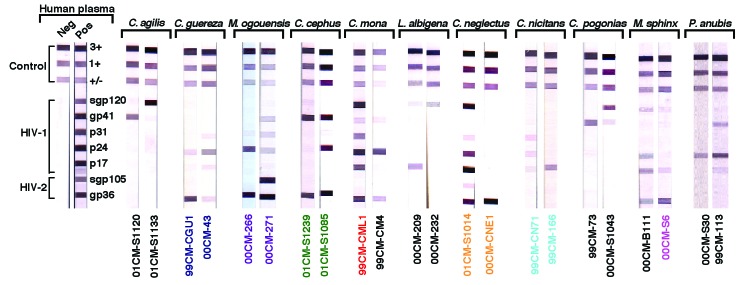
Figure 1
Figure 1
Detection of HIV-1/HIV-2 cross-reactive antibodies in sera from 11 primate species by using a line immunoassay (INNO-LIA HIV Confirmation, Innogenetics, Ghent, Belgium). Varying patterns of reactivity to HIV peptides and proteins (HIV-1 gp120, gp41, p31, p24, and p17; HIV-2 gp130, and gp36) are shown. Samples from which Simian immunodeficiency virus (SIV) sequences were subsequently amplified by polymerase chain reaction are color-coded as in Figure 2. Plasma samples from HIV-1/HIV-2-negative and -positive persons are shown as controls on the left. The 3+, 1+ and +/- bands at the top of all test strips control for sample addition (presence of plasma immunoglobulin) and test performance (binding of secondary antibody).
Figure 2
Figure 2
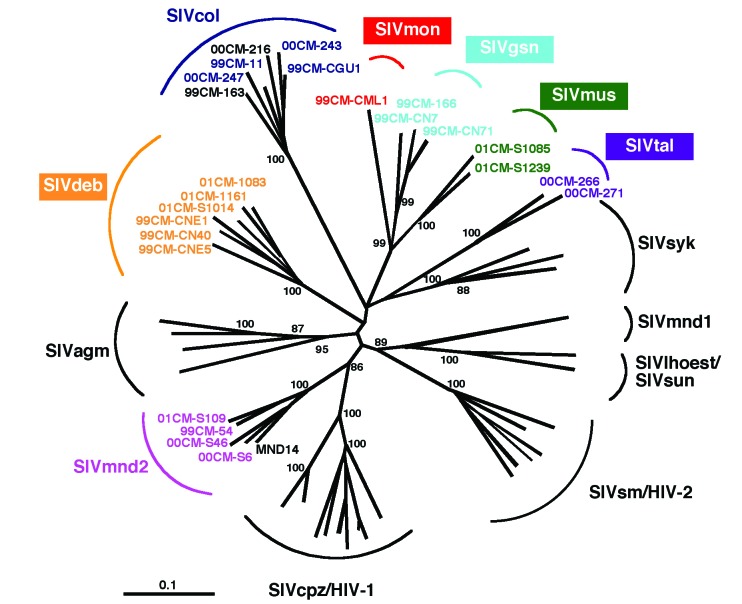
Identification of diverse Simian immunodeficiency virus (SIV) lineages in primate bushmeat. A 650-bp pol fragment was amplified from monkeys representing seven primate species, sequenced, and subjected to phylogenetic tree analysis by the neighbor-joining method. The positions of 21 SIV sequences from the present study (in color) are shown in relation to HIV/SIV reference sequences from the Los Alamos HIV/SIV Sequence Database (in black). The consensus length of the final alignment used for tree construction was 555 bp. The new species-specific SIV lineages are generally identified by a lower-case three-letter code corresponding to the initial letters of the common species name (e.g., SIVgsn for greater spot-nosed monkeys [Cercopithecus nictitans], SIVmus for mustached guenons [C. cephus] and SIVmon for mona monkeys [C. mona]). Lineages are defined as clusters of viral sequences from the same primate species that group together with significant (>80%) bootstrap values. We maintained the lineage designation of SIVtal previously assigned to a virus thought to be derived from a zoo animal of the species Miopithecus talapoin since that sequence, and the two newly derived talapoin viruses from M. ogouensis, cluster together in a phylogenetic tree derived from additional pol nucleotide sequences (not shown). Branch lengths are drawn to scale (the bar indicates 10% divergence). The numbers at the nodes indicate the percent bootstrap values supporting the cluster to the right (only values >80% are shown).

References

    1. Barre-Sinoussi F, Chermann JC, Rey F, Nugeyre MT, Chamaret S, Gruest J, et al. Isolation of a T-lymphotropic retrovirus from a patient at risk for acquired immune deficiency syndrome (AIDS). Science. 1983;220:868–70. 10.1126/science.6189183 - DOI - PubMed
    1. Clavel F, Mansinho K, Chamaret S, Guetard D, Favier V, Nina J, et al. Human immunodeficiency virus type 2 infection associated with AIDS in West Africa. N Engl J Med. 1987;316:1180–5. - PubMed
    1. UNAIDS. 2000. Report on the global HIV/AIDS epidemic. Available at: URL: http://www.unaids.org/
    1. van der Loeff MFS, Aaby P. Towards a better understanding of the epidemiology of HIV-2. AIDS. 1999;13:S69–84. - PubMed
    1. Hahn BH, Shaw GM, De Cock KM, Sharp PM. AIDS as a zoonosis: scientific and public health implications. Science. 2000;287:607–17. 10.1126/science.287.5453.607 - DOI - PubMed

Publication types

MeSH terms

LinkOut - more resources