Genes in a refined Smith-Magenis syndrome critical deletion interval on chromosome 17p11.2 and the syntenic region of the mouse
- PMID: 11997338
- PMCID: PMC186594
- DOI: 10.1101/gr.73702
Genes in a refined Smith-Magenis syndrome critical deletion interval on chromosome 17p11.2 and the syntenic region of the mouse
Abstract
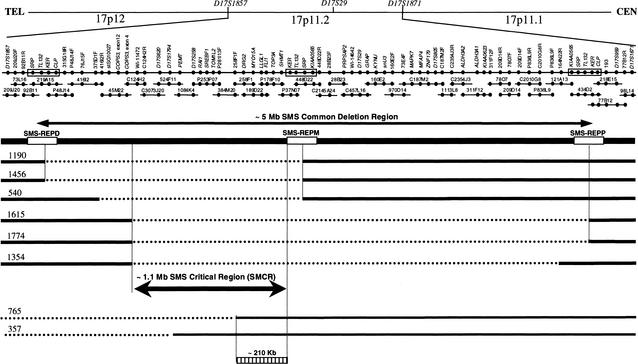
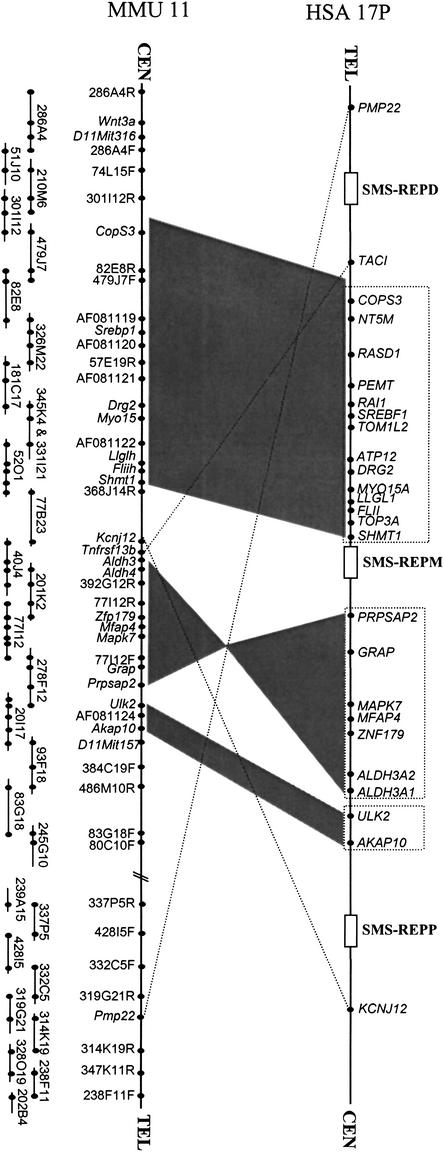
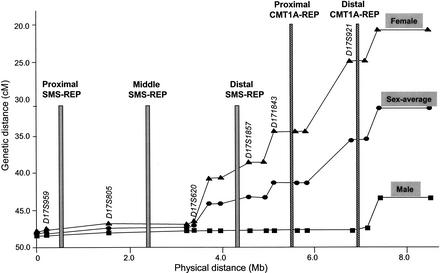
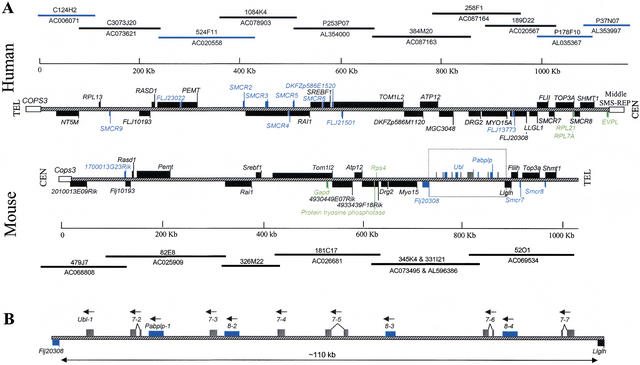
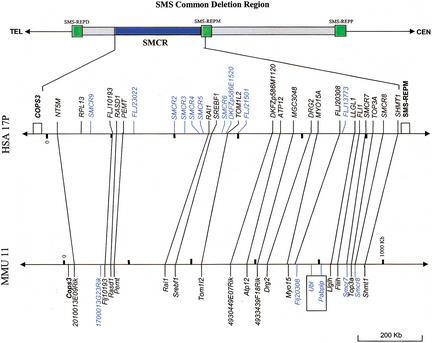
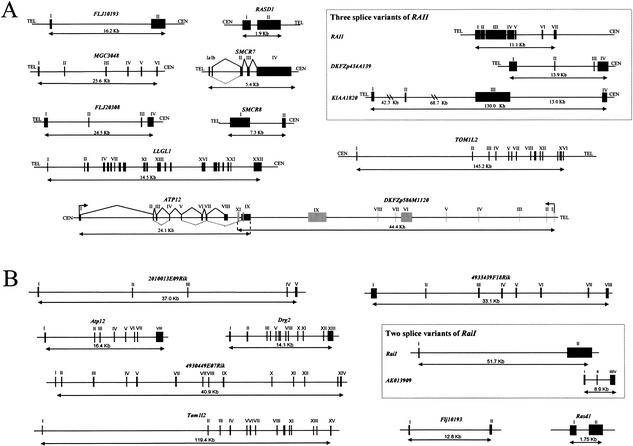
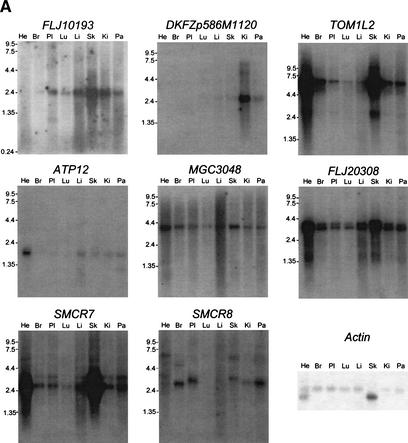
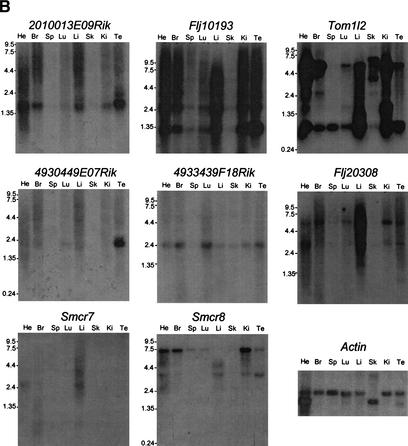
Smith-Magenis syndrome (SMS) is a multiple congenital anomaly/mental retardation syndrome associated with behavioral abnormalities and sleep disturbance. Most patients have the same approximately 4 Mb interstitial genomic deletion within chromosome 17p11.2. To investigate the molecular bases of the SMS phenotype, we constructed BAC/PAC contigs covering the SMS common deletion interval and its syntenic region on mouse chromosome 11. Comparative genome analysis reveals the absence of all three approximately 200-kb SMS-REP low-copy repeats in the mouse and indicates that the evolution of SMS-REPs was accompanied by transposition of adjacent genes. Physical and genetic map comparisons in humans reveal reduced recombination in both sexes. Moreover, by examining the deleted regions in SMS patients with unusual-sized deletions, we refined the minimal Smith-Magenis critical region (SMCR) to an approximately 1.1-Mb genomic interval that is syntenic to an approxiamtely 1.0-Mb region in the mouse. Genes within the SMCR and its mouse syntenic region were identified by homology searches and by gene prediction programs, and their gene structures and expression profiles were characterized. In addition to 12 genes previously mapped, we identified 8 new genes and 10 predicted genes in the SMCR. In the mouse syntenic region of the human SMCR, 16 genes and 6 predicted genes were identified. The SMCR is highly conserved between humans and mice, including 19 genes with the same gene order and orientation. Our findings will facilitate both the identification of gene(s) responsible for the SMS phenotype and the engineering of an SMS mouse model.
Figures
References
-
- Amid C, Bahr A, Mujica A, Sampson N, Bikar S-E, Winterpacht A, Zabel B, Hankeln T, Schmidt ER. Comparative genomic sequencing reveals a strikingly similar architecture of a conserved syntenic region on human chromosome 11p15.3 (including gene ST5) and mouse chromosome 7. Cytogenet Cell Genet. 2001;93:284–290. - PubMed
-
- Ansari-Lari MA, Oeltjen JC, Schwartz S, Zhang Z, Muzny DM, Lu J, Gorrell JH, Chinault AC, Belmont JW, Miller W, et al. Comparative sequence analysis of a gene-rich cluster at human chromosome 12p13 and its syntenic region in mouse chromosome 6. Genome Res. 1998;8:29–40. - PubMed
-
- Baker RT, Board PG. The human ubiquitin/52-residue ribosomal protein fusion gene subfamily (UbA52) is composed primarily of processed pseudogenes. Genomics. 1992;14:520–522. - PubMed
-
- Beamer LJ, Carroll SF, Eisenberg D. Crystal structure of human BPI and two bound phospholipids at 2.4 angstrom resolution. Science. 1997;276:1861–1864. - PubMed
-
- Cai W-W, Reneker J, Chow C-W, Vaishnav M, Bradley A. An anchored framework BAC map of mouse chromosome 11 assembled using multiplex oligonucleotide hybridization. Genomics. 1998;54:387–397. - PubMed
Publication types
MeSH terms
Substances
Grants and funding
LinkOut - more resources
Full Text Sources
Other Literature Sources
Molecular Biology Databases
Miscellaneous