. 2002 May 14;99(10):7045-8.
doi: 10.1073/pnas.052160199. Epub 2002 May 7.

The lethal and edema factors of anthrax toxin bind only to oligomeric forms of the protective antigen

Affiliations

The lethal and edema factors of anthrax toxin bind only to oligomeric forms of the protective antigen

Jeremy Mogridge et al. Proc Natl Acad Sci U S A. .

Abstract

The three proteins that comprise anthrax toxin, edema factor (EF), lethal factor (LF), and protective antigen (PA), assemble at the mammalian cell surface into toxic complexes. After binding to its receptor, PA is proteolytically activated, yielding a carboxyl-terminal 63-kDa fragment (PA(63)) that coordinates assembly of the complexes, promotes their endocytosis, and translocates EF and LF to the cytosol. PA(63) spontaneously oligomerizes to form symmetric ring-shaped heptamers that are capable of binding three molecules of EF and/or LF as competing ligands. To determine whether binding of these ligands depends on oligomerization of PA(63), we prepared two oligomerization-deficient forms of this protein, each mutated on a different PA(63)-PA(63) contact face. In solution or when bound to receptors on Chinese hamster ovary K1 cells, neither mutant alone bound ligand, but a mixture of them did. After the two mutants were proteolytically activated and mixed with ligand in solution, a ternary complex was isolated containing one molecule of each protein. Thus EF and LF bind stably only to PA(63) dimers or higher order oligomers. These findings are relevant to the kinetics and pathways of assembly of anthrax toxin complexes.


Figures
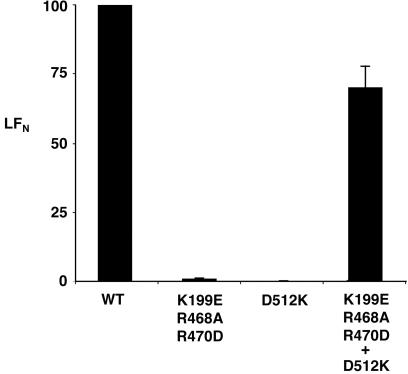
Figure 1
Figure 1
Neither of two oligomerization-deficient forms of PA63 on cells stably binds LFN, but a mixture of the two does. Trypsin-nicked PA (2 × 10⁻⁸ M) wild type (WT), D512K, K199E/R468A/R470D, or a mixture of the two mutant forms (1 × 10⁻⁸ M of each) was incubated with Chinese hamster ovary K1 cells at 4°C for 2 h. The cells were washed twice with PBS and incubated with [35S]LFN at 4°C for 2 h. The cells then were washed with PBS, and radioactive content was measured by scintillation counting. The units on the ordinate are percentages of control (wild-type PA.) Nonspecific binding of LFN to cells (less than 10%) was subtracted from the experimental measurements to yield specific binding. The error bars represent SE of the mean.
Figure 2
Figure 2
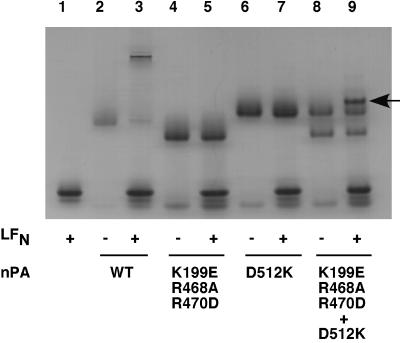
Native gel electrophoresis of oligomerization-deficient PA mutants in the presence and absence of ligand. Trypsin-nicked PA (nPA) of wild type (WT) or mutant (2 μg) was incubated in the presence or absence of LFN (3 μg), and the mixture was electrophoresed on a 4–20% acrylamide Tris-glycine gel. The gels were stained with Coomassie blue. A band in lane 9 corresponding to a putative heterotrimer containing a molecule of LFN and a molecule of PA63 from each of the two mutant PAs is indicated by the arrow.
Figure 3
Figure 3
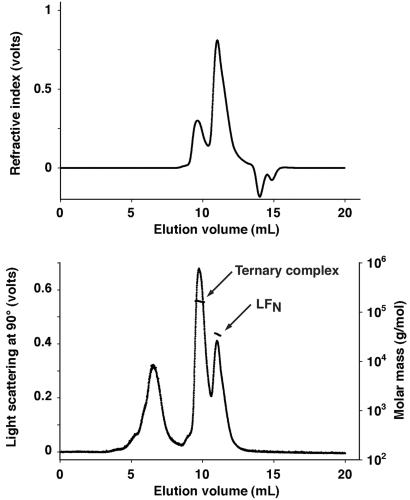
Use of multiangle laser light scattering to identify a ternary complex of LFN and the two oligomerization-deficient forms of PA63. A mixture of LFN (1 mg) with trypsin-nicked PA–D512K (300 μg) and PA–K199E/R468A/R470D (300 μg) was chromatographed over a Shodex KW-803 gel filtration column connected to a light-scattering instrument (Lower) and an interferometric refractometer (Upper). The values of molecular mass determined in volume increments across each peak are shown (arrows). The light-scattering peak at ≈7 ml elution volume represents a very small amount of contaminating high molecular mass material (note the absence of interferometric refractometer signal). The negative refractive index values at 14–15 ml elution volume represent differences between the composition of the sample and elution buffers.
Figure 4
Figure 4
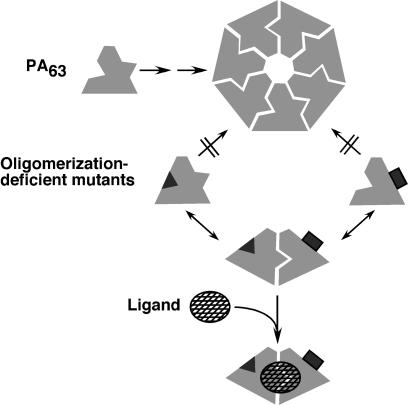
Complex formation by wild type and oligomerization-deficient mutants of PA63. Only one potential pathway of formation of the ternary complex is illustrated.

References

    1. Leppla S H. Proc Natl Acad Sci USA. 1982;79:3162–3166. - PMC - PubMed
    1. O'Brien J, Friedlander A, Dreier T, Ezzell J, Leppla S. Infect Immun. 1985;47:306–310. - PMC - PubMed
    1. Hoover D L, Friedlander A M, Rogers L C, Yoon I-K, Warren R L, Cross A S. Infect Immun. 1994;62:4432–4439. - PMC - PubMed
    1. Duesbery N S, Webb C P, Leppla S H, Gordon V M, Klimpel K R, Copeland T D, Ahn N G, Oskarsson M K, Fukasawa K, Paull K D, Woude G F V. Science. 1998;280:734–737. - PubMed
    1. Vitale G, Pellizzari R, Recchi C, Napolitani G, Mock M, Montecucco C. Biochem Biophys Res Commun. 1998;248:706–711. - PubMed

Publication types

LinkOut - more resources