. 2002 Jun;22(11):3639-52.
doi: 10.1128/MCB.22.11.3639-3652.2002.

The adeno-associated virus type 2 Rep protein regulates RNA processing via interaction with the transcription template

Affiliations

The adeno-associated virus type 2 Rep protein regulates RNA processing via interaction with the transcription template

Jianming Qiu et al. Mol Cell Biol. 2002 Jun.

Abstract

The adeno-associated virus type 2 (AAV) large Rep proteins can act to increase the ratio of spliced to unspliced AAV RNA when they are targeted to the transcription template via a Rep binding element. The required Rep binding site is both location and orientation independent; however, Rep enhancement decreases as the distance between the promoter and the intron of the affected transcription unit increases. Only the AAV intron and an extended polyadenylation site must remain for the AAV transcription unit to manifest responsiveness to Rep. A number of promoters, when driving the AAV capsid gene transcription unit, were responsive to targeted Rep, though to various degrees. Transactivation of transcription initiation is not sufficient for the enhancement of RNA processing, because activation of the P40 transcription unit by other activators targeted to this transcription template did not result in enhancement of the ratio of spliced to unspliced AAV RNA. These results suggest that Rep may act as a trans regulator of RNA processing by modulating such functions coupled to RNA polymerase II (RNA pol II) transcription, perhaps by affecting the composition of the transcription complex either prior to or during elongation. These results reveal another way in which gene expression can be regulated by trans-acting proteins and help explain an important feature of the parvovirus life cycle.


Figures
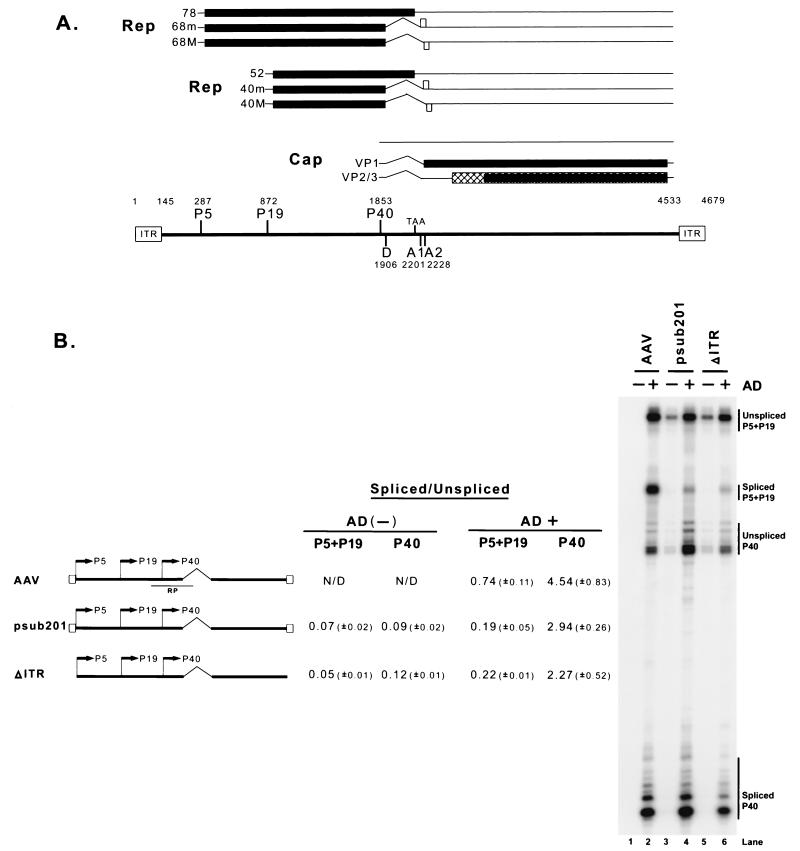
FIG. 1.
FIG. 1.
(A) Genetic map of AAV. Transcripts and protein-encoding regions for the three AAV promoters are shown. The promoters, intron donor (D) and acceptors (A1 and A2), and ITRs are mapped with their nucleotide designations. (B) The ratios of spliced to unspliced RNAs generated from the different AAV promoters are different during both wild-type AAV infection and transfection of full-length AAV plasmid constructs. 293 cells were either infected with AAV2 (MOI, 10) or transfected with either psub201 or ΔITR in the absence (−) or presence (+) of adenovirus (AD) (MOI, 10). A map of these constructs (not to scale) is shown. Ten micrograms of total RNA from infected or transfected cells was protected by the RP probe, which is depicted in relation to the AAV genome. A representative experiment is shown, and the AAV-specific RNA bands are indicated on the right. Multiple bands protected by P40 unspliced and spliced RNA likely reflect the use of multiple initiation sites within these regions (27). Quantitations of the ratio of spliced to unspliced RNAs specifically derived from the P5+P19 and P40 promoters are shown. All of the values are averages of the results of at least three separate experiments, with standard deviations in parentheses. Previous work has shown (27) that the ratios of spliced to unspliced AAV RNA increase through the course of infection; lane 2 shows the maximal levels of spliced products seen at late times during infection. N/D, not determined
FIG. 2.
FIG. 2.
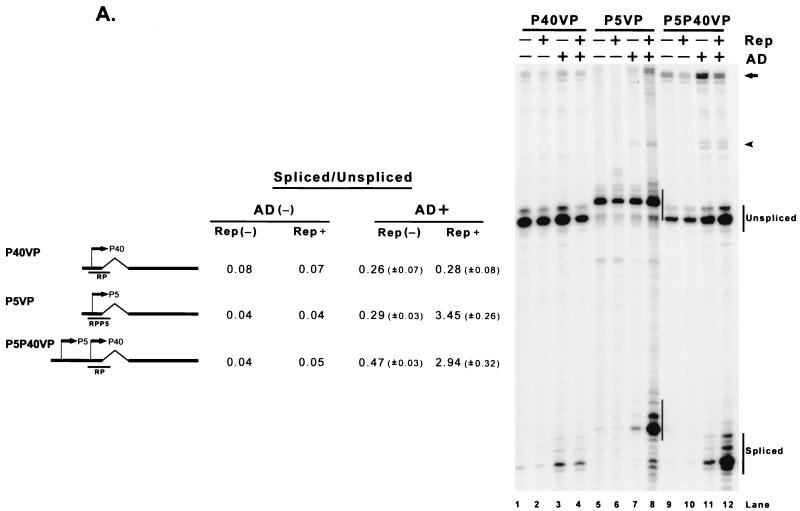
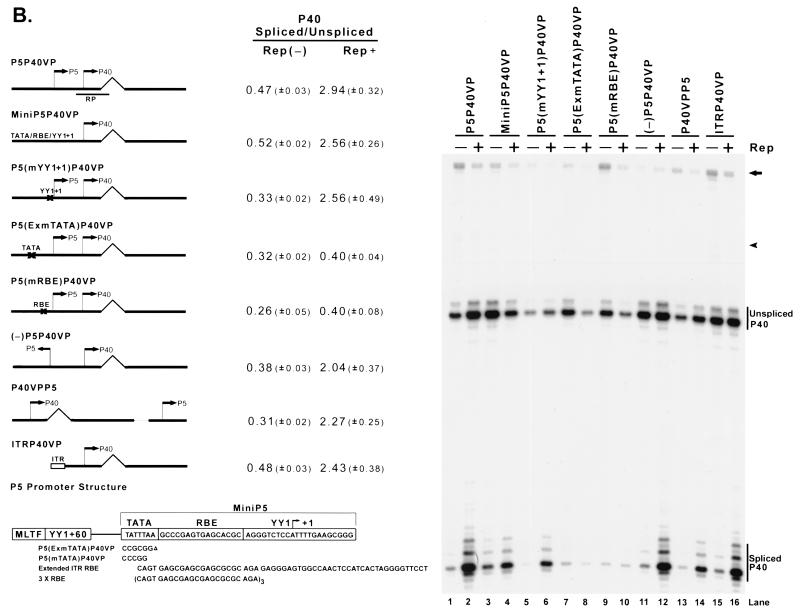
The AAV Rep proteins, when targeted to the transcription template, can enhance the ratio of spliced to unspliced AAV RNAs. (A) 293 cells were transfected with plasmid P40VP (lanes 1 to 4), P5VP (lanes 5 to 8), and P5P40VP (lanes 9 to 12) with (Rep+) or without [Rep(−)] cotransfection of the Rep supplementation plasmid RepSM in the absence [AD(−)] or presence (AD+) of adenovirus (MOI, 10). Ten micrograms of total RNA from transfected cells was protected by the homologous probes RP (lanes 1 to 4 and 9 to 12) and RPP5 (lanes 5 to 8), which are depicted under their respective plasmid diagrams on the left. Spliced and unspliced RNA specifically initiated from either the P40 (lanes 1 to 4 and 9 to 12) or P5 (lanes 5 to 8) promoters in a representative experiment is shown and labeled on the right. Quantitations of the ratio of spliced to unspliced RNAs for the intron-proximal promoters are shown and are averages of the results of at least three separate experiments, with standard deviations in parentheses. For quantitations in the absence of adenovirus, all standard deviations were <0.01. For the P5P40VP construct, a portion of the bands shown by the arrow and arrowhead reflect unspliced and spliced RNA generated from the P5 promoter, respectively (lanes 9 to 12); in the other lanes, these bands are assumed to derive from low levels of plasmid read-around transcription. (B) Mutant constructs, as described in the text, are shown. An X in the plasmid diagrams is used to show the location of some of these mutations. 293 cells were transfected with (+) or without (−) Rep supplementation by RepSM in trans in the presence of adenovirus. Harvested total RNA samples were protected by the RP probe, and the unspliced and spliced RNA bands specifically initiated at the P40 promoter of a representative experiment are indicated on the right. Quantitations of the ratio of spliced to unspliced P40-initiated RNAs are shown and are the averages of the results of at least three separate experiments, with standard deviations in parentheses. For the experiment shown in lanes 1 to 10, the portions of the bands shown by the arrow and arrowhead reflect the unspliced and spliced RNAs generated from the P5 promoter, respectively; in the other lanes, the bands are assumed to derive from low levels of plasmid read-around transcription. The structure of the AAV P5 promoter is shown at the bottom of the diagram. The sequence shows the mini P5 element (used in MiniP5P40VP), which confers Rep responsiveness to the transcription template (lanes 3 and 4). The boxed region indicates sequence elements previously characterized to bind YY1, MLTF, and TBP and also the RBE. TATA mutations that either abolish Rep responsiveness [P5(ExmTATA)P40VP; lanes 7 and 8] or have no effect on this function [P5(mTATA)P40VP; see text] are depicted.
FIG. 2.
FIG. 2.
The AAV Rep proteins, when targeted to the transcription template, can enhance the ratio of spliced to unspliced AAV RNAs. (A) 293 cells were transfected with plasmid P40VP (lanes 1 to 4), P5VP (lanes 5 to 8), and P5P40VP (lanes 9 to 12) with (Rep+) or without [Rep(−)] cotransfection of the Rep supplementation plasmid RepSM in the absence [AD(−)] or presence (AD+) of adenovirus (MOI, 10). Ten micrograms of total RNA from transfected cells was protected by the homologous probes RP (lanes 1 to 4 and 9 to 12) and RPP5 (lanes 5 to 8), which are depicted under their respective plasmid diagrams on the left. Spliced and unspliced RNA specifically initiated from either the P40 (lanes 1 to 4 and 9 to 12) or P5 (lanes 5 to 8) promoters in a representative experiment is shown and labeled on the right. Quantitations of the ratio of spliced to unspliced RNAs for the intron-proximal promoters are shown and are averages of the results of at least three separate experiments, with standard deviations in parentheses. For quantitations in the absence of adenovirus, all standard deviations were <0.01. For the P5P40VP construct, a portion of the bands shown by the arrow and arrowhead reflect unspliced and spliced RNA generated from the P5 promoter, respectively (lanes 9 to 12); in the other lanes, these bands are assumed to derive from low levels of plasmid read-around transcription. (B) Mutant constructs, as described in the text, are shown. An X in the plasmid diagrams is used to show the location of some of these mutations. 293 cells were transfected with (+) or without (−) Rep supplementation by RepSM in trans in the presence of adenovirus. Harvested total RNA samples were protected by the RP probe, and the unspliced and spliced RNA bands specifically initiated at the P40 promoter of a representative experiment are indicated on the right. Quantitations of the ratio of spliced to unspliced P40-initiated RNAs are shown and are the averages of the results of at least three separate experiments, with standard deviations in parentheses. For the experiment shown in lanes 1 to 10, the portions of the bands shown by the arrow and arrowhead reflect the unspliced and spliced RNAs generated from the P5 promoter, respectively; in the other lanes, the bands are assumed to derive from low levels of plasmid read-around transcription. The structure of the AAV P5 promoter is shown at the bottom of the diagram. The sequence shows the mini P5 element (used in MiniP5P40VP), which confers Rep responsiveness to the transcription template (lanes 3 and 4). The boxed region indicates sequence elements previously characterized to bind YY1, MLTF, and TBP and also the RBE. TATA mutations that either abolish Rep responsiveness [P5(ExmTATA)P40VP; lanes 7 and 8] or have no effect on this function [P5(mTATA)P40VP; see text] are depicted.
FIG. 3.
FIG. 3.
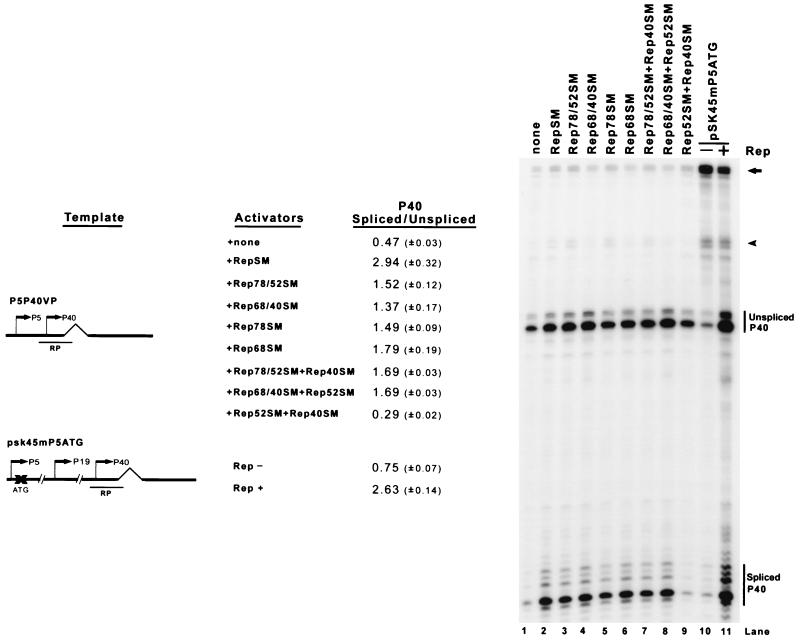
The large Rep proteins are required and sufficient to enhance the ratio of spliced to unspliced AAV RNA. 293 cells were transfected with the minimal P5P40VP reporter plasmid in the presence of adenovirus, and different Rep proteins were provided in trans by cotransfection. For the sample shown in lane 11, Rep was supplied by the plasmid RepSM. pSK45mP5ATG, a full-length AAV construct in which the initiating AUG for the large Rep proteins has been mutated, is described in the text. Total RNA was protected by the RP probe, and bands specifically protected by P40-initiated spliced and unspliced RNAs from a representative experiment are designated. Quantitations of the ratio of spliced to unspliced P40-initiated RNAs are shown and are averages of the results of at least three separate experiments, with standard deviations in parentheses. All of the Rep-supplying plasmids contained silent mutations in the region protected by the RP probe and are described in Materials and Methods. The arrow and arrowhead denote the unspliced and spliced RNAs, respectively, from the P5+P19 promoters (lanes 10 and 11) and from the P5 promoter (lanes 1 to 9), with some low-level contribution from plasmid read-around (lanes 1 to 9).
FIG. 4.
FIG. 4.
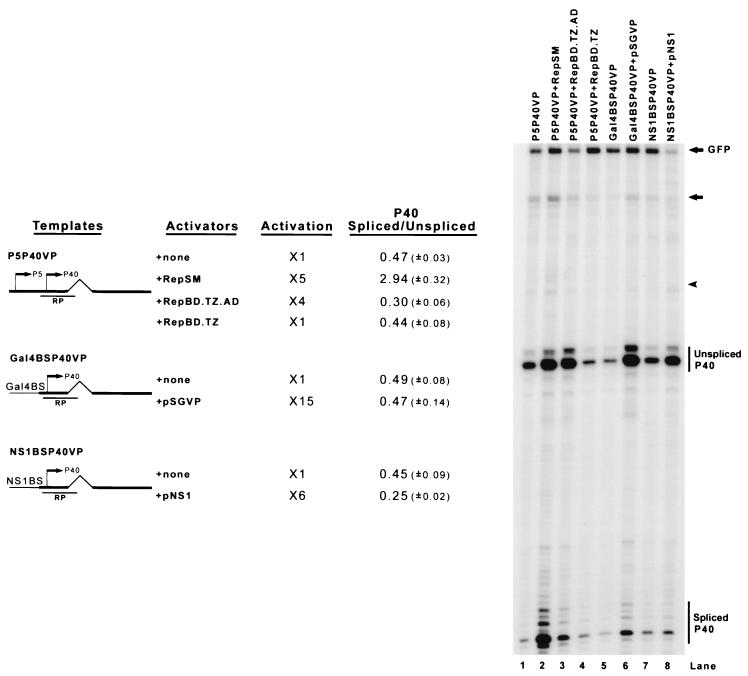
Activation of the P40 promoter is not enough to enhance the ratio of spliced to unspliced AAV RNA. 293 cells were cotransfected with minimal AAV capsid gene constructs bearing either the native P5 promoter (P5P40VP), three repeated Gal4 binding sequences (Gal4BSP40VP), or the MVM NS1 binding sequence (NS1BSVP) as described in the text, along with the activator plasmids shown. RepBD.TZ expressed only the oligomerized Rep binding domain (Rep aa 1 to 244), RepBD.TZ.AD expressed a Rep oligomerized binding domain/VP16 activation domain chimera, pSGVP expressed the chimeric Gal4 binding domain/VP16 activation domain fusion, and pNS1 expressed the MVM NS1 protein. To evaluate the levels of promoter activation, an EGFP-expressing plasmid (pEGFP) was cotransfected at 0.04 μg/60-mm dish in all groups as an internal control. Total RNAs were protected with the RP probe and a GFP probe. Bands specifically protected by P40-generated spliced and unspliced RNA and GFP RNA from a representative experiment are shown and labeled on the right. The fold activation and quantitations of the ratio of spliced to unspliced RNAs from at least three separate experiment are shown. Activation levels were standardized to that of the GFP internal control and compared to the unactivated background, which was set to 1 (lanes 1, 5, and 7). The ratios of spliced to unspliced RNAs include standard deviations in parentheses. For lanes 1 to 4, the unlabeled arrow and arrowhead denote a combination of unspliced (arrow) and spliced (arrowhead) P5 plus a low level of read-around transcription RNA; in the other lanes, these bands are assumed to derive from plasmid read-around transcription.
FIG. 5.
FIG. 5.
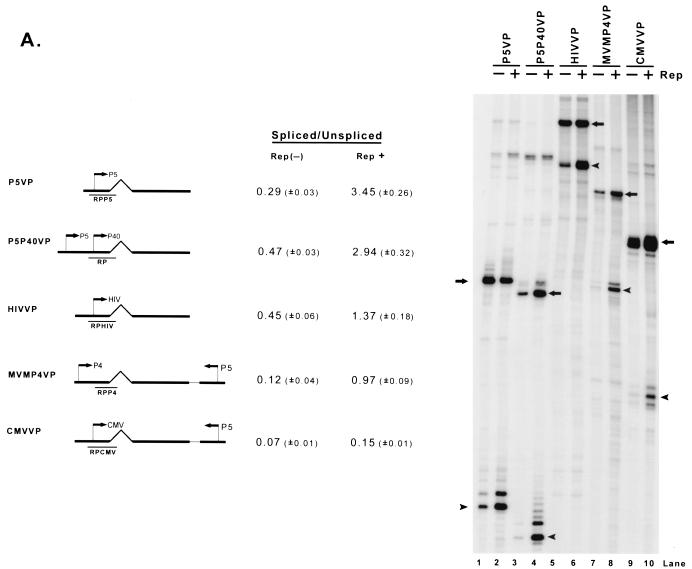
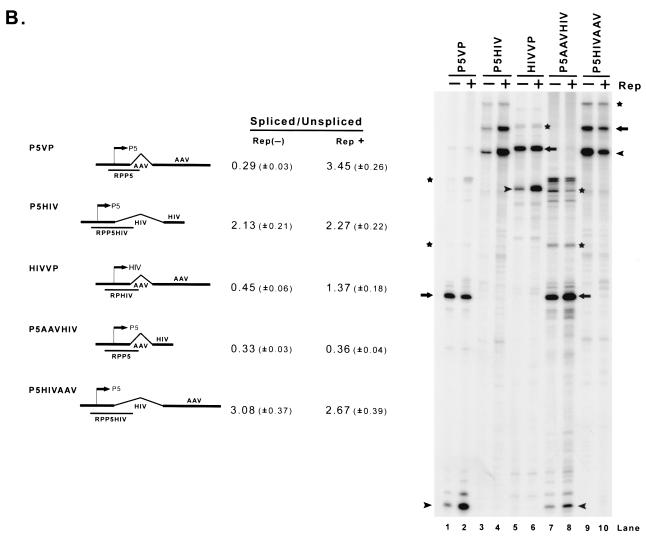
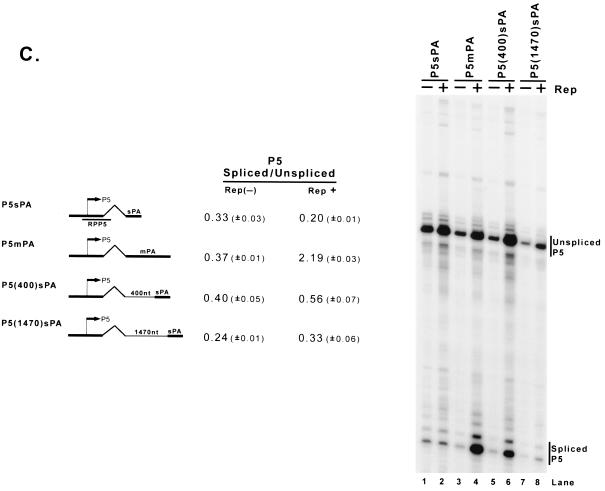
Enhancement of the ratio of spliced to unspliced RNA levels by Rep is promoter specific and requires the AAV intron and polyadenylation site. (A) 293 cells were transfected with AAV capsid gene sequences driven by the native P5 or P40 promoters (P5VP or P5P40VP), the HIV LTR (HIVVP), the MVM P4 promoter (MVMP4VP), or the CMV IE promoter (CMVVP). P5 sequences were inserted into MVMP4VP and CMVVP downstream of the AAV capsid gene in the opposite orientation to provide a fully functional Rep binding element as shown in Fig. 2B; the HIV LTR contains an RBE that has been previously characterized (1, 25). Cells were either cotransfected with RepSM (Rep+) or not [Rep(−)] in the presence of adenovirus. Total RNAs were protected with their respective homologous probes (RPP5, RP, RPHIV, RPP4, and RPCMV), and bands representing authentically initiated spliced (arrowhead) or unspliced (arrow) RNA from a representative sample are shown (except for P4-generated RNA, which uses an internal probe). Quantitations of the ratio of spliced to unspliced RNAs are shown and are averages of the results of at least three separate experiments, with standard deviations in parentheses. (B) Plasmids diagrammed at left and described in the text were transfected into 293 cells either with (Rep+) or without [Rep(−)] cotransfection of the Rep-supplementing plasmid RepSM in the presence of adenovirus. Total RNAs were protected by the homologous probes (RPP5, RPP5HIV, and RPHIV) indicated under the plasmid diagrams, and bands protected by specifically initiated spliced (arrowhead) or unspliced (arrow) RNA from a representative experiment are shown. Bands labeled with an asterisk are likely due to low levels of read-around transcription and were not considered in the quantitation. Quantitations of the ratio of spliced to unspliced RNAs are shown and are averages of the results of at least three separate experiments, with standard deviations in parentheses. (C) Plasmids P5sPA (containing only the AAV P5 promoter, the AAV intron, and the minimal AAV polyadenylation site [nt 4326 to 4492]), P5mpA (containing the AAV P5 promoter, the AAV intron, and the extended AAV polyadenylation site [nt 3941 to 4492]), or P5 (400)sPA and P5 (1470)sPA (which contain 403 and 1,466 nt of pBR322 DNA sequences inserted into P5sPA, respectively) were cotransfected into 293 cells either with (Rep+) or without [Rep(−)] cotransfection of the Rep-supplying plasmid RepSM in the presence of adenovirus. Total RNAs were protected by the RPP5 probe, which is depicted under the diagram of P5sPA. Bands protected by spliced and unspliced RNA from a representative experiment are shown and so labeled. Quantitations of the ratio of P5-specifically initiated spliced to unspliced RNAs are shown and are averages of the results of at least three separate experiments, with standard deviations in parentheses.
FIG. 5.
FIG. 5.
Enhancement of the ratio of spliced to unspliced RNA levels by Rep is promoter specific and requires the AAV intron and polyadenylation site. (A) 293 cells were transfected with AAV capsid gene sequences driven by the native P5 or P40 promoters (P5VP or P5P40VP), the HIV LTR (HIVVP), the MVM P4 promoter (MVMP4VP), or the CMV IE promoter (CMVVP). P5 sequences were inserted into MVMP4VP and CMVVP downstream of the AAV capsid gene in the opposite orientation to provide a fully functional Rep binding element as shown in Fig. 2B; the HIV LTR contains an RBE that has been previously characterized (1, 25). Cells were either cotransfected with RepSM (Rep+) or not [Rep(−)] in the presence of adenovirus. Total RNAs were protected with their respective homologous probes (RPP5, RP, RPHIV, RPP4, and RPCMV), and bands representing authentically initiated spliced (arrowhead) or unspliced (arrow) RNA from a representative sample are shown (except for P4-generated RNA, which uses an internal probe). Quantitations of the ratio of spliced to unspliced RNAs are shown and are averages of the results of at least three separate experiments, with standard deviations in parentheses. (B) Plasmids diagrammed at left and described in the text were transfected into 293 cells either with (Rep+) or without [Rep(−)] cotransfection of the Rep-supplementing plasmid RepSM in the presence of adenovirus. Total RNAs were protected by the homologous probes (RPP5, RPP5HIV, and RPHIV) indicated under the plasmid diagrams, and bands protected by specifically initiated spliced (arrowhead) or unspliced (arrow) RNA from a representative experiment are shown. Bands labeled with an asterisk are likely due to low levels of read-around transcription and were not considered in the quantitation. Quantitations of the ratio of spliced to unspliced RNAs are shown and are averages of the results of at least three separate experiments, with standard deviations in parentheses. (C) Plasmids P5sPA (containing only the AAV P5 promoter, the AAV intron, and the minimal AAV polyadenylation site [nt 4326 to 4492]), P5mpA (containing the AAV P5 promoter, the AAV intron, and the extended AAV polyadenylation site [nt 3941 to 4492]), or P5 (400)sPA and P5 (1470)sPA (which contain 403 and 1,466 nt of pBR322 DNA sequences inserted into P5sPA, respectively) were cotransfected into 293 cells either with (Rep+) or without [Rep(−)] cotransfection of the Rep-supplying plasmid RepSM in the presence of adenovirus. Total RNAs were protected by the RPP5 probe, which is depicted under the diagram of P5sPA. Bands protected by spliced and unspliced RNA from a representative experiment are shown and so labeled. Quantitations of the ratio of P5-specifically initiated spliced to unspliced RNAs are shown and are averages of the results of at least three separate experiments, with standard deviations in parentheses.
FIG. 5.
FIG. 5.
Enhancement of the ratio of spliced to unspliced RNA levels by Rep is promoter specific and requires the AAV intron and polyadenylation site. (A) 293 cells were transfected with AAV capsid gene sequences driven by the native P5 or P40 promoters (P5VP or P5P40VP), the HIV LTR (HIVVP), the MVM P4 promoter (MVMP4VP), or the CMV IE promoter (CMVVP). P5 sequences were inserted into MVMP4VP and CMVVP downstream of the AAV capsid gene in the opposite orientation to provide a fully functional Rep binding element as shown in Fig. 2B; the HIV LTR contains an RBE that has been previously characterized (1, 25). Cells were either cotransfected with RepSM (Rep+) or not [Rep(−)] in the presence of adenovirus. Total RNAs were protected with their respective homologous probes (RPP5, RP, RPHIV, RPP4, and RPCMV), and bands representing authentically initiated spliced (arrowhead) or unspliced (arrow) RNA from a representative sample are shown (except for P4-generated RNA, which uses an internal probe). Quantitations of the ratio of spliced to unspliced RNAs are shown and are averages of the results of at least three separate experiments, with standard deviations in parentheses. (B) Plasmids diagrammed at left and described in the text were transfected into 293 cells either with (Rep+) or without [Rep(−)] cotransfection of the Rep-supplementing plasmid RepSM in the presence of adenovirus. Total RNAs were protected by the homologous probes (RPP5, RPP5HIV, and RPHIV) indicated under the plasmid diagrams, and bands protected by specifically initiated spliced (arrowhead) or unspliced (arrow) RNA from a representative experiment are shown. Bands labeled with an asterisk are likely due to low levels of read-around transcription and were not considered in the quantitation. Quantitations of the ratio of spliced to unspliced RNAs are shown and are averages of the results of at least three separate experiments, with standard deviations in parentheses. (C) Plasmids P5sPA (containing only the AAV P5 promoter, the AAV intron, and the minimal AAV polyadenylation site [nt 4326 to 4492]), P5mpA (containing the AAV P5 promoter, the AAV intron, and the extended AAV polyadenylation site [nt 3941 to 4492]), or P5 (400)sPA and P5 (1470)sPA (which contain 403 and 1,466 nt of pBR322 DNA sequences inserted into P5sPA, respectively) were cotransfected into 293 cells either with (Rep+) or without [Rep(−)] cotransfection of the Rep-supplying plasmid RepSM in the presence of adenovirus. Total RNAs were protected by the RPP5 probe, which is depicted under the diagram of P5sPA. Bands protected by spliced and unspliced RNA from a representative experiment are shown and so labeled. Quantitations of the ratio of P5-specifically initiated spliced to unspliced RNAs are shown and are averages of the results of at least three separate experiments, with standard deviations in parentheses.
FIG. 6.
FIG. 6.
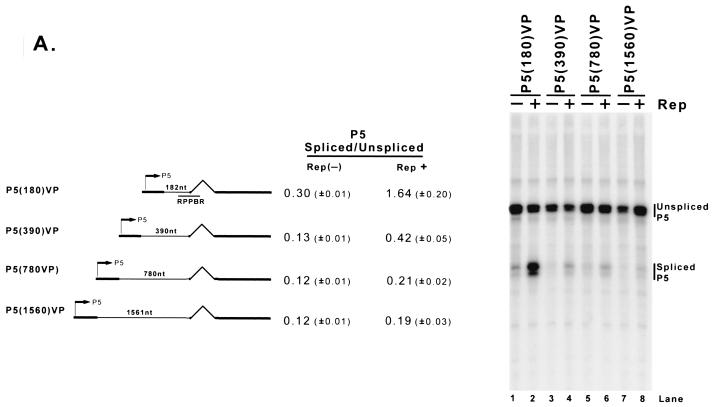
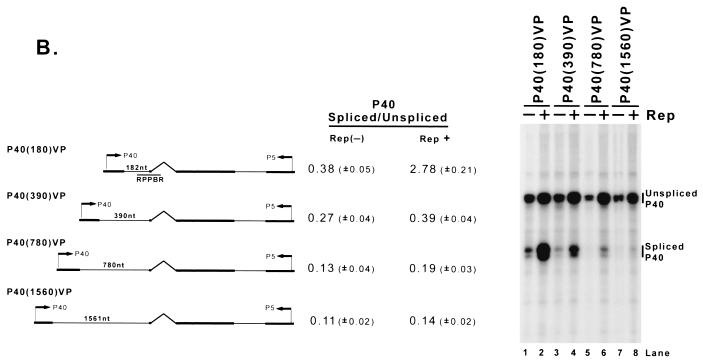
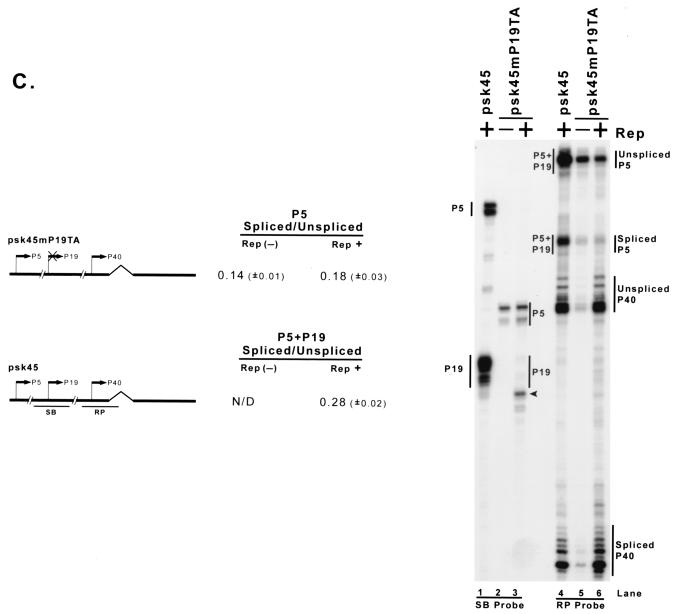
As the distance between the promoter and the AAV intron is increased, the level of Rep enhancement is diminished. (A) Plasmids with differently sized insertions of pBR322 DNA between the AAV P5 promoter and the AAV intron (as described in the text) were transfected into 293 cells with (Rep+) or without [Rep(−)] cotransfection of the Rep-supplementing plasmid RepSM in the presence of adenovirus. Total RNA was protected by the RPPBR probe, which is depicted under the diagram of P5 (180)VP. Bands protected by spliced and unspliced RNA from a representative experiment are shown and labeled on the right. The insertion in P5 (1560)VP (lanes 7 and 8) put the P5 promoter at approximately its native position relative to the AAV intron. Quantitations of the ratio of P5-specifically initiated spliced to unspliced RNAs are shown and are averages of the results of at least three separate experiments, with standard deviations in parentheses. (B) Plasmids described in the text and similar to those described in panel A, except utilizing the AAV P40 promoter and bearing P5 sequences downstream in the opposite orientation (which serves as a fully functional Rep binding element [see Fig. 2B]), were transfected into 293 cells either with (Rep+) or without [Rep(−)] cotransfection of the Rep-supplementing plasmid RepSM in the presence of adenovirus. Total RNA was protected by the RPPBR probe, which is depicted under the diagram of P40 (180)VP. Bands protected by spliced and unspliced RNA from a representative experiment are shown and labeled on the right. Quantitations of the ratio of P40-specifically initiated spliced to unspliced RNAs are shown and are averages of the results of at least three separate experiments, with standard deviations in parentheses. (C) pSK45 and pSK45mP19TA, in which the P19 promoter was destroyed (see text for details), were transfected into 293 cells in the presence of adenovirus and, in the case of pSK45mP19TA, with (Rep+) or without [Rep(−)] cotransfection of the Rep-supplying plasmid RepSMP19SM, which contained a series of silent mutations within both the RP and SB probe regions (see text for details). Total RNAs were individually protected by the SB (to distinguish P5 from P19 products) and RP (to distinguish P5+P19 from P40 products) probes, and bands protected by these probes from a representative experiment are shown and labeled accordingly. The arrowhead denotes an RNA breakdown band created from protection of P5+P19 RNA by cotransfected RepSMP19SM. Inspection of results with the SB probe (lanes 2 and 3) confirms that pSK45mP19TA no longer generates detectable P19-generated RNA, and so the spliced and unspliced RNAs labeled as being P5 generated in lanes 5 and 6 are uncontaminated by P19 products. Quantitations of the ratio of P5-specifically initiated spliced to unspliced RNAs for the pSK45mP19TA construct and of P5+P19-generated spliced to unspliced RNAs for pSK45 are shown and are averages of the results of at least three separate experiments, with standard deviations in parentheses. N/D, not determined.
FIG. 6.
FIG. 6.
As the distance between the promoter and the AAV intron is increased, the level of Rep enhancement is diminished. (A) Plasmids with differently sized insertions of pBR322 DNA between the AAV P5 promoter and the AAV intron (as described in the text) were transfected into 293 cells with (Rep+) or without [Rep(−)] cotransfection of the Rep-supplementing plasmid RepSM in the presence of adenovirus. Total RNA was protected by the RPPBR probe, which is depicted under the diagram of P5 (180)VP. Bands protected by spliced and unspliced RNA from a representative experiment are shown and labeled on the right. The insertion in P5 (1560)VP (lanes 7 and 8) put the P5 promoter at approximately its native position relative to the AAV intron. Quantitations of the ratio of P5-specifically initiated spliced to unspliced RNAs are shown and are averages of the results of at least three separate experiments, with standard deviations in parentheses. (B) Plasmids described in the text and similar to those described in panel A, except utilizing the AAV P40 promoter and bearing P5 sequences downstream in the opposite orientation (which serves as a fully functional Rep binding element [see Fig. 2B]), were transfected into 293 cells either with (Rep+) or without [Rep(−)] cotransfection of the Rep-supplementing plasmid RepSM in the presence of adenovirus. Total RNA was protected by the RPPBR probe, which is depicted under the diagram of P40 (180)VP. Bands protected by spliced and unspliced RNA from a representative experiment are shown and labeled on the right. Quantitations of the ratio of P40-specifically initiated spliced to unspliced RNAs are shown and are averages of the results of at least three separate experiments, with standard deviations in parentheses. (C) pSK45 and pSK45mP19TA, in which the P19 promoter was destroyed (see text for details), were transfected into 293 cells in the presence of adenovirus and, in the case of pSK45mP19TA, with (Rep+) or without [Rep(−)] cotransfection of the Rep-supplying plasmid RepSMP19SM, which contained a series of silent mutations within both the RP and SB probe regions (see text for details). Total RNAs were individually protected by the SB (to distinguish P5 from P19 products) and RP (to distinguish P5+P19 from P40 products) probes, and bands protected by these probes from a representative experiment are shown and labeled accordingly. The arrowhead denotes an RNA breakdown band created from protection of P5+P19 RNA by cotransfected RepSMP19SM. Inspection of results with the SB probe (lanes 2 and 3) confirms that pSK45mP19TA no longer generates detectable P19-generated RNA, and so the spliced and unspliced RNAs labeled as being P5 generated in lanes 5 and 6 are uncontaminated by P19 products. Quantitations of the ratio of P5-specifically initiated spliced to unspliced RNAs for the pSK45mP19TA construct and of P5+P19-generated spliced to unspliced RNAs for pSK45 are shown and are averages of the results of at least three separate experiments, with standard deviations in parentheses. N/D, not determined.
FIG. 6.
FIG. 6.
As the distance between the promoter and the AAV intron is increased, the level of Rep enhancement is diminished. (A) Plasmids with differently sized insertions of pBR322 DNA between the AAV P5 promoter and the AAV intron (as described in the text) were transfected into 293 cells with (Rep+) or without [Rep(−)] cotransfection of the Rep-supplementing plasmid RepSM in the presence of adenovirus. Total RNA was protected by the RPPBR probe, which is depicted under the diagram of P5 (180)VP. Bands protected by spliced and unspliced RNA from a representative experiment are shown and labeled on the right. The insertion in P5 (1560)VP (lanes 7 and 8) put the P5 promoter at approximately its native position relative to the AAV intron. Quantitations of the ratio of P5-specifically initiated spliced to unspliced RNAs are shown and are averages of the results of at least three separate experiments, with standard deviations in parentheses. (B) Plasmids described in the text and similar to those described in panel A, except utilizing the AAV P40 promoter and bearing P5 sequences downstream in the opposite orientation (which serves as a fully functional Rep binding element [see Fig. 2B]), were transfected into 293 cells either with (Rep+) or without [Rep(−)] cotransfection of the Rep-supplementing plasmid RepSM in the presence of adenovirus. Total RNA was protected by the RPPBR probe, which is depicted under the diagram of P40 (180)VP. Bands protected by spliced and unspliced RNA from a representative experiment are shown and labeled on the right. Quantitations of the ratio of P40-specifically initiated spliced to unspliced RNAs are shown and are averages of the results of at least three separate experiments, with standard deviations in parentheses. (C) pSK45 and pSK45mP19TA, in which the P19 promoter was destroyed (see text for details), were transfected into 293 cells in the presence of adenovirus and, in the case of pSK45mP19TA, with (Rep+) or without [Rep(−)] cotransfection of the Rep-supplying plasmid RepSMP19SM, which contained a series of silent mutations within both the RP and SB probe regions (see text for details). Total RNAs were individually protected by the SB (to distinguish P5 from P19 products) and RP (to distinguish P5+P19 from P40 products) probes, and bands protected by these probes from a representative experiment are shown and labeled accordingly. The arrowhead denotes an RNA breakdown band created from protection of P5+P19 RNA by cotransfected RepSMP19SM. Inspection of results with the SB probe (lanes 2 and 3) confirms that pSK45mP19TA no longer generates detectable P19-generated RNA, and so the spliced and unspliced RNAs labeled as being P5 generated in lanes 5 and 6 are uncontaminated by P19 products. Quantitations of the ratio of P5-specifically initiated spliced to unspliced RNAs for the pSK45mP19TA construct and of P5+P19-generated spliced to unspliced RNAs for pSK45 are shown and are averages of the results of at least three separate experiments, with standard deviations in parentheses. N/D, not determined.

References

    1. Antoni, B. A., A. B. Rabson, I. L. Miller, J. P. Trempe, N. Chejanovsky, and B. J. Carter. 1991. Adeno-associated virus Rep protein inhibits human immunodeficiency virus type 1 production in human cells. J. Virol. 65:396-404. - PMC - PubMed
    1. Bauren, G., S. Belikov, and L. Wieslander. 1998. Transcriptional termination in the Balbiani ring 1 gene is closely coupled to 3′-end formation and excision of the 3′-terminal intron. Genes Dev. 12:2759-2769. - PMC - PubMed
    1. Bentley, D. L. 1999. Coupling RNA polymerase II transcription with pre-mRNA processing. Curr. Opin. Cell Biol. 11:347-351. - PubMed
    1. Berns, K. 1996. Parvoviridae: the viruses and their replication, p. 1017-1041. In B. N. Fields, D. M. Knipe, and P. M. Howley (ed.), Fundamental virology. Lippincott-Raven, Philadelphia, Pa.
    1. Berns, K. I., and C. Giraud. 1996. Biology of adeno-associated virus. Curr. Top. Microbiol. Immunol. 218:1-23. - PubMed

Publication types

MeSH terms

LinkOut - more resources