. 2002 May;13(5):1582-93.
doi: 10.1091/mbc.01-09-0462.

Selective and signal-dependent recruitment of membrane proteins to secretory granules formed by heterologously expressed von Willebrand factor

Affiliations
Free PMC article

Selective and signal-dependent recruitment of membrane proteins to secretory granules formed by heterologously expressed von Willebrand factor

Anastasia D Blagoveshchenskaya et al. Mol Biol Cell. 2002 May.
Free PMC article

Abstract

von Willebrand factor (vWF) is a large, multimeric protein secreted by endothelial cells and involved in hemostasis. When expressed in AtT-20 cells, vWF leads to the de novo formation of cigar-shaped organelles similar in appearance to the Weibel-Palade bodies of endothelial cells in which vWF is normally stored before regulated secretion. The membranes of this vWF-induced organelle, termed the pseudogranule, are uncharacterized. We have examined the ability of these pseudogranules, which we show are secretagogue responsive, to recruit membrane proteins. Coexpression experiments show that the Weibel-Palade body proteins P-selectin and CD63, as well as the secretory organelle membrane proteins vesicle-associated membrane protein-2 and synaptotagmin I are diverted away from the endogenous adrenocorticotropic hormone-containing secretory granules to the vWF-containing pseudogranules. However, transferrin receptor, lysosomal-associated membrane protein 1, and sialyl transferase are not recruited. The recruitment of P-selectin is dependent on a tyrosine-based motif within its cytoplasmic domain. Our data show that vWF pseudogranules specifically recruit a subset of membrane proteins, and that in a process explicitly driven by the pseudogranule content (i.e., vWF), the active recruitment of at least one component of the pseudogranule membrane (i.e., P-selectin) is dependent on residues of P-selectin that are cytosolic and therefore unable to directly interact with vWF.


Figures
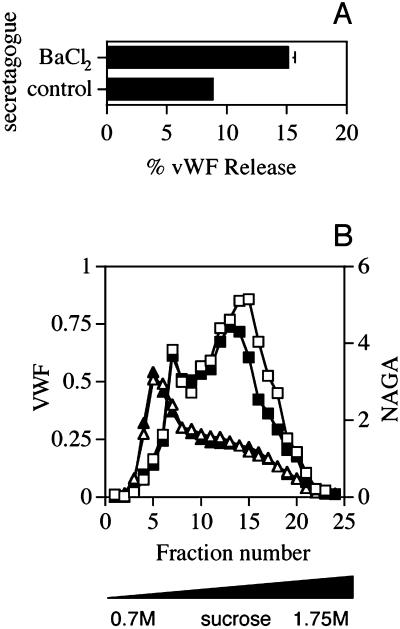
Figure 1
Figure 1
Effects of secretagogue stimulation on secretion (A) and intracellular distribution (B) of vWF in AtT-20 cells. (A) vWF secretion. Duplicate dishes of AtT-20 cells transiently expressing vWF incubated in the presence or absence of 3 mM BaCl2 for 1 h at 37°C. The incubation medium was then collected and the amounts of vWF both in the medium and in the cell lysates were determined by an ELISA. The extent of stimulated vWF release was calculated as the amount of vWF released divided by cell-associated plus released vWF and expressed as a percentage. Each bar represents the mean ± SE of three independent experiments. (B) Intracellular distribution of vWF. AtT-20 cells expressing vWF were incubated in the presence or absence of 3 mM BaCl2 as described in A, rinsed with HB, homogenized, and a PNS obtained. The PNS was centrifuged on linear 0.7–1.75 M sucrose gradients to equilibrium in an SW40Ti rotor (Beckman Coulter) for 24 h at 35000 rpm, which was then collected in 0.5-ml fractions. The distribution of vWF across the gradients from control cells (□) or from cells treated with BaCl2 (∗) was monitored by ELISA (see MATERIALS AND METHODS). The distribution of NAGA activity across the same gradients was determined as described in MATERIALS AND METHODS and is shown for control cells (▴) and those treated with BaCl2 (▵). The data from one representative experiment out of two are shown.
Figure 2
Figure 2
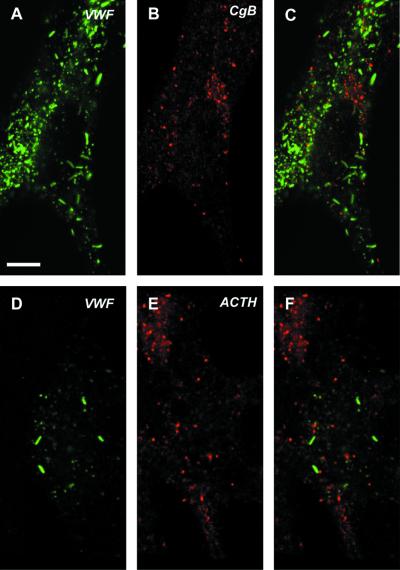
vWF pseudogranules do not contain endogenous ACTH or CgB. AtT-20 cells transiently expressing vWF (3 d posttransfection) were double labeled with either rabbit anti-vWF (A and C) and mouse monoclonal anti-CgB (B and C) or mouse monoclonal anti-vWF (D and F) and rabbit anti-ACTH (E and F). Fixation, permeabilization, and immunofluorescent labeling were performed as described in MATERIALS AND METHODS. The images shown in C and F represent the two channels merged. Bar, 5 μm.
Figure 3
Figure 3
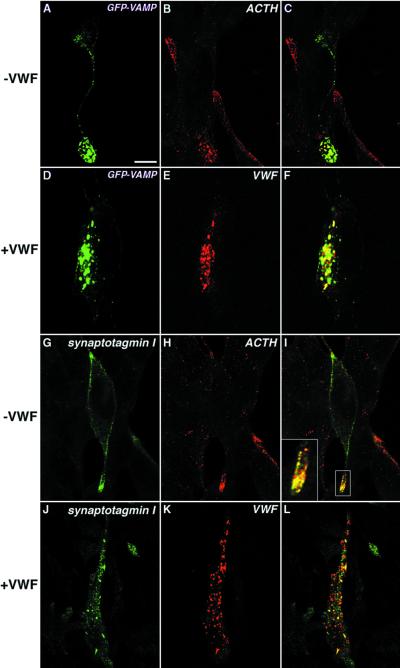
vWF alters the localization of GFP-VAMP and synaptotagmin I in AtT-20 cells. Fixation and permeabilization of cells were carried out as described in MATERIALS AND METHODS. Cells transfected with corresponding cDNAs to transiently express GFP-VAMP (A–C) or full-length synaptotagmin I (G–I) on their own were labeled with rabbit polyclonal anti-ACTH (B and C and E and F) plus mouse monoclonal anti-synaptotagmin I (G and I). Cells coexpressing vWF plus GFP-VAMP (D–F) or vWF plus synaptotagmin I (J–L) were stained with rabbit polyclonal anti-vWF (E and F and K and L) plus mouse monoclonal anti-synaptotagmin I (J and L). C, F, I, and L show merges of the two channels. Bar, 5 μm.
Figure 4
Figure 4
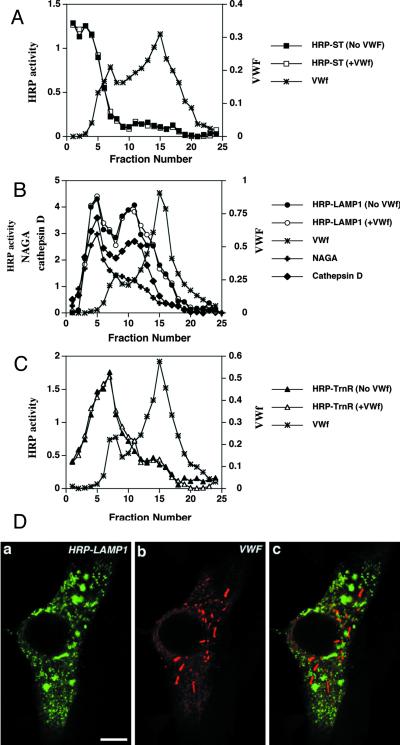
vWF does not affect the localization of HRP-ST, HRP-LAMP1, and HRP-TrnR in AtT-20 cells. (A–C) Cells transiently expressing either HRP-ST, HRP-LAMP1, or HRP-TrnR in the absence or presence of vWF expression were fractionated on 0.7–1.75 M sucrose equilibrium gradients followed by measurement of HRP activity across the gradient (see MATERIALS AND METHODS). The amounts of vWF (∗), NAGA activity (+), and cathepsin D (♦) across the gradient were measured as described in MATERIALS AND METHODS. (A) Distribution of ST-HRP expressed on its own (▪) or coexpressed with vWF (□). (B) Distribution of HRP-LAMP1 expressed on its own (●) or coexpressed with vWF (○). (C) Distribution of HRP-TrnR expressed on its own (▴) or coexpressed with vWF (▵). (D) Immunofluorescence labeling of cells transiently coexpressing HRP-LAMP1 and vWF. Cells were fixed and permeabilized as described in MATERIALS AND METHODS and then colabeled with rabbit polyclonal anti-HRP (a) and sheep polyclonal anti-vWF (b). A merger of two composite channels is shown in c. Bar, 5 μm.
Figure 5
Figure 5
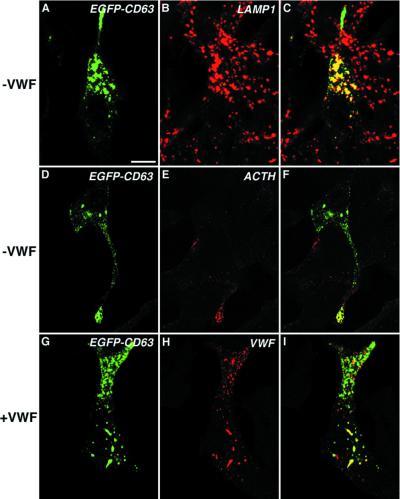
Effect of vWF on the localization of EGFP-CD63 in AtT-20 cells. AtT-20 cells expressing EGFP-CD63 on its own (A–F) were fixed, permeabilized as described in text, and labeled either with rabbit polyclonal anti-LAMP1 (B and C) or with rabbit polyclonal anti-ACTH (E and F). Cells coexpressing EGFP-CD63 and vWF were fixed, permeabilized as described in MATERIALS AND METHODS, and then stained with rabbit polyclonal anti-vWF (H and I). C, F, and I show the two channels merged. Bar, 5 μm.
Figure 6
Figure 6
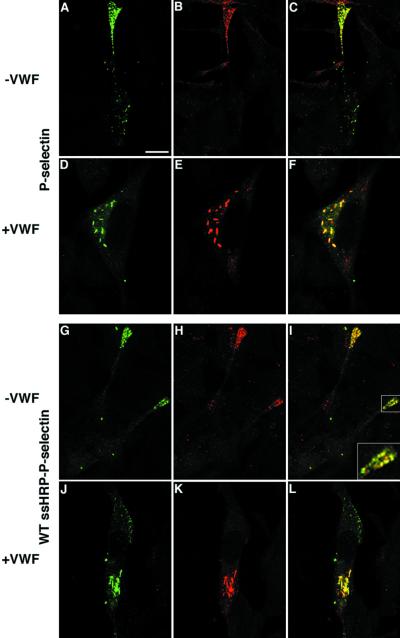
Localization of full-length P-selectin and ssHRPP-selectin in the presence or absence of vWF in AtT-20 cells. Cells transiently expressing either full-length P-selectin (A–C) or ssHRPP-selectin (G–I) alone were double labeled with either mouse monoclonal AK-6 (A and C) and rabbit polyclonal anti-ACTH (B and C) or with mouse monoclonal 2H11 (G and I) and rabbit polyclonal anti-ACTH (H and I). AtT-20 cells transiently coexpressing vWF plus full-length P-selectin (D and F) were costained with mouse monoclonal AK-6 (D and F) and rabbit polyclonal anti-vWF (E and F), whereas cells coexpressing vWF plus ssHRPP-selectin (J–L) were double labeled with mouse monoclonal 2H11 (J and L) and rabbit polyclonal anti-vWF (K and L). Fixation, permeabilization, and immunofluorescent labeling were performed as described in MATERIALS AND METHODS. The images shown in C, F, I, and L represent the two channels merged. Bar, 5 μm.
Figure 7
Figure 7
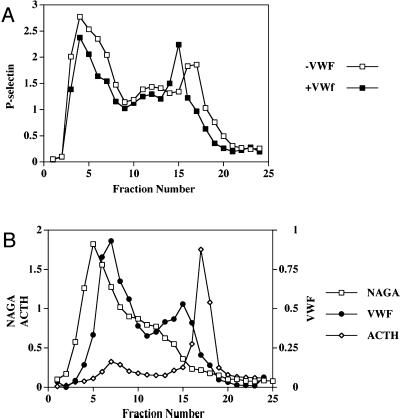
ssHRPP-selectin accumulating within ACTH-containing granules and lysosomes is diverted to pseudogranules in cells expressing vWF. AtT-20 cells transiently expressing either ssHRPP-selectin on its own or coexpressing ssHRPP-selectin plus vWF were processed by subcellular fractionation, as detailed in the legend for Figure 1B at 4 d posttransfection. (A) Distribution of HRP activity along 0.7–1.75 M sucrose equilibrium gradients from cells expressing ssHRPP-selectin on its own (□) and those coexpressing ssHRPP-selectin and vWF (▪). (B) Distribution of vWF (●), NAGA activity (□), and ACTH immunoreactivity (♦) were monitored by ELISA, by NAGA enzymatic assay, and by quantitative densitometry as described in MATERIALS AND METHODS. The data from one of three representative independent experiments are shown.
Figure 8
Figure 8
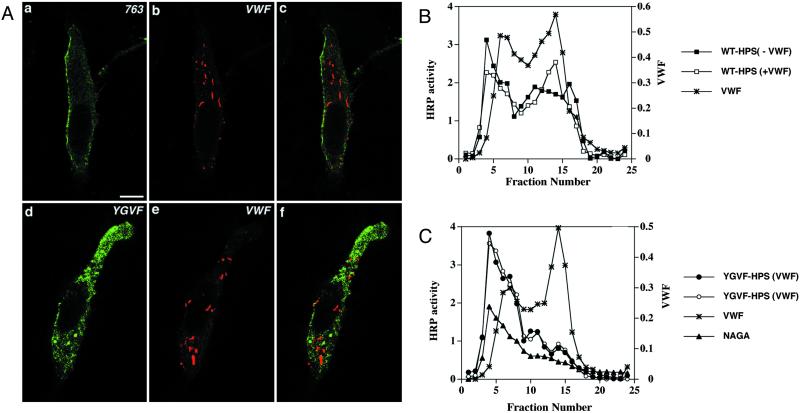
vWF has no effect on the distribution of ssHRPP-selectin763 and ssHRPP-selectinYGVF in AtT-20 cells. (A) Double immunofluorescence labeling of AtT-20 cells transiently coexpressing ssHRPP-selectin763 (763) and vWF (a–c) as well as ssHRPP-selectinYGVF (YGVF) and vWF (d–f). After fixation and permeabilization, the cells were stained with mouse monoclonal 2H11 (a and c and d and f) and rabbit polyclonal anti-vWF (b and c and e and f). c and f represent a merger of two composite channels. (B and C) Subcellular compartmentalization of ssHRPP-selectin, WT-HPS (B), and ssHRPP-selectinYGVF (YGVF-HPS) (C) in the cells expressing or mock-expressing vWF. AtT-20 cells transiently expressing ssHRPP-selectin (▪), ssHRPP-selectin plus vWF (□), ssHRPP-selectinYGVF (●), and ssHRPP-selectinYGVF plus vWF (○) were processed by subcellular fractionation and the distribution of HRP activity across the gradients was monitored as described in the legend for Figure 3. The distributions of vWF (∗) and NAGA activity (▴) are shown. Data from one of two representative experiments are displayed.

References

    1. Arvan P, Castle D. Sorting and storage during secretory granule biogenesis: looking backward and looking forward. Biochem J. 1998;332:593–610. - PMC - PubMed
    1. Blagoveshchenskaya AD, Cutler DF. Biochemical analyses of trafficking with horseradish peroxidase-tagged chimeras. Methods Enzymol. 2000a;327:45–60. - PubMed
    1. Blagoveshchenskaya AD, Cutler DF. Sorting to synaptic-like microvesicles from early and late endosomes requires overlapping but not identical targeting signals. Mol Biol Cell. 2000b;11:1801–1814. - PMC - PubMed
    1. Blagoveshchenskaya AD, Hewitt EW, Cutler DF. A complex web of signal-dependent trafficking underlies the triorganellar distribution of P-selectin in neuroendocrine PC12 cells. J Cell Biol. 1999;145:1419–1433. - PMC - PubMed
    1. Blagoveshchenskaia AD, Kornilova ES, Nikol'skii NN. The endocytosis of the epidermal growth factor (EGF) in EGF-dependent cells of the HC11 mouse mammary epithelium line. Tsitologiia. 1995;37:883–892. - PubMed

Publication types

LinkOut - more resources