. 2002 May;136(2):207-16.
doi: 10.1038/sj.bjp.0704703.

Inhibitory effects of tramadol on nicotinic acetylcholine receptors in adrenal chromaffin cells and in Xenopus oocytes expressing alpha 7 receptors

Affiliations

Inhibitory effects of tramadol on nicotinic acetylcholine receptors in adrenal chromaffin cells and in Xenopus oocytes expressing alpha 7 receptors

Munehiro Shiraishi et al. Br J Pharmacol. 2002 May.

Abstract

1. Tramadol has been used clinically as an analgesic; however, the mechanism of its analgesic effects is still unknown. 2. We used bovine adrenal chromaffin cells to investigate effects of tramadol on catecholamine secretion, nicotine-induced cytosolic Ca(2+) concentration ([Ca(2+)](i)) increases and membrane current changes. We also investigated effects of tramadol on alpha7 nicotinic acetylcholine receptors (AChRs) expressed in Xenopus oocytes. 3. Tramadol concentration-dependently suppressed carbachol-induced catecholamine secretion to 60% and 27% of the control at the concentration of 10 and 100 microM, respectively, whereas it had little effect on veratridine- or high K(+)-induced catecholamine secretion. 4. Tramadol also suppressed nicotine-induced ([Ca(2+)](i)) increases in a concentration-dependent manner. Tramadol inhibited nicotine-induced inward currents, and the inhibition was unaffected by the opioid receptor antagonist naloxone. 5. Tramadol inhibited nicotinic currents carried by alpha7 receptors expressed in Xenopus oocytes. 6. Tramadol inhibited both alpha-bungarotoxin-sensitive and -insensitive nicotinic currents in bovine adrenal chromaffin cells. 7. In conclusion, tramadol inhibits catecholamine secretion partly by inhibiting nicotinic AChR functions in a naloxone-insensitive manner and alpha7 receptors are one of those inhibited by tramadol.


Figures
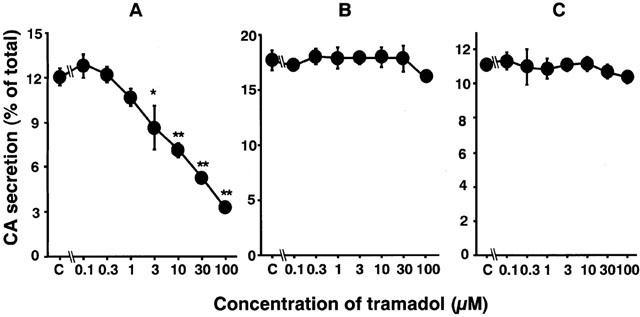
Figure 1
Figure 1
Effects of tramadol on catecholamine (CA) secretion induced by carbachol (A), veratridine (B) or high K+ (C) in bovine adrenal chromaffin cells. Cells were incubated with carbachol (300 μM), veratridine (0.1 mM) or a high K+ (56 mM) solution in the presence of various concentrations of tramadol for 5 min at 37°C. Catecholamine secreted into the medium were measured (see Methods), and expressed as percentage of total catecholamines. Data are means±s.e.mean of four experiments. *P<0.05, **P<0.01 compared with carbachol alone.
Figure 2
Figure 2
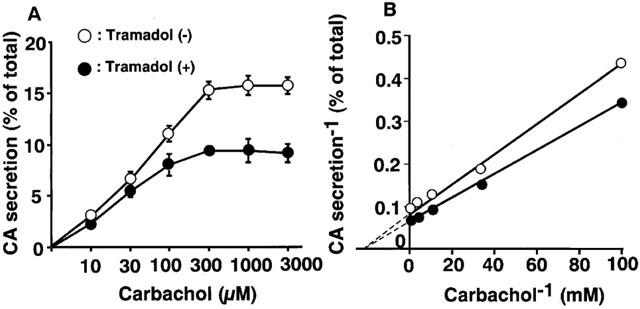
Characterization of inhibitory effects of tramadol on carbachol-evoked catecholamine (CA) secretion in bovine adrenal chromaffin cells. The inhibitory effects of tramadol on carbachol-evoked catecholamine secretion (A) and double-reciprocal plot analysis of the effects (B). Cells were incubated for 5 min with or without carbachol (10 μM to 3 mM) in the presence or absence of tramadol (10 μM). Data are means±s.e.mean of three experiments.
Figure 3
Figure 3
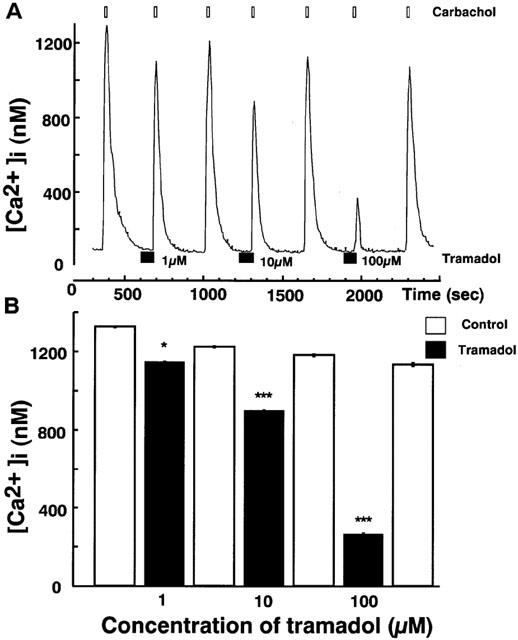
Effects of tramadol on [Ca2+]i rises induced by carbachol in bovine adrenal chromaffin cells. These figures show average changes of the cytosolic Ca2+ concentration induced by carbachol (300 μM) with or without various concentrations of tramadol (1,10 and 100 μM) (A and B). Carbachol was added for 20 s after pretreatment with tramadol (10 μM). Tramadol alone did not induce any change in basal [Ca2+]i rises. Open bars mean the period for carbachol applications and closed bars indicate the period for tramadol applications. *P<0.05, ***P<0.001 (n=16).
Figure 4
Figure 4
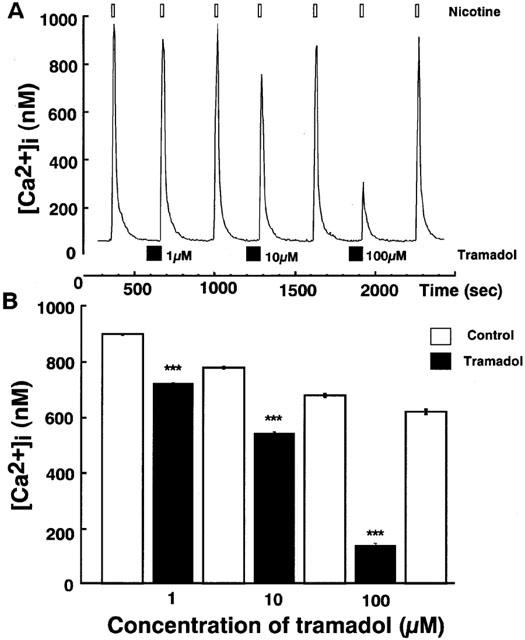
Effects of tramadol on [Ca2+]i rises induced by nicotine in bovine adrenal chromaffin cells. These figures show average changes of the cytosolic Ca2+ concentration induced by nicotine (10 μM) with or without various concentrations of tramadol (1,10 and 100 μM) A and B. Nicotine was added for 20 s after pretreatment with tramadol (10 μM). Tramadol alone did not induce any change in basal [Ca2+]i rises. Open bars mean the period for nicotine applications and closed bars indicate the period for tramadol applications. ***P<0.001 (n=16).
Figure 5
Figure 5
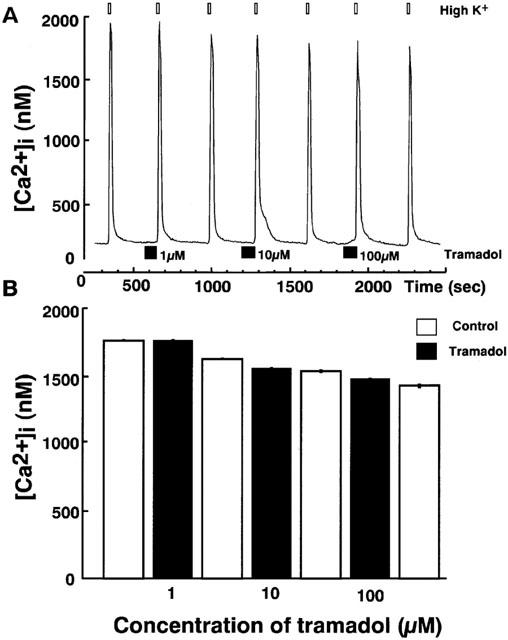
Effects of tramadol on [Ca2+]i rises induced by high K+ in bovine adrenal chromaffin cells. These figures show average changes of the cytosolic Ca2+ concentration induced by high K+ (50 mM) with or without various concentrations of tramadol (1,10 and 100 μM) (A and B). High K+ was added for 20 s after pretreatment with tramadol (10 μM). Tramadol alone did not induce any change in basal [Ca2+]i rises. Open bars mean the period for high K+ applications and closed bars indicate the period for tramadol applications (n=16).
Figure 6
Figure 6
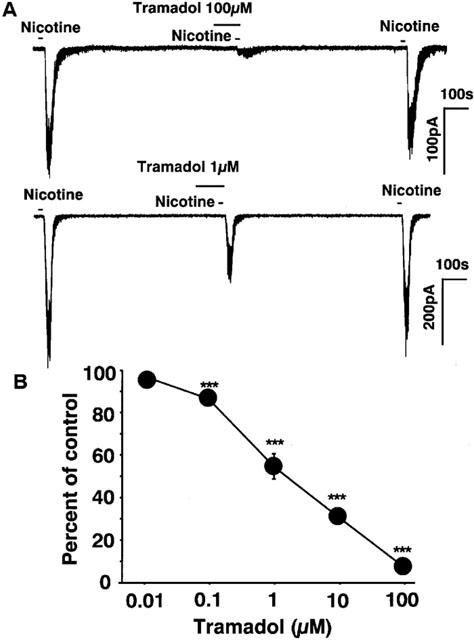
Effects of tramadol on nicotine-induced inward currents recorded by the whole-cell patch-clamp technique in bovine adrenal chromaffin cells. The membrane potential was voltage-clamped to −60 mV. (A) Tracings obtained from a single adrenal chromaffin cell show the effect of tramadol on 10 μM nicotine-induced currents. Nicotine was applied for 20 s with or without 2 min treatment with 100 and 1 μM tramadol. (B) Concentration-response relationship of tramadol on the nicotine-induced currents. Tramadol (10 nM–100 μM) was applied to the cell for 2 min and then 10 μM nicotine was applied for 20 s. Data represent the mean±s.e.mean (n=4–10). ***P<0.001 compared with the control response, using ANOVA.
Figure 7
Figure 7
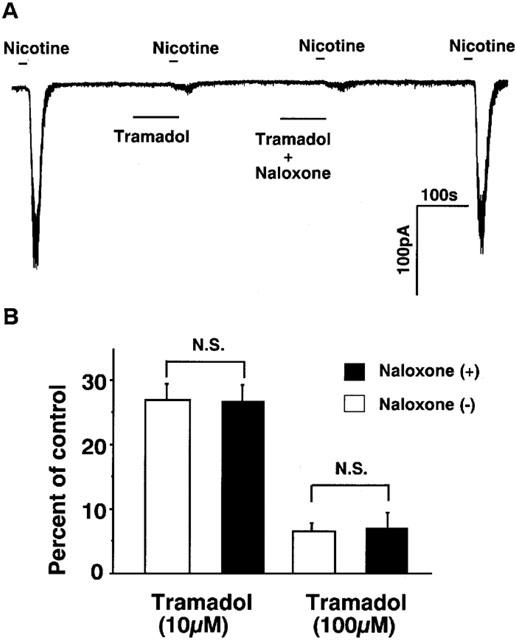
Effects of naloxone on the inhibition by tramadol of nicotine induced inward currents in bovine adrenal chromaffin cells. The effects of tramadol with or without co-application of naloxone were measured to know whether opioid effect of tramadol affect on nicotinic receptor ion channels or not. Membrane potential was voltage-clamped at −60 mV. (A) Tracings were obtained from a single cell showing the effect of tramadol (100 μM) on 10 μM nicotine-induced currents with or without co-application of naloxone (10 μM). Note that naloxone alone did not induce any ionic currents. (B) The effects of naloxone (10 μM) on the inhibition by 100 and 10 μM tramadol on 10 μM nicotine-induced currents. Open bars mean the tramadol applications without naloxone and closed bars indicate the tramadol applications with naloxone. Values are the mean±s.e.mean (n=4).
Figure 8
Figure 8
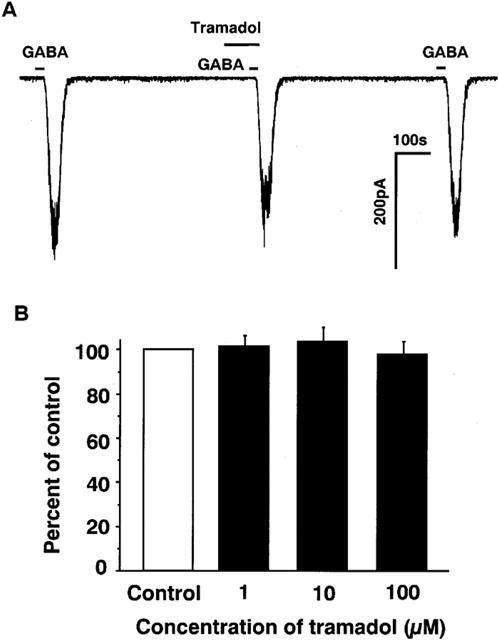
Effects various concentrations of tramadol on inward currents induced by GABA in bovine adrenal chromaffin cells. To know the effects of tramadol on the other ligand-gated ion channels, GABAA receptors instead of nicotinic receptors were examined in adrenal chromaffin cells. (A) Tracings obtained from a single adrenal chromaffin cell show the effect of tramadol (10 μM) on 1 μM GABA-induced currents. (B) Effects of tramadol (1–100 μM) on 1 μM GABA-induced inward currents. GABA was applied for 20 s with or without 2 min treatment with various concentrations of tramadol (1–100 μM). Membrane potential was voltage-clamped at −60 mV (n=6).
Figure 9
Figure 9
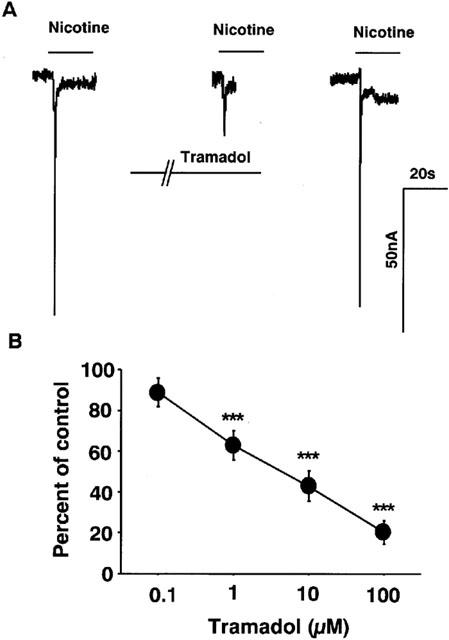
Effects of tramadol on nicotinic receptor-stimulated currents in Xenopus oocytes expressing α7 receptors. (A) Tracings obtained from a single oocyte expressing α7 nicotinic AChRs show the effect of tramadol on 1 mM nicotine-induced currents. Nicotine was applied for 20 s with or without 2 min treatment with 10 μM tramadol. (B) Concentration-response relationship of tramadol on nicotine-induced currents. Tramadol (100 nM–100 μM) was applied to the oocytes for 2 min and then 1 mM nicotine was applied for 20 s. Data represent the mean±s.e.mean (n=3–6). ***P<0.001 compared with the control response, using ANOVA.
Figure 10
Figure 10
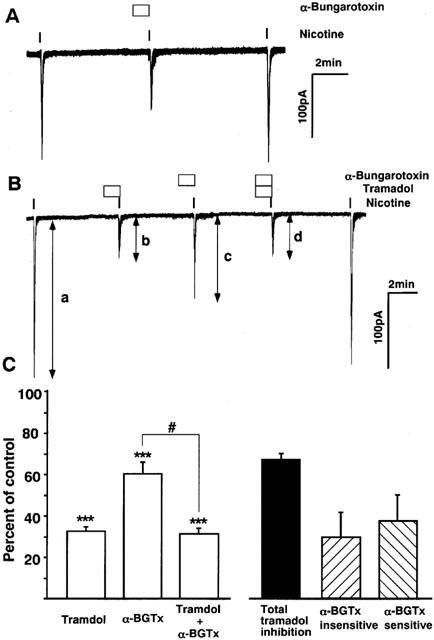
Effects of α-bungarotoxin on nicotine-induced inward currents and on the inhibition by tramadol in bovine adrenal chromaffin cells. The effects of α-bungarotoxin, a selective blocker of α7 nicotinic ACh receptors with or without co-application of tramadol were measured to know whether α7 receptors are involved in the tramadol inhibition on nicotinic currents. The rate of perfusion was doubled and the duration of nicotine application was set to 5 s in this series of experiments. Note that current kinetics is faster than that seen in the previous figures obtained with slower perfusion. Membrane potential was voltage-clamped at −60 mV. (A) a representative tracing obtained from a single cell showing reversible inhibition by α-bungarotoxin (1 μM). (B) The effects of tramadol (10 μM) on control nicotinic currents and currents that had been suppressed by α-bungarotoxin. Values are the mean±s.e.mean (n=4). (C) Summary of the results shown in B. The columns ‘Tramadol', ‘α-BGTx' and ‘Tramadol + α-BGTx' were calculated by dividing ‘b' by ‘a', ‘c' by ‘a' and ‘d' by ‘a' in B, respectively. The columns ‘Total tramadol inhibition', ‘α-BGTx-insensitive' and ‘α-BGTx-sensitive' were calculated by subtracting ‘Tramadol' from 100, ‘Tramadol + α-BGTx' from ‘α-BGTx' and ‘α-BGTx-insensitive' from ‘Total tramadol inhibition', respectively. ***P<0.001 compared with the control response, using ANOVA. #P<0.05 between the two columns.

References

    1. ALKONDON M., PEREIRA E.F., BARBOSA C.T., ALBUQUERQUE E.X. Neuronal nicotinic acetylcholine receptor activation modulates gamma-aminobutyric acid release from CA1 neurons of rat hippocampal slices. J. Pharmacol. Exp. Ther. 1997;283:1396–1411. - PubMed
    1. BANNON A.W., DECKER M.W., HOLLADAY M.W., CURZON P., DONNELLY-ROBERTS D., PUTTFARCKEN P.S., BITNER R.S., DIAZ A., DICKENSON A.H., PORSOLT R.D., WILLIAMS M., ARNERIC S.P. Broad-spectrum, non-opioid analgesic activity by selective modulation of neuronal nicotinic acetylcholine receptors. Science. 1998;279:77–81. - PubMed
    1. BORMANN J., CLAPHAM D.E. gamma-Aminobutyric acid receptor channels in adrenal chromaffin cells: a patch-clamp study. Proc. Natl. Acad. Sci. U.S.A. 1985;82:2168–2172. - PMC - PubMed
    1. BROXTON N.M., DOWN J.G., GEHRMANN J., ALEWOOD P.F., SATCHELL D.G., LIVETT B.G. Alpha-conotoxin ImI inhibits the alpha-bungarotoxin-resistant nicotinic response in bovine adrenal chromaffin cells. J. Neurochem. 1999;72:1656–1662. - PubMed
    1. CAMPOS-CARO A., SMILLIE F.I., DOMINGUEZ DEL TORO E., ROVIRA J.C., VICENTE-AGULLO F., CHAPULI J., JUIZ J.M., SALA S., SALA F., BALLESTA J.J., CRIADO M. Neuronal nicotinic acetylcholine receptors on bovine chromaffin cells: cloning, expression, and genomic organization of receptor subunits. J. Neurochem. 1997;68:488–497. - PubMed

Publication types

LinkOut - more resources