. 2002 May;136(2):237-47.
doi: 10.1038/sj.bjp.0704713.

Intracisternal urocortin inhibits vagally stimulated gastric motility in rats: role of CRF(2)

Affiliations

Intracisternal urocortin inhibits vagally stimulated gastric motility in rats: role of CRF(2)

C-Y Chen et al. Br J Pharmacol. 2002 May.

Erratum in

  • Br J Pharmacol. 2002 Oct;137(3):409

Abstract

1. Corticotropin-releasing factor (CRF) acts in the brain to inhibit thyrotropin-releasing hormone (TRH) analogue, RX-77368-induced vagal stimulation of gastric motility. We investigated CRF receptor-mediated actions of rat urocortin (rUcn) injected intracisternally (ic) on gastric motor function. 2. Urethane-anaesthetized rats with strain gauges on the gastric corpus were injected i.c. with rUcn and 20 min later, with i.c. RX-77368. CRF antagonists were injected i.c. 10 min before rUcn. 3. RX-77368 (1.5, 3, 10, 30 and 100 ng, i.c.) dose-dependently increased corpus contractions, expressed as total area under the curve (AUC, mV min(-1)) to 2.6+/-2.5, 6.1+/-5.9, 9.8+/-2.6, 69.7+/-21.7 and 74.9+/-28.7 respectively vs 0.2+/-0.1 after i.c. saline. Ucn (1, 3 or 10 microg) inhibited RX-77368 (30 ng)-induced increase in total AUC by 28, 62 and 93% respectively vs i.c. saline+RX-77368. 4. The CRF(1)/CRF(2) antagonist, astressin-B (60 microg, i.c.) completely blocked i.c. rUcn (3 microg, i.c.)-induced inhibition of gastric motility stimulated by RX-77368 (30 ng). 5. The selective CRF(2) antagonist, astressin(2)-B (30, 60 or 100 microg, i.c. ) dose-dependently prevented i.c. rUCn action while the CRF(1) antagonist, NBI-27914 did not. 6. In conscious rats, rUcn (0.6 or 1 microg, i.c.) inhibited gastric emptying of an ingested chow meal by 61 and 92% respectively. rUcn action was antagonized by astressin(2)-B. 7. These data show that i.c. rUcn acts through CRF(2) receptors to inhibit central vagal gastric contractile response and postoprandial emptying.


Figures
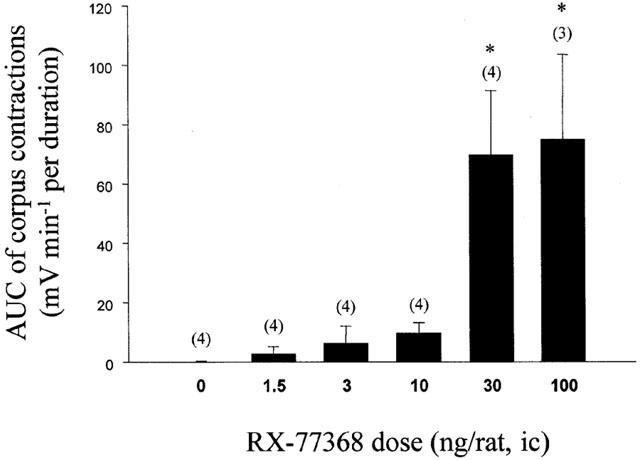
Figure 1
Figure 1
Dose-related stimulation of gastric contractions induced by intracisternal injection of the TRH analogue, RX-77368 in 18-h fasted urethane-anaesthetized rats. After a 30 min basal period, different groups of rats were injected i.c. with either saline or RX-77368 (1.5, 3, 10, 30 and 100 ng) and corpus contractions were recorded for 120 min. Each bar represents the mean±s.e.m. of total AUC of gastric contractions; the number of rats per group is indicated on top of bars; *P<0.05 compared with other doses (ANOVA).
Figure 2
Figure 2
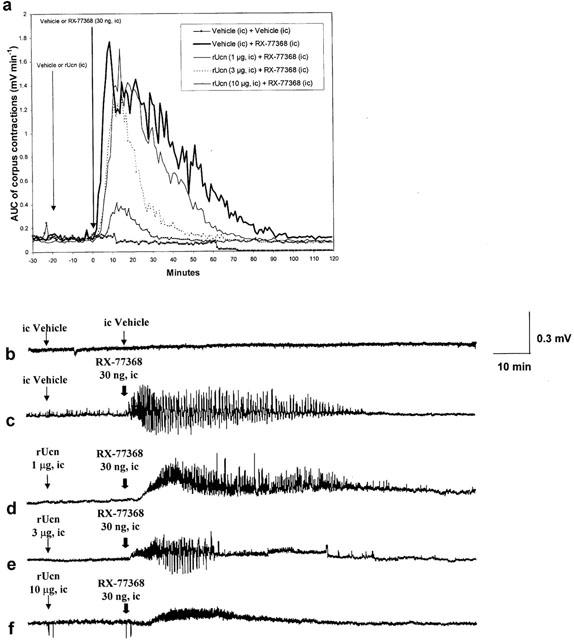
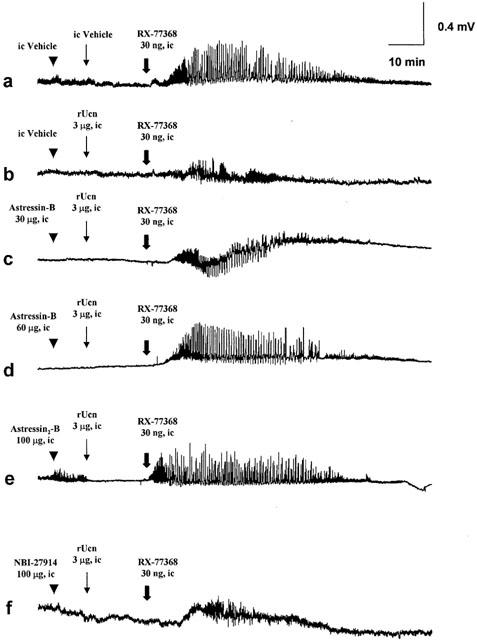
(a) Time course of gastric contractile response to i.c. RX-77368 and dose-related inhibitory effect of i.c. urocortin in 18-h fasted urethane-anaesthetized rats. Each point represents the mean AUC min−1 of corpus contractions; (b–f) Representative traces of the dose-related and temporal inhibitory effect of intracisternal urocortin on RX-77368-induced stimulation of gastric contractions. Note the marked increase in corpus contractility induced by i.c. injection of the TRH analogue (c) compared with that of saline (b) and the dose-related inhibition of contractile response (magnitude and duration) by urocortin at 1, 3 and 10 μg (d–f).
Figure 3
Figure 3
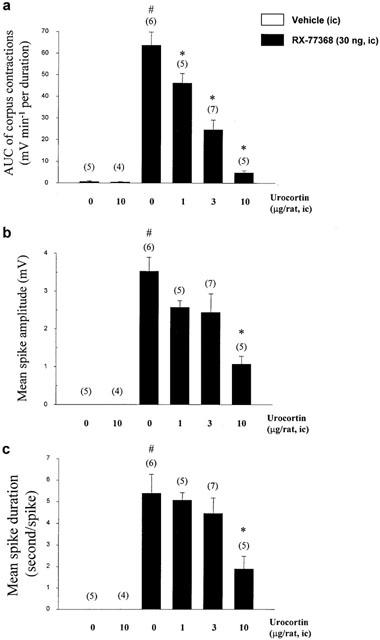
Dose-related inhibitory effect of intracisternal urocortin on RX-77368-induced stimulation of gastric contractions in 18-h fasted urethane-anaesthetized rats. After 30 min basal period, different groups of rats were injected i.c. with vehicle or rUcn (1, 3 or 10 μg) and 20 min later with RX-77368 (30 ng) or saline, and corpus contractions were recorded for 120 min. Bar graphs represent the mean±s.e.m. of total AUC (a), mean spike amplitude (b), and mean spike duration (c); the number of animals is indicated on top of the columns. *P<0.05 compared with vehicle+RX-77368; #P<0.05 vs vehicle+vehicle or urocortin+vehicle.
Figure 4
Figure 4
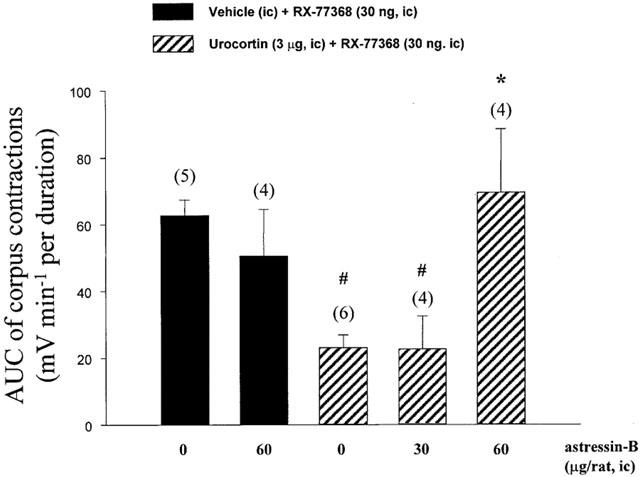
Intracisternal astressin B antagonized intracisternal urocortin-induced inhibition of RX-77368 induced stimulation of gastric contractions in 18-h fasted urethane-anaesthetized rats. Intracisternal injection of astressin B or vehicle was followed 10 min later by that of urocortin or vehicle and 20 min later by RX-77368. Gastric contractility was monitored for 40 min before and 120 min after RX-77368 injection. Each bar represents the mean±s.e.m. of total AUC of corpus contractions; the number of rats per group is indicated on top of each bar. *P<0.05 compared with vehicle+urocortin+RX-77368; #P<0.05 compared with vehicle+vehicle+RX-77368.
Figure 5
Figure 5
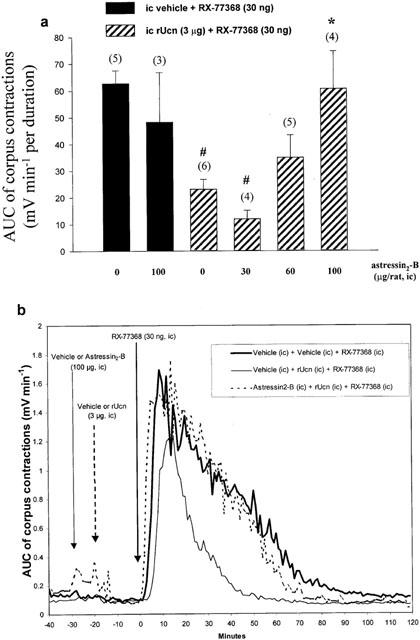
Intracisternal astressin2-B dose-dependently antagonized intracisternal urocortin-induced inhibition of RX-77368 stimulated gastric contractions in 18 h-fasted urethane-anaesthetized rats. Intracisternal injection of astressin2-B or vehicle was followed 10 min later by that of urocortin or vehicle and 20 min later RX-77368. Gastric contractility was monitored for 40 min before injections and up to 120 min after RX-77368. Each bar represents the mean±s.e.m. of total AUC of contractions; the number of rats per group is indicated on top of each bar (a). Time course of contractile response with each point representing the mean of AUC min−1 (b). *P<0.05 compared with vehicle+urocortin+RX-77368; #P<0.05 compared with vehicle+vehicle+RX-77368.
Figure 6
Figure 6
Representative tracing of blockade of intracisternal urocortin-induced inhibition of gastric motor activity stimulated by RX-77368: blockade by the CRF1/CRF2 receptor antagonist, astressin B and the selective CRF2 receptor antagonist, astressin2-B but not by the selective CRF1 receptor antagonist, NBI-27914 in 18-h fasted urethane-anaesthetized rats. Note the marked increase in corpus contractility induced by i.c. injection of the TRH analogue (a) and the inhibitory effect of i.c. rUcn (b) and the dose-related reversal by astressin B (c,d) and astressin2-B (e) while NBI-27914 had no effect (f).
Figure 7
Figure 7
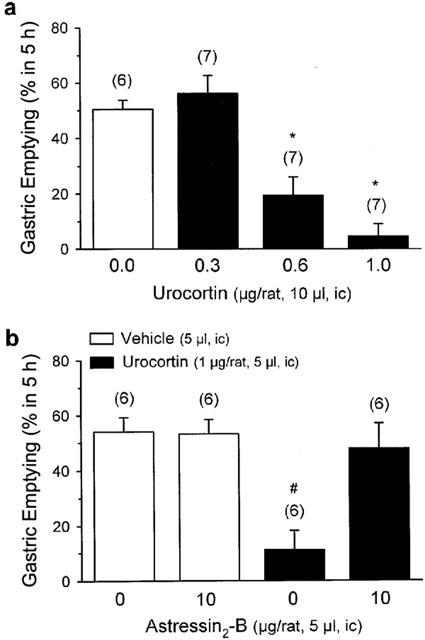
Dose-related inhibition of gastric emptying of a solid meal by intracisternal injection of urocortin in conscious fed rats (a) and blockade of urocortin effects by pretreatment with the selective CRF2 receptor antagonist astressin2-B (b). Fasted rats were given free access to Purina chow and water for 3 h, then food and water were removed; (a) saline or rUcn (0.3–1 μg) was injected i.c. in different groups of rats; (b) vehicle or astressin2-B was injected i.c. followed by i.c. injection of saline or rUcn (1 μg) and gastric emptying monitored 5 h later. Each bar represents the mean±s.e.m.; the number of rats per group is indicated on top of each bar. *P<0.05 compared with vehicle (0.0) and rUen (0.3). #P<0.05 compared with other experimental groups.

References

    1. ASAKAWA A., INUI A., UENO N., MAKINO S., FUJINO M.A., KASUGA M. Urocortin reduces food intake and gastric emptying in lean and ob/ob obese mice. Gastroenterology. 1999;116:1287–1292. - PubMed
    1. BERTHOUD H.R., CARLSON N.R., POWLEY T.L. Topography of efferent vagal innervation of the gastrointestinal tract. Am. J. Physiol. 1991;260:R200–R207. - PubMed
    1. BITTENCOURT J.C., SAWCHENKO P.E. Do centrally administered neuropeptides access cognate receptors?: an analysis in the central corticotropin-releasing factor system. J. Neurosci. 2000;20:1142–1156. - PMC - PubMed
    1. BROCCARDO M., IMPROTA G. Pituitary-adrenal and vagus modulation of sauvagine- and CRF-induced inhibition of gastric emptying in rats. Eur. J. Pharmacol. 1990;182:357–362. - PubMed
    1. BUÉNO L., FARGEAS M.J., GUÉ M., PEETERS T.L., BORMANS V., FIORAMONTI J. Effects of corticotropin-releasing factor on plasma motilin and somatostatin levels and gastrointestinal motility in dogs. Gastroenterology. 1986;91:884–889. - PubMed

Publication types

MeSH terms

Substances

LinkOut - more resources