[Nphe1,Arg14,Lys15]nociceptin-NH2, a novel potent and selective antagonist of the nociceptin/orphanin FQ receptor
- PMID: 12010780
- PMCID: PMC1573345
- DOI: 10.1038/sj.bjp.0704706
[Nphe1,Arg14,Lys15]nociceptin-NH2, a novel potent and selective antagonist of the nociceptin/orphanin FQ receptor
Abstract
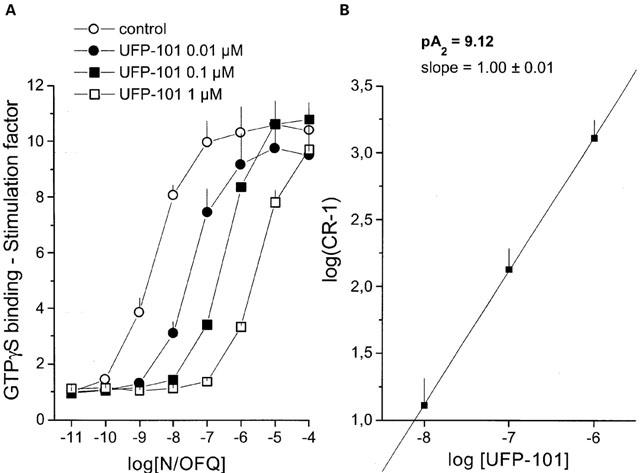
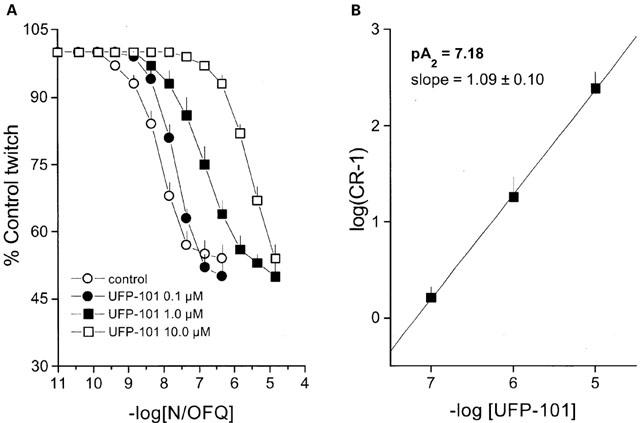
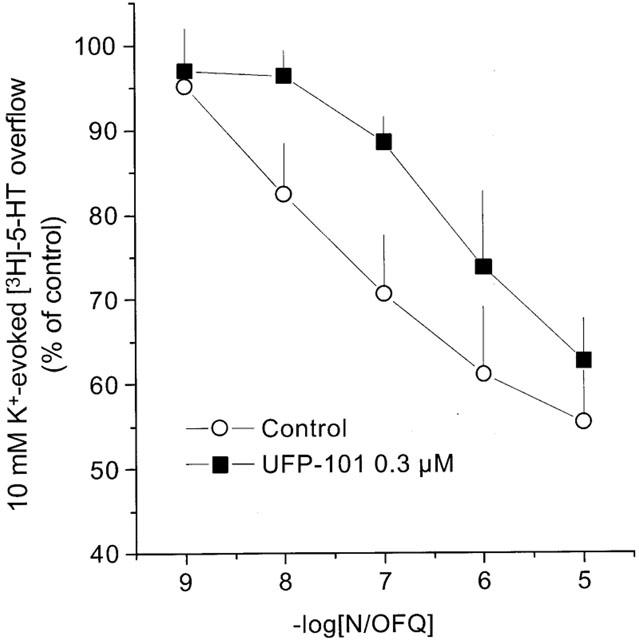
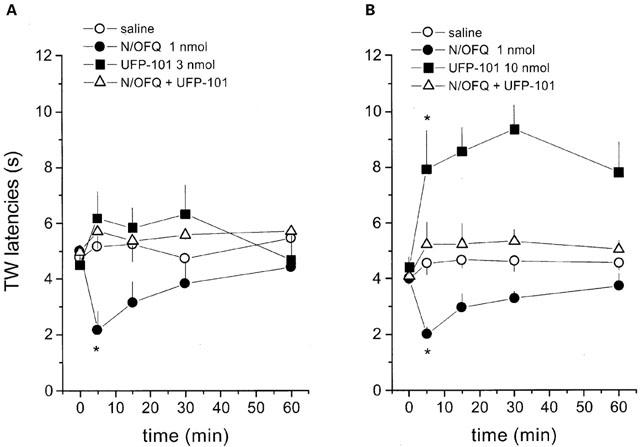
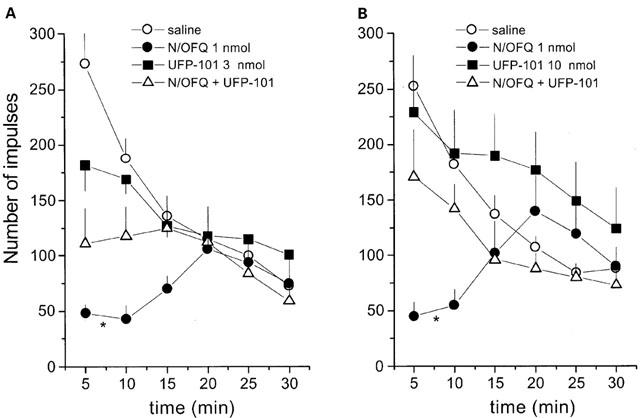
1. Nociceptin/orphanin FQ (N/OFQ) modulates several biological functions by activating a specific G-protein coupled receptor (NOP). Few molecules are available that selectively activate or block the NOP receptor. Here we describe the in vitro and in vivo pharmacological profile of a novel NOP receptor ligand, [Nphe(1),Arg(14),Lys(15)]N/OFQ-NH(2) (UFP-101). 2. UFP-101 binds to the human recombinant NOP receptor expressed in Chinese hamster ovary (CHO) cells with high affinity (pK(i) 10.2) and shows more than 3000 fold selectivity over classical opioid receptors. UFP-101 competitively antagonizes the effects of N/OFQ on GTPgamma(35)S binding in CHO(hNOP) cell membranes (pA(2) 9.1) and on cyclic AMP accumulation in CHO(hNOP) cells (pA(2) 7.1), being per se inactive at concentrations up to 10 microM. 3. In isolated peripheral tissues of mice, rats and guinea-pigs, and in rat cerebral cortex synaptosomes preloaded with [(3)H]-5-HT, UFP-101 competitively antagonized the effects of N/OFQ with pA(2) values in the range of 7.3 - 7.7. In the same preparations, the peptide was inactive alone and did not modify the effects of classical opioid receptor agonists. 4. UFP-101 is also active in vivo where it prevented the depressant action on locomotor activity and the pronociceptive effect induced by 1 nmol N/OFQ i.c.v. in the mouse. In the tail withdrawal assay, UFP-101 at 10 nmol produces per se a robust and long lasting antinociceptive effect. 5. UFP-101 is a novel, potent and selective NOP receptor antagonist which appears to be a useful tool for future investigations of the N/OFQ-NOP receptor system.
Figures
References
-
- BECKER J.A., WALLACE A., GARZON A., INGALLINELLA P., BIANCHI E., CORTESE R., SIMONIN F., KIEFFER B.L., PESSI A. Ligands for kappa-opioid and ORL1 receptors identified from a conformationally constrained peptide combinatorial library. J. Biol. Chem. 1999;274:27513–27522. - PubMed
-
- BERGER H., CALO G., ALBRECHT E., GUERRINI R., BIENERT M. [Nphe1]NC(1–13)NH2 selectively antagonizes nociceptin/orphanin FQ-stimulated G-protein activation in rat brain. J. Pharmacol. Exp. Ther. 2000;294:428–433. - PubMed
-
- BIGONI R., CALO G., RIZZI A., GUERRINI R., DE RISI C., HASHIMOTO Y., HASHIBA E., LAMBERT D.G., REGOLI D. In vitro characterization of J-113397, a non-peptide nociceptin/orphanin FQ receptor antagonist. Naunyn Schmiedebergs Arch. Pharmacol. 2000;361:565–568. - PubMed
-
- BIGONI R., GIULIANI S., CALO G., RIZZI A., GUERRINI R., SALVADORI S., REGOLI D., MAGGI C.A. Characterization of nociceptin receptors in the periphery: in vitro and in vivo studies. Naunyn Schmiedebergs Arch. Pharmacol. 1999;359:160–167. - PubMed
-
- CALO G., BIGONI R., RIZZI A., GUERRINI R., SALVADORI S., REGOLI D. Nociceptin/orphanin FQ receptor ligands. Peptides. 2000a;21:935–947. - PubMed
Publication types
MeSH terms
Substances
LinkOut - more resources
Full Text Sources
Other Literature Sources
Molecular Biology Databases