Staging of hepatocellular carcinoma: assessment of the CLIP, Okuda, and Child-Pugh staging systems in a cohort of 257 patients in Toronto
- PMID: 12010894
- PMCID: PMC1773247
- DOI: 10.1136/gut.50.6.881
Staging of hepatocellular carcinoma: assessment of the CLIP, Okuda, and Child-Pugh staging systems in a cohort of 257 patients in Toronto
Abstract
Background: A new staging system for hepatocellular carcinoma (HCC) has recently been reported from Italy (CLIP classification). It combines Child-Pugh staging with tumour criteria: tumour morphology, portal invasion, and alpha fetoprotein levels.
Aims: To validate the use of the CLIP staging in a cohort of HCC patients and compare it with Okuda staging.
Patients and methods: A retrospective analysis of patients with HCC diagnosed in the Toronto General Hospital between October 1994 and December 1998.
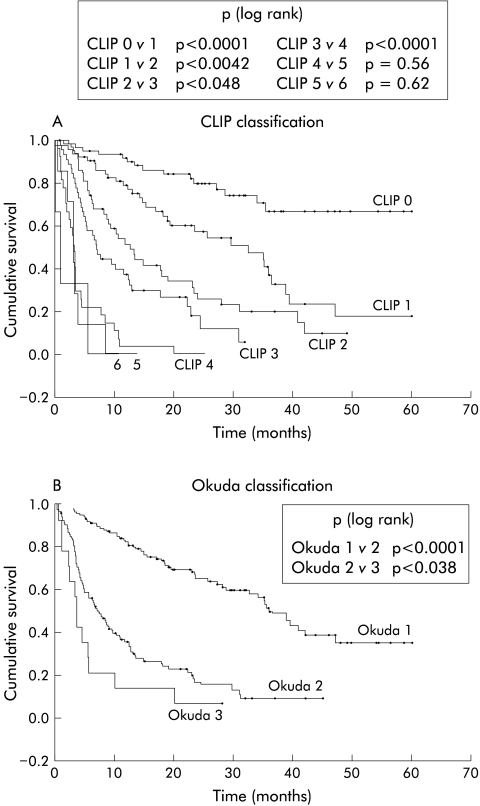
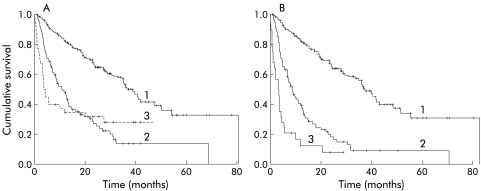
Results: A total of 313 patients were identified; 19 patient with insufficient data and 37 transplant patients were excluded. Hence 257 patients in whom complete data for clinical staging were available were included in the study. The median survival of the cohort was 22.8 months. The CLIP stage 0 group (23.1% of the cohort) and the Okuda stage 1 group (50.7% of the cohort) had a five year survival rate of 67% and 35%, respectively (p<0.02). The CLIP stage 0 criteria more accurately defined patients with a good prognosis. The Okuda classification failed to identify two thirds of the 37 patients with a poor prognosis, who were identified by the CLIP criteria. Patients with a CLIP score > or =4 shared a very poor prognosis (median survival 1-3 months). Further classification above stage 4 was unnecessary.
Summary: The CLIP classification for HCC is easy to implement and more accurate than the Okuda classification. Our cohort was different from the CLIP cohort (more hepatitis B) but the results were still consistent.
Figures
Comment in
-
HCC: what's the score.Gut. 2002 Jun;50(6):749-50. doi: 10.1136/gut.50.6.749. Gut. 2002. PMID: 12010872 Free PMC article. No abstract available.
References
-
- Okuda K, Ohtsuki T, Obata H, et al. Natural history of hepatocellular carcinoma and prognosis in relation to treatment. Cancer 1985;56:918–28. - PubMed
-
- Pugh RNH, Murray-Lyon IM, Dawson JL, et al. Transection of the oesophagus for bleeding oesophageal varices. Br J Surg 1973;60:646–64. - PubMed
-
- International Union Against Cancer (UICC). In: LH Sobin, Ch Wittekind, eds. TMN classification of malignant tumours, 5 edn. New York: Wiley-Liss, 1997:74–7.
-
- Izumi R, Shimizu K, II T, et al. Prognostic factors of hepatocellular carcinoma in patients undergoing hepatic resection. Gastroenterology 1994;106:720–7. - PubMed
-
- Staudacher C, Chiappa A, Biella F, et al. Validation of the modified TMN-Izumi classification for hepatocellular carcinoma. Tumori 200;86:8–11. - PubMed
Publication types
MeSH terms
LinkOut - more resources
Full Text Sources
Other Literature Sources
Medical