


Role of tumor necrosis factor alpha in Helicobacter pylori gastritis in tumor necrosis factor receptor 1-deficient mice
- PMID: 12011009
- PMCID: PMC127975
- DOI: 10.1128/IAI.70.6.3149-3155.2002
Role of tumor necrosis factor alpha in Helicobacter pylori gastritis in tumor necrosis factor receptor 1-deficient mice
Abstract
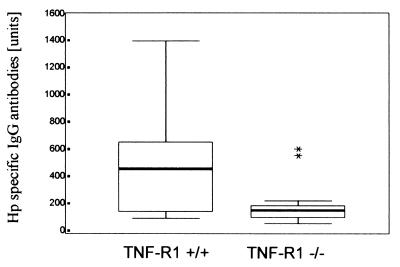
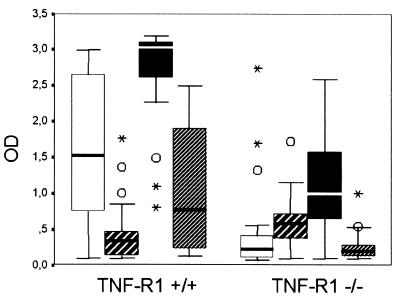
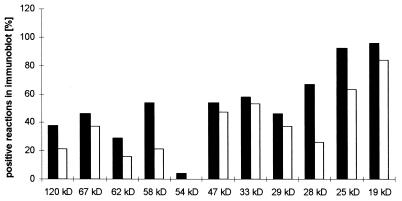
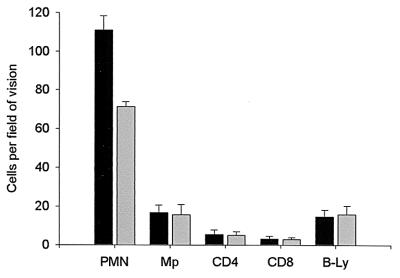
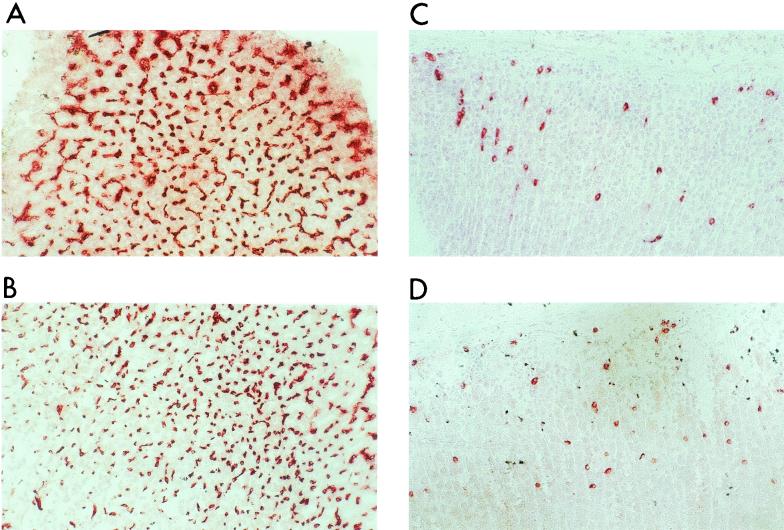
Increased gastric production of interleukin 8 and tumor necrosis factor alpha (TNF-alpha) has been implicated in the pathogenesis of Helicobacter pylori-associated gastroduodenal disease. In the present study we used a mouse model to demonstrate whether loss of the tumor necrosis factor receptor 1 (TNF-R1) function leads to differences in gastric inflammation or the systemic immune response in H. pylori infection. Six different clinical isolates of H. pylori (three cytotoxin-positive and three cytotoxin-negative strains) were adapted to C57BL/6 mice. TNF-R1-deficient (TNF-R1(-/-)) mice (n = 19) and isogenetic controls (n = 24) were infected and sacrificed after 4 weeks of infection. Inflammation of the stomach and the humoral immune response to H. pylori were evaluated by histological, immunohistochemical, and serological methods. There was no detectable difference in the grade or activity of gastritis in TNF-R1(-/-) mice when they were compared with wild-type mice, but the number of lymphoid aggregates was slightly reduced in the gastric mucosa of TNF-R1(-/-) mice. Interestingly, total immunoglobulin G (IgG), as well as IgG1, IgG2b, and IgG3, H. pylori-specific antibody titers were significantly higher in wild-type mice. As revealed by immunoblot analysis, the difference in reactivity against H. pylori antigens was not based on a failure to recognize single H. pylori antigens in TNF-R1(-/-) mice. We therefore suggest that TNF-R1-mediated TNF-alpha signals might support a systemic humoral immune response against H. pylori and that the gastric inflammatory response to H. pylori infection seems to be independent of TNF-R1-mediated signals.
Figures
References
-
- Atherton, J. C., P. Cao, R. M. Peek, Jr., M. K. Tummuru, M. J. Blaser, and T. L. Cover. 1995. Mosaicism in vacuolating cytotoxin alleles of Helicobacter pylori. Association of specific vacA types with cytotoxin production and peptic ulceration. J. Biol. Chem. 270:17771-17777. - PubMed
-
- Atherton, J. C., R. M. Peek, K. T. Tham, T. L. Cover, and M. J. Blaser. 1997. Clinical and pathological importance of heterogeneity in vacA, the vacuolating cytotoxin gene of Helicobacter pylori. Gastroenterology 112:92-99. - PubMed
-
- Beales, I. L., and J. Calam. 1997. Stimulation of IL-8 production in human gastric epithelial cells by Helicobacter pylori, IL-1beta and TNF-alpha requires tyrosine kinase activity, but not protein kinase C. Cytokine 9:514-520. - PubMed
-
- Beutler, B., and A. Cerami. 1988. Tumor necrosis, cachexia, shock, and inflammation: a common mediator. Annu. Rev. Biochem. 57:505-518. - PubMed
Publication types
MeSH terms
Substances
LinkOut - more resources
Full Text Sources
Other Literature Sources
Medical
Research Materials
