


Differences in innate immune responses (in vitro) to HeLa cells infected with nondisseminating serovar E and disseminating serovar L2 of Chlamydia trachomatis
- PMID: 12011019
- PMCID: PMC128021
- DOI: 10.1128/IAI.70.6.3234-3248.2002
Differences in innate immune responses (in vitro) to HeLa cells infected with nondisseminating serovar E and disseminating serovar L2 of Chlamydia trachomatis
Abstract
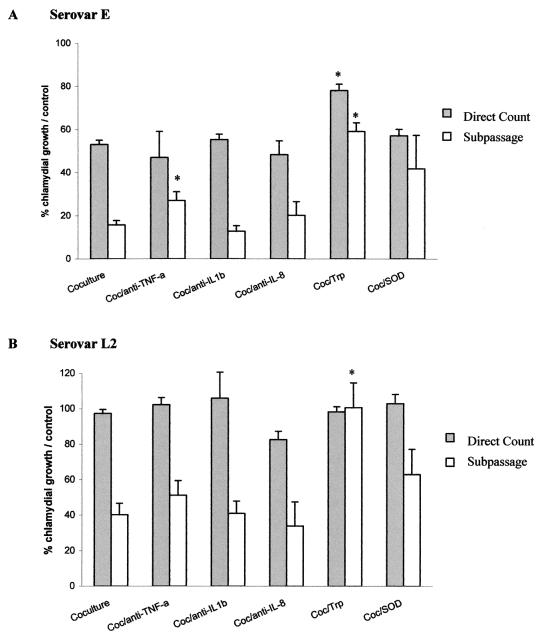
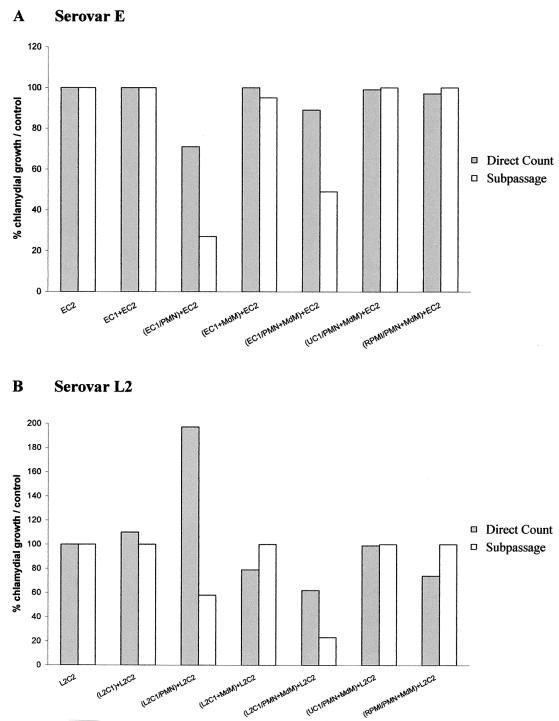
The inflammatory response associated with Chlamydia trachomatis genital infections is thought to be initiated by the release of proinflammatory cytokines from infected epithelial cells. This study focuses on the interactions between C. trachomatis-infected HeLa cells and immune cells involved in the early stages of infection, i.e., neutrophils and macrophages. First, we showed that the expression of interleukin-11 (IL-11), an anti-inflammatory cytokine mainly active on macrophages, was upregulated at the mRNA level in the genital tracts of infected mice. Second, incubation of differentiated THP-1 (dTHP-1) cells or monocyte-derived macrophages (MdM) with basal culture supernatants from C. trachomatis serovar E- or serovar L2-infected HeLa cells resulted in macrophage activation with a differential release of tumor necrosis factor alpha (TNF-alpha) and upregulation of indoleamine 2,3-deoxygenase (IDO) but not of Toll-like receptor 2 and 4 mRNA expression. Third, coculture of infected HeLa cells with dTHP-1 cells resulted in a reduction in chlamydial growth, which was more dramatic for serovar E than for L2 and which was partially reversed by the addition of anti-TNF-alpha antibodies for serovar E or exogenous tryptophan for both serovars but was not reversed by the addition of superoxide dismutase or anti-IL-8 or anti-IL-1beta antibodies. A gamma interferon-independent IDO mRNA upregulation was also detected in dTHP-1 cells from infected cocultures. Lastly, with a two-stage coculture system, we found that (i) supernatants from neutrophils added to the apical side of infected HeLa cell cultures were chlamydicidal and induced MdM to express antichlamydial activity and (ii) although polymorphonuclear leukocytes released more proinflammatory cytokines in response to serovar E- than in response to L2-infected cells, MdM were strongly activated by serovar L2 infection, indicating that the early inflammatory response generated with a nondisseminating or a disseminating strain is different.
Figures


References
-
- Airenne, S., H. M. Surcel, A. Bloigu, K. Laitinen, P. Saikku, and A. Laurila. 2000. The resistance of human monocyte-derived macrophages to Chlamydia pneumoniae infection is enhanced by interferon-gamma. APMIS 108:139-144. - PubMed
-
- Bozza, M., J. L. Bliss, A. J. Dorner, and W. L. Trepicchio. 2001. Interleukin-11 modulates Th1/Th2 cytokine production from activated CD4+ T cells. J. Interferon Cytokine Res. 21:21-30. - PubMed
-
- Campbell, S., S. J. Richmond, P. S. Yates, and C. C. Storey. 1994. Lipopolysaccharide in cells infected by Chlamydia trachomatis. Microbiology 140:1995-2002. - PubMed
-
- Cario, E., I. M. Rosenberg, S. L. Brandwein, P. L. Beck, H.-C. Reinecker, and D. K. Podolsky. 2000. Lipopolysaccharide activates distinct signaling pathways in intestinal epithelial cell lines expressing Toll-like receptors. J. Immunol. 164:966-972. - PubMed
-
- Currier, A. R., M. H. Ziegler, M. M. Riley, T. A. Babcock, V. P. Telbis, and J. M. Carlin. 2000. Tumor necrosis factor-α and lipopolysaccharide enhance interferon-induced antichlamydial indoleamine dioxygenase activity independently. J. Interferon Cytokine Res. 20:369-376. - PubMed
Publication types
MeSH terms
Substances
Grants and funding
LinkOut - more resources
Full Text Sources
Medical
Research Materials
