


doi: 10.1128/IAI.70.6.3277-3280.2002.
Segmented filamentous bacteria interact with intraepithelial mononuclear cells
Affiliations
- PMID: 12011024
- PMCID: PMC128008
- DOI: 10.1128/IAI.70.6.3277-3280.2002
Item in Clipboard
Segmented filamentous bacteria interact with intraepithelial mononuclear cells
Infect Immun.
2002 Jun.
Abstract
Segmented filamentous bacteria (SFB) are found in multiple species and play an important role in the development of mucosal immunity. The mechanism by which the bacteria interact with the immune system has not been well defined. We provide morphologic evidence of direct interaction between SFB and intraepithelial mononuclear cells.
Figures
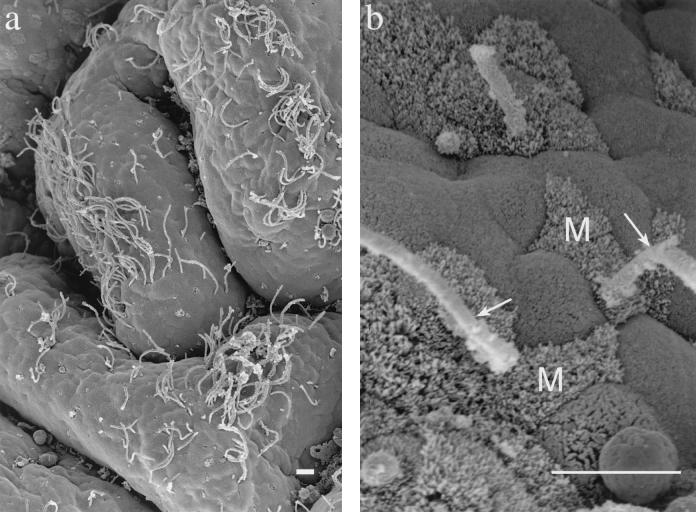
Scanning electron micrographs of ileal tissue with associated SFB. (a) Villi with SFB. Bar = 10 μm. (b) SFB (arrows) attached near M cells (M) of the follicle-associated epithelium. Bar = 10 μm.
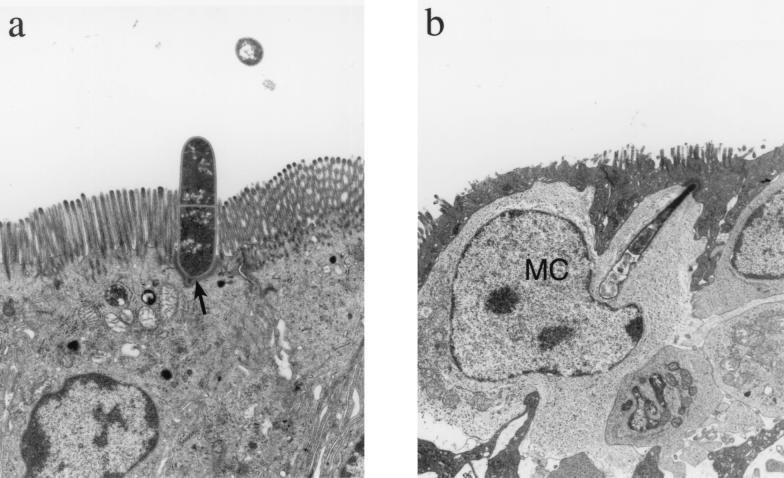
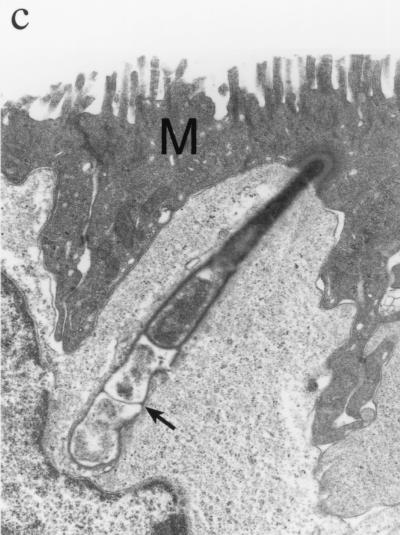
Transmission electron micrographs of SFB attached to the intestinal epithelium. (a) SFB (arrow) attached to the apical portion of the enterocyte. Magnification, ×4,300. (b) SFB extending through an M cell and into intimate association with a mononuclear cell (MC). Magnification, ×4,300. (c) The SFB segments (arrow) which are below the M cell (M) and which are most intimately associated with the mononuclear cell are irregularly shaped and less electron dense. Magnification, ×11,500.
Transmission electron micrographs of SFB attached to the intestinal epithelium. (a) SFB (arrow) attached to the apical portion of the enterocyte. Magnification, ×4,300. (b) SFB extending through an M cell and into intimate association with a mononuclear cell (MC). Magnification, ×4,300. (c) The SFB segments (arrow) which are below the M cell (M) and which are most intimately associated with the mononuclear cell are irregularly shaped and less electron dense. Magnification, ×11,500.
References
-
- Ackermann, M. R., N. F. Cheville, and B. L. Deyoe. 1988. Bovine ileal dome lymphoepithelial cells: endocytosis and transport of Brucella abortus strain 19. Vet. Pathol. 25:2835. - PubMed
-
- Alpan, O., G. Rudomen, and P. Matzinger. 2001. The role of dendritic cells, B cells, and M cells in gut-oriented immune responses. J. Immunol. 166:4843-4852. - PubMed
-
- Beier, R., and A. Gerbert. 1998. Kinetics of particle uptake in the domes of Peyer's patches. Am. J. Physiol. 275:G130-G137. - PubMed
-
- Garland, C. D., A. Lee, and M. R. Dickson. 1982. Segmented filamentous bacteria in the rodent small intestine: colonization of growing animals and possible role in host resistance to Salmonella. Microb. Ecol. 8:181-190. - PubMed
MeSH terms
LinkOut - more resources
Full Text Sources
Medical
