. 2002 May;129(1):85-94.
doi: 10.1104/pp.010829.

Characterization of FRO1, a pea ferric-chelate reductase involved in root iron acquisition

Affiliations

Characterization of FRO1, a pea ferric-chelate reductase involved in root iron acquisition

Brian M Waters et al. Plant Physiol. 2002 May.

Abstract

To acquire iron, many plant species reduce soil Fe(III) to Fe(II) by Fe(III)-chelate reductases embedded in the plasma membrane of root epidermal cells. The reduced product is then taken up by Fe(II) transporter proteins. These activities are induced under Fe deficiency. We describe here the FRO1 gene from pea (Pisum sativum), which encodes an Fe(III)-chelate reductase. Consistent with this proposed role, FRO1 shows similarity to other oxidoreductase proteins, and expression of FRO1 in yeast conferred increased Fe(III)-chelate reductase activity. Furthermore, FRO1 mRNA levels in plants correlated with Fe(III)-chelate reductase activity. Sites of FRO1 expression in roots, leaves, and nodules were determined. FRO1 mRNA was detected throughout the root, but was most abundant in the outer epidermal cells. Expression was detected in mesophyll cells in leaves. In root nodules, mRNA was detected in the infection zone and nitrogen-fixing region. These results indicate that FRO1 acts in root Fe uptake and they suggest a role in Fe distribution throughout the plant. Characterization of FRO1 has also provided new insights into the regulation of Fe uptake. FRO1 expression and reductase activity was detected only in Fe-deficient roots of Sparkle, whereas both were constitutive in brz and dgl, two mutants with incorrectly regulated Fe accumulation. In contrast, FRO1 expression was responsive to Fe status in shoots of all three plant lines. These results indicate differential regulation of FRO1 in roots and shoots, and improper FRO1 regulation in response to a shoot-derived signal of iron status in the roots of the brz and dgl mutants.


Figures
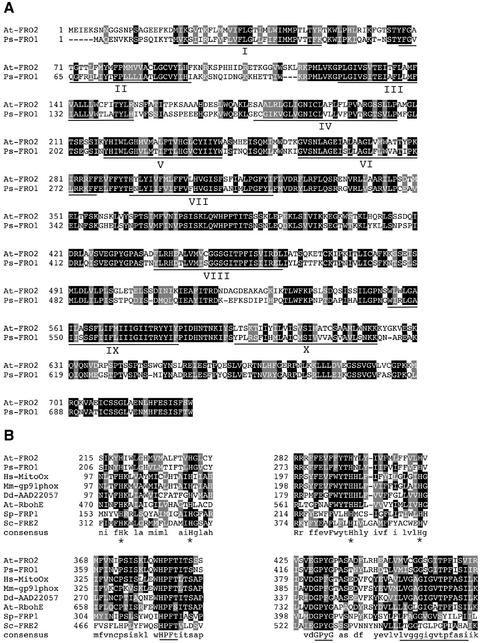
Figure 1
Figure 1
Characterization of the FRO1 amino acid sequence. A, Alignment of Arabidopsis FRO2 (At-FRO2) and pea FRO1 (Ps-FRO1). Positions of amino acid identity are shaded in black, and similar residues are shaded in gray. The locations of the 10 potential transmembrane domains are underlined and numbered I-X. B, Conservation of specific motifs within FRO1 and related oxidoreductases. FRO1 and FRO2 sequences are aligned with human mitogenic oxidase (Hs-MitoOx, accession no. AF127763), mouse gp91phox (Mm-gp91phox, accession no. U43384), Dictyostelium discoideum superoxide-generating NADPH oxidase heavy chain (Dd-AAD22057, accession no. AF123275), Arabidopsis RbohE (At-RbohE, accession no. AF055356), S. pombe FRP1 (Sp-FRP1, accession no. L07749), and S. cerevisiae FRE2 (Sc-FRE2, accession no. Z28220). Conserved histidines involved in heme binding are indicated with asterisks, and the conserved FAD-binding motif (HPFT), the NAD-binding motif (GPyG), and the oxidoreductase signature sequence are underlined.
Figure 2
Figure 2
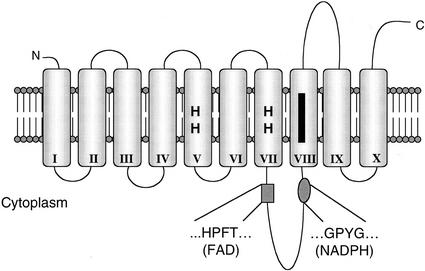
Predicted membrane topology of FRO1. The cylinders represent transmembrane domains I-X and the heme-binding histidines are shown. The black bar denotes the location of the oxidoreductase signature sequence.
Figure 3
Figure 3
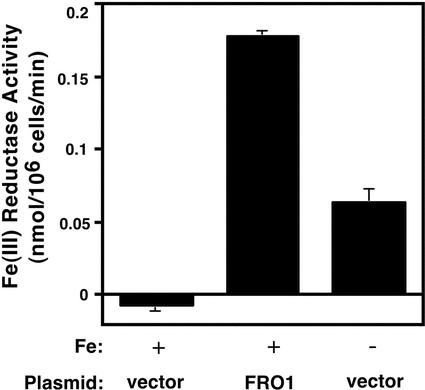
FRO1 is a functional Fe(III)-chelate reductase when expressed in yeast. Wild-type yeast (DY1457) transformed with the vector or the FRO1-expressing plasmid pYES2.0-FRO1 (FRO1) were grown in iron-replete medium (synthetic dextrose [SD] medium supplemented with 10 μm FeCl3) (+) or in iron-limiting medium (SD medium supplemented with 1 mm EDTA) (-) and assayed for Fe(III)-chelate reductase activity. Reductase activity values were obtained by first subtracting out reduction occurring in a no-cell background control, so small negative values are possible for strains with no detectable activity.
Figure 4
Figure 4
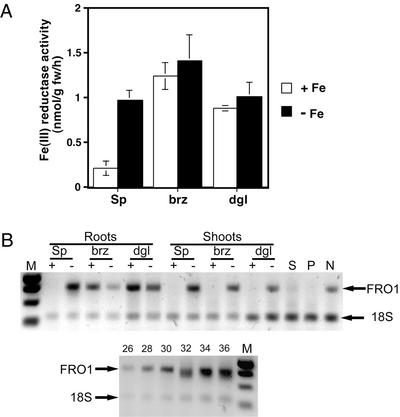
Regulation of Fe(III)-chelate reductase activity and FRO1 mRNA levels. A, Reductase activity of whole roots. Pea plants of the indicated genotype were grown hydroponically for 12 d in nutrient solution with 5 μm Fe(III)-EDDHA (+Fe) or without added Fe (−Fe). Fe(III)-chelate reductase activity was assayed with the bathophenanthrolinedisulfonic acid (BPDS) assay. B, Quantitative reverse transcriptase (RT)-PCR detection of FRO1 mRNA. Total RNA from roots and shoots of plants grown as described in A. RNA was also isolated from whole seeds (S) and pods (P) of soil-grown Sparkle plants during active seed fill, and from established Sparkle nodules (N). RNA (0.1 μg) was used as template for RT-PCR. All samples were subjected to 30 cycles PCR except for seed, pod, and nodule samples, which were subjected to 35 cycles. The lower panel shows a control indicating the quantitative nature of the assay. Numbers above indicate number of PCR cycles. A negative control without RT showed no bands, indicating the absence of genomic DNA contamination. M, Mr markers, from top to bottom, 1,000, 750, 500, and 250 bp.
Figure 5
Figure 5
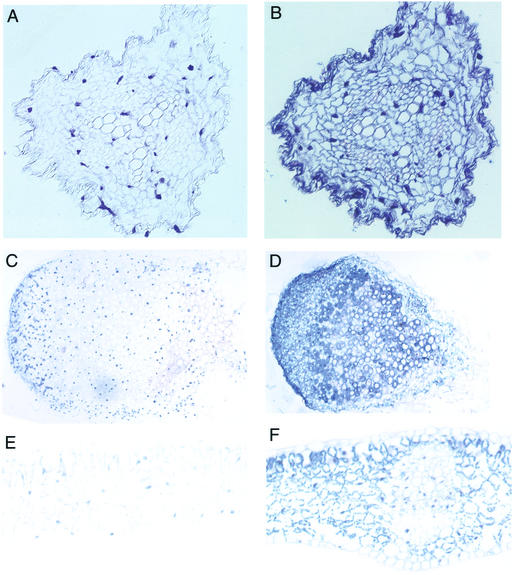
Localization of tissue-specific FRO1 expression by in situ hybridization. Thin sections of plant tissues were probed with sense (A, C, and E) or antisense (B, D, and F) biotinylated FRO1 probes. Probe hybridization was detected with a streptavidin-alkaline phosphatase conjugate and nitroblue tetrazolium/5-bromo-4-chloro-3-indolyl phosphate. Fe-deficient Sparkle root (A and B), soil-grown Sparkle nodule (C and D), and Fe-deficient Sparkle leaf (E and F) cross sections are shown.

References

    1. Altschul SF, Madden TL, Schäffer AA, Zhang J, Zhang Z, Miller W, Lipman DJ. Gapped BLAST and PSI-BLAST: a new generation of protein database search programs. Nucleic Acids Res. 1997;25:3389–3402. - PMC - PubMed
    1. Appel RD, Bairoch A, Hochstrasser DF. A new generation of information retrieval tools for biologists: the example of the ExPASy WWW server. Trends Biochem Sci. 1994;19:258–260. - PubMed
    1. Bateman A, Birney E, Durbin R, Eddy S, Finn RD, Sonnhammer ELL. Pfam 3.1: 1313 multiple alignments match the majority of proteins. Nucleic Acids Res. 1999;27:260–262. - PMC - PubMed
    1. Brown JC, Chaney RL, Amber JE. A new tomato mutant inefficient in the transport of iron. Physiol Plant. 1971;25:45–53.
    1. Bughio N, Takahashi M, Yoshimura E, Nishizawa NK, Mori S. Characteristics of light-regulated iron transport system in barley chloroplasts. Soil Sci Plant Nutr. 1997;43:959–963.

Publication types

MeSH terms

Associated data

LinkOut - more resources