. 2002 May;129(1):211-24.
doi: 10.1104/pp.010690.

Structure-function analysis of nod factor-induced root hair calcium spiking in Rhizobium-legume symbiosis

Affiliations

Structure-function analysis of nod factor-induced root hair calcium spiking in Rhizobium-legume symbiosis

Rebecca J Wais et al. Plant Physiol. 2002 May.

Abstract

In the Rhizobium-legume symbiosis, compatible bacteria and host plants interact through an exchange of signals: Host compounds promote the expression of bacterial biosynthetic nod (nodulation) genes leading to the production of a lipochito-oligosaccharide signal, the Nod factor (NF). The particular array of nod genes carried by a given species of Rhizobium determines the NF structure synthesized and defines the range of legume hosts by which the bacterium is recognized. Purified NF can induce early host responses even in the absence of live Rhizobium One of the earliest known host responses to NF is an oscillatory behavior of cytoplasmic calcium, or calcium spiking, in root hair cells, initially observed in Medicago spp. and subsequently characterized in four other genera (D.W. Ehrhardt, R. Wais, S.R. Long [1996] Cell 85: 673-681; S.A. Walker, V. Viprey, J.A. Downie [2000] Proc Natl Acad Sci USA 97: 13413-13418; D.W. Ehrhardt, J.A. Downie, J. Harris, R.J. Wais, and S.R. Long, unpublished data). We sought to determine whether live Rhizobium trigger a rapid calcium spiking response and whether this response is NF dependent. We show that, in the Sinorhizobium meliloti-Medicago truncatula interaction, bacteria elicit a calcium spiking response that is indistinguishable from the response to purified NF. We determine that calcium spiking is a nod gene-dependent host response. Studies of calcium spiking in M. truncatula and alfalfa (Medicago sativa) also uncovered the possibility of differences in early NF signal transduction. We further demonstrate the sufficiency of the nod genes for inducing calcium spiking by using Escherichia coli BL21 (DE3) engineered to express 11 S. meliloti nod genes.


Figures
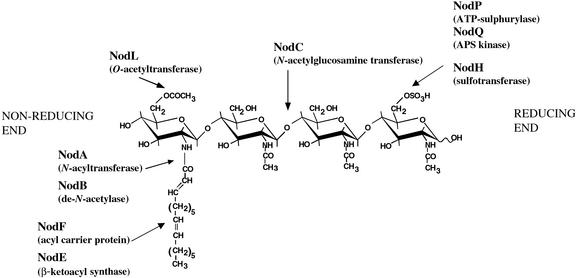
Figure 1
Figure 1
S. meliloti NF structure and Nod protein function. Each Nod protein is encoded by an equivalently named nod gene. NodA, NodB, and NodC are common to all rhizobia. The remaining Nod proteins are responsible for the modifications of NF that confer activity on selected legume species.
Figure 2
Figure 2
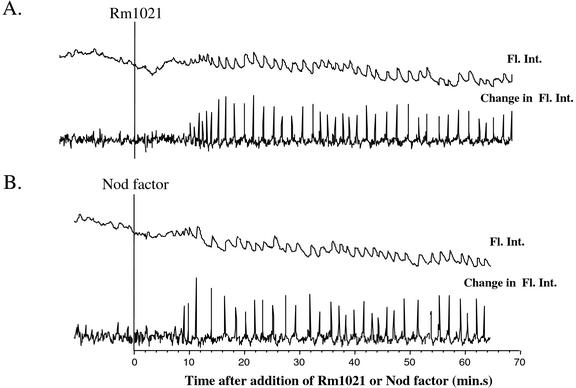
Rm1021 causes calcium spiking in M. truncatula. A, Rm1021-induced calcium spiking in M. truncatula. B, NF-induced calcium spiking in M. truncatula. A and B show representative traces of calcium spiking. Top trace is the fluorescence intensity corrected for background fluctuations. Bottom trace in each case shows the change in fluorescence intensity from one time point to the next [X(n + 1) − Xn]. Bacteria were prepared as described in “Materials and Methods.” One nanomolar NF or 108 Rm1021 bacteria were added at vertical line. Fl. Int, Fluorescence intensity.
Figure 3
Figure 3
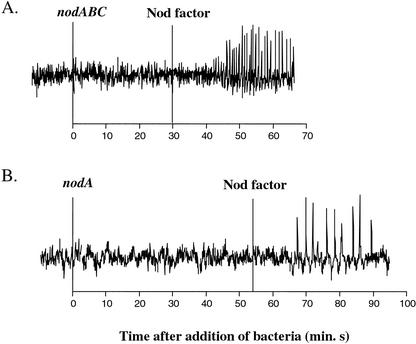
Calcium spiking response to common nod mutants. A, nodABC strain SL44. B, nodA strain GMI3253. Representative traces of the change in fluorescence in root hairs responding to bacterial mutants lacking common nod genes. Bacteria were added at the vertical line (time = 0 min). Purified NF was added back to verify that the root hair was capable of initiating calcium spiking.
Figure 4
Figure 4
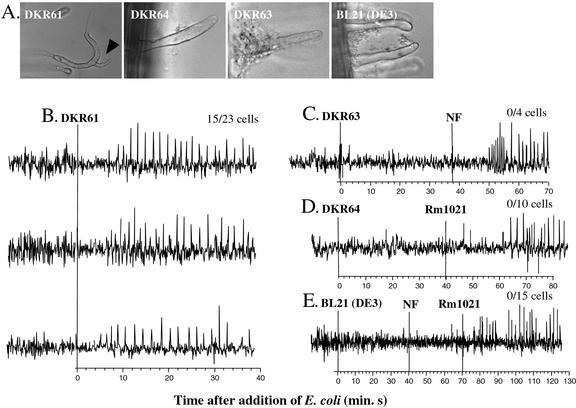
E. coli carrying 11 nod genes can trigger calcium spiking in M. truncatula. A, Root hair deformation response to DKR61 (carrying common and host-specific nod genes), DKR64 (carrying host-specific nod genes), DKR63 (carrying common nod genes), and BL21 (DE3). Black arrowhead marks a branched root hair. B, Calcium spiking response of three representative root hairs to DKR61 [BL21 (DE3) pRmE2 pRmJT5]. C, Calcium spiking response to DKR63 [BL21 (DE3) pRmE2]. D, Calcium spiking response to DKR64 [BL21 (DE3) pRmJT5]. E, Calcium spiking response to E. coli BL21 (DE3). Root hair deformation (A) and calcium spiking phenotypes (B–E) elicited by E. coli BL21 (DE3) strains carrying common and/or host-specific nod genes. Root hair deformation assays were scored 48 h after inoculation with bacteria, as described in “Materials and Methods.” In B through E, E. coli cells were added at time = 0 min, marked by the solid vertical line, and NF and/or Rm1021 cells were added subsequently as a positive control.
Figure 5
Figure 5
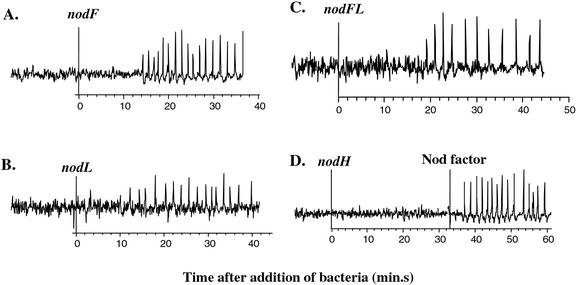
Calcium spiking response to host-specific nod mutants. A, nodF strain JAS108. B, nodL strain RJW13. C, nodFL strain RJW14. D, nodH strain JT210. Representative traces of the change in fluorescence in root hairs responding to bacterial mutants lacking common nod genes. Bacteria were added at time = 0 min. Purified NF was added back to verify that the root hair was capable of initiating calcium spiking.
Figure 6
Figure 6
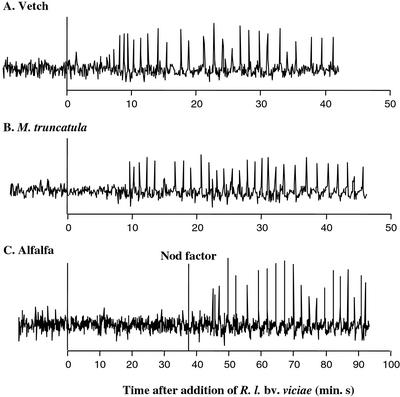
R. leguminosarum bv viciae triggers calcium spiking in vetch and M. truncatula but not alfalfa. Representative traces of calcium response elicited by R. leguminosarum bv viciae strain A34 in vetch (A), M. truncatula (B), and alfalfa (C). Bacteria were added at time = 0 min in all cases. For alfalfa, where A34 cells failed to induce a response, purified NF was added back to verify the root hair's ability to initiate calcium spiking.
Figure 7
Figure 7
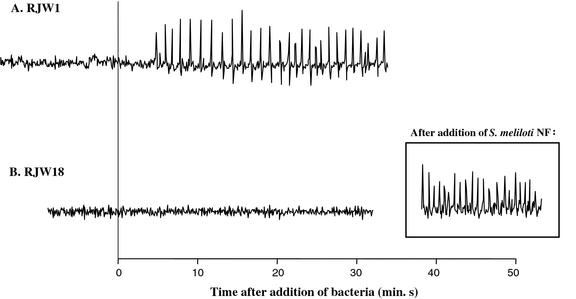
S. meliloti host-specific nod genes confer upon R. leguminosarum bv viciae the ability to trigger calcium spiking in alfalfa. Representative traces of change in fluorescence in alfalfa root hairs exposed to: A, RJW1 (A34 pRmJT5); or B, RJW18 (A34 pRmS210). In B, the ability of the root hair to initiate calcium spiking is demonstrated after exposure to wild-type S. meliloti NF.
Figure 8
Figure 8
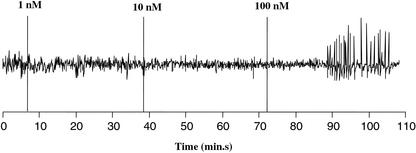
Calcium spiking response of alfalfa to nodH-derived NF. Representative trace of alfalfa root hair response to increasing doses of unsulfated S. meliloti NF.

References

    1. Ardourel M, Demont N, Debelle F, Maillet Debelle, de Billy F, Prome JC, Denarie J, Truchet G. Rhizobium meliloti lipooligosaccharide nodulation factors: different structural requirements for bacterial entry into target root hair cells and induction of plant symbiotic developmental responses. Plant Cell. 1994;6:1357–1374. - PMC - PubMed
    1. Ardourel M, Lortet G, Maillet F, Roche P, Truchet G, Prome JC, Rosenberg C. In Rhizobium meliloti, the operon associated with the nod box n5 comprises nodL, noeA and noeB, three host-range genes specifically required for the nodulation of particular Medicago species. Mol Microbiol. 1995;17:687–699. - PubMed
    1. Beringer JE. R factor transfer in Rhizobium leguminosarum. J Gen Microbiol. 1974;84:188–198. - PubMed
    1. Cardenas L, Holdaway-Clarke TL, Sanchez F, Quinto C, Feijo JA, Kunkel JG, Hepler PK. Ion changes in legume root hairs responding to Nod factors. Plant Physiol. 2000;123:443–452. - PMC - PubMed
    1. Catoira R, Galera C, de Billy F, Penmetsa RV, Journet EP, Maillet F, Rosenberg C, Cook D, Gough C, Dénarié J. Four genes of Medicago truncatula controlling components of a Nod factor transduction pathway. Plant Cell. 2000;12:1647–1666. - PMC - PubMed

Publication types

MeSH terms

LinkOut - more resources