


Protection by isoprene against singlet oxygen in leaves
- PMID: 12011357
- PMCID: PMC155890
- DOI: 10.1104/pp.010909
Protection by isoprene against singlet oxygen in leaves
Abstract
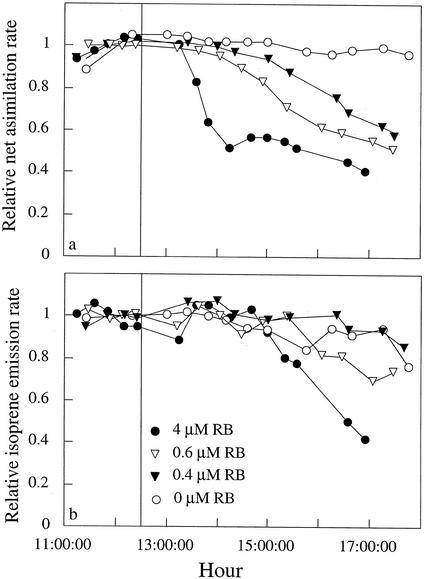
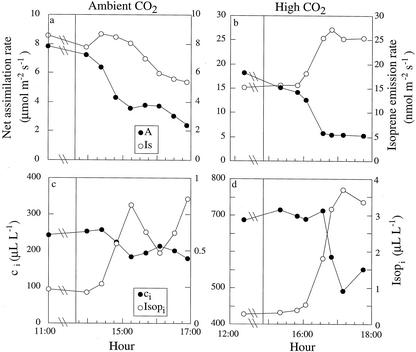
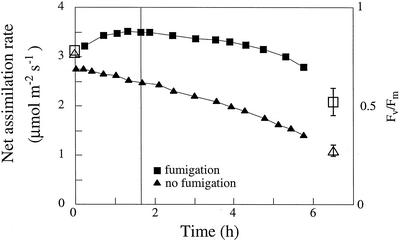
Isoprene (2-methyl-1,3-butadiene) protection against effects of singlet oxygen was investigated in Myrtus communis and Rhamnus alaternus. In M. communis, singlet oxygen produced in the leaves by Rose Bengal (RB) led to a 65% decrease in net assimilation rates within 3 h, whereas isoprene emission rates showed either a 30% decrease at ambient CO2 concentrations or a 70% increase under high CO2. In both cases, these changes led to an increase in calculated internal isoprene concentrations. The isoprene protection effect was directly demonstrated by fumigation of young (non-emitting) leaves, treated with RB or bromoxynil (simulating photoinhibition). There was 42% and 29% reduction in the damage to net assimilation compared with non-fumigated leaves for RB or bromoxynil, respectively. In R. alaternus, similar effects of RB on net assimilation were observed, and additional fluorescence measurements showed a significantly smaller decrease in Fv/Fm in isoprene-fumigated young leaves treated with RB (from 0.78 to 0.52), compared with non-fumigated leaves (from 0.77 to 0.27). The internal isoprene concentrations used in this study and possible rate of 1O2 production in leaves indicate that the protective effects observed should be beneficial also under natural conditions.
Figures
References
-
- Adams WWI, Demmig-Adams B. Carotenoid composition and down regulation of photosystem II in three conifer species during the winter. Physiol Plant. 1994;92:451–458.
-
- Chameides WL, Lindsay RW, Richardson J, Kiang CS. The role of biogenic hydrocarbons in urban photochemical smog: Atlanta as a case study. Science. 1988;241:1473–1475. - PubMed
-
- Demmig-Adams B. Carotenoids and photoprotection in plants: a role for the xanthophyll zeaxanthin. Biochim Biophys Acta. 1990;1020:1–24.
-
- Durrant JR, Giorgi LB, Barber J, Klug DR, Porter G. Characterization of triplet states in isolated photosystem II reaction centers: oxygen quenching as a mechanism for photodamage. Biochim Biophys Acta. 1990;1017:167–175.
-
- Fang C, Monson RK, Cowling EB. Isoprene emission, photosynthesis, and growth in sweetgum (liquidambar styraciflua) seedlings exposed to short- and long-term drying cycles. Tree Physiol. 1996;16:441–446. - PubMed
MeSH terms
Substances
LinkOut - more resources
Full Text Sources
