


. 2002 May 14;99 Suppl 3(Suppl 3):7280-7.
doi: 10.1073/pnas.082080899.
Agent-based modeling: methods and techniques for simulating human systems
Affiliations
- PMID: 12011407
- PMCID: PMC128598
- DOI: 10.1073/pnas.082080899
Item in Clipboard
Agent-based modeling: methods and techniques for simulating human systems
Proc Natl Acad Sci U S A.
.
Abstract
Agent-based modeling is a powerful simulation modeling technique that has seen a number of applications in the last few years, including applications to real-world business problems. After the basic principles of agent-based simulation are briefly introduced, its four areas of application are discussed by using real-world applications: flow simulation, organizational simulation, market simulation, and diffusion simulation. For each category, one or several business applications are described and analyzed.
Figures
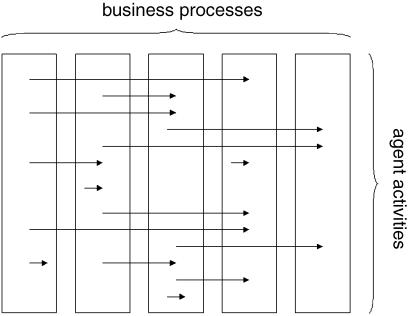
Illustration of the business process and agent views of a business.
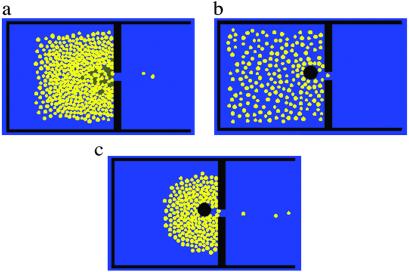
Fire escape agent-based simulation (live simulation available at www.helbing.org ). People are represented by circles, green circles being injured people. Simulations assume 200 people in a room. (a) No column. (b) With column, after 10 s. (c) With column, after 20 s. In the absence of the column, 44 people escape and 5 are injured after 45 s; with the column, 72 people escape and no one is injured after 45 s. After Helbing et al. (4).
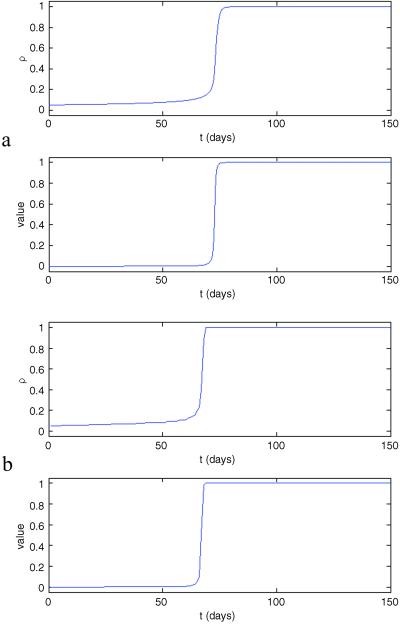
(a) Differential equation results. (b) Mean-field agent-based model.
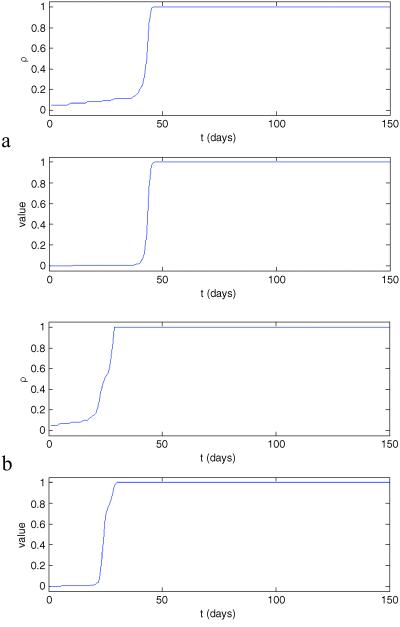
(a) One hundred agents, 30 random neighbors. (b) One hundred agents, clustered neighbors (two clusters, spread starting in one cluster).
References
-
- Epstein J. M. & Axtell, R. L., (1996) Growing Artificial Societies: Social Science from the Bottom Up (MIT Press, Cambridge, MA).
-
- Axelrod R., (1997) The Complexity of Cooperation: Agent-Based Models of Competition and Collaboration (Princeton Univ. Press, Princeton, NJ).
-
- Reynolds C. (1987) Comput. Graphics 21, 25-34.
-
- Helbing D., Farkas, I. & Vicsek, T. (2000) Nature (London) 407, 487-490. - PubMed
-
- Still K. G. (1993) Fire 84, 40-41.
LinkOut - more resources
Full Text Sources
Other Literature Sources
